
Tree Risk Assessment Qualification Application Practice Test
$69.00
- Buy to unlock unlimited access to all Quiz questions and Answers in this Quiz.
- After purchase you can print a PDF of the whole quiz at any point. The PDF will contain the questions and the correct answers.
About this Exam
The International Society of Arboriculture (ISA) Tree Risk Assessment Qualification (TRAQ) is a critical credential for arborists and urban forestry professionals tasked with evaluating the likelihood of tree failure and its potential consequences. This comprehensive program establishes a standardized framework for assessing tree risk, providing participants with the knowledge and practical skills necessary to make informed recommendations that balance public safety with the inherent benefits of trees. It is specifically designed for experienced arborists, urban foresters, municipal employees, consultants, and anyone responsible for managing tree populations near people or property.
Ready to test your knowledge?
Buy Now to Access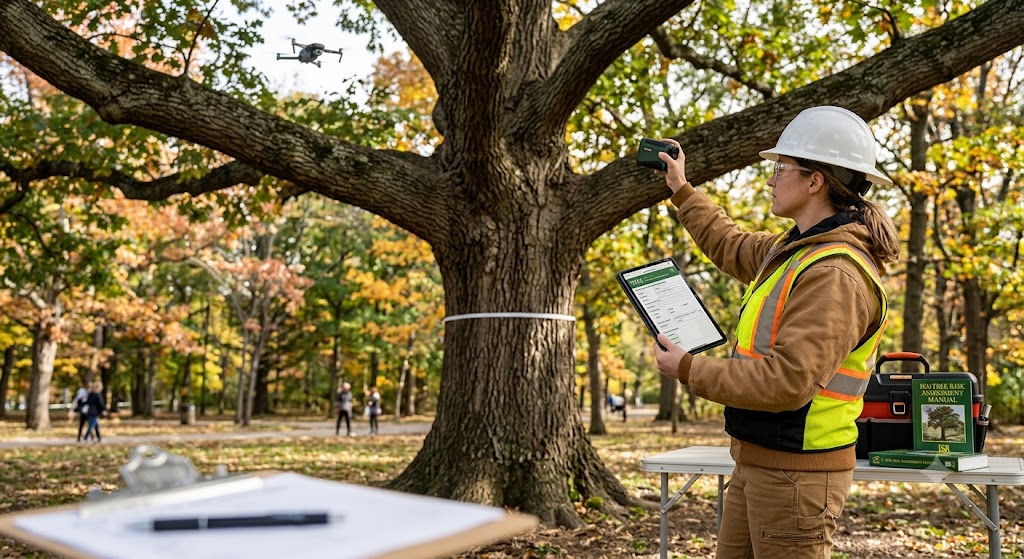
Additional Information
What the Course Entails and Exam Details
This is a comprehensive, multi-day qualification course
combining classroom instruction, field demonstrations, and practical
application, rather than a stand-alone exam. The curriculum is meticulously
structured, focusing on several core pillars. You will deeply explore Tree
Biology and Mechanics, learning how trees fail, the indicators of structural
defects, and the forces that influence stability. The course details the
standardized Risk Assessment Process, guiding you through the identification of
targets, analyzing the likelihood of failure, and determining the overall risk
rating. Mitigation and Management strategies form a vital component, teaching
you how to recommend and prioritize appropriate risk reduction actions.
What to Expect in the Final Exam
The final assessment is a multifaceted evaluation designed
to confirm your understanding of the TRAQ protocol and your ability to apply it
in the field. It consists of two primary components.
First, you will complete a Comprehensive Written
Examination. This section features 100 multiple-choice questions covering all
aspects of the TRAQ curriculum, from biomechanics and decay fungi to risk
matrix interpretation and mitigation options. You will have a specific time
limit, typically 2.5 hours, to complete this component.
Second, you must pass a Field Performance Assessment. During
this practical phase, you will independently assess a designated, real-world
tree on-site. You will correctly complete the TRAQ basic tree risk assessment
form, accurately identifying defects, evaluating potential targets, analyzing
risks, and formulating appropriate, actionable mitigation recommendations. The
evaluation is rigorous and adheres strictly to the qualified standard. To earn
the qualification, you must pass both the written and field assessments with
scores of 75% or higher.
How to Study and Exam Centers
The key to success on the TRAQ assessment is thorough
preparation and a deep understanding of the course materials. Focus your study
efforts on the ISA Tree Risk Assessment Manual, which serves as the
primary resource and comprehensive guide for the course. Pay close attention to
definitions, risk matrices, and defect categorization.
Practice is essential: use your local environment to
identify defects and apply the TRAQ methodology on trees around you. Consider
forming study groups to review mechanics and debate risk scenarios. Many
candidates find value in taking the practice test mentioned in the title to
familiarize themselves with the style of written questions and build
confidence.
The TRAQ course and assessments are delivered exclusively
through ISA, often in collaboration with regional ISA chapters. They are
typically held at specific physical testing centers or authorized venues
suitable for both classroom instruction and field work. To find upcoming
courses, you should check the official ISA events calendar or contact your
local chapter for schedules and registration details. The written component
may, in some regions, be offered through proctored online portals, but the
practical field component always requires an in-person, field-based evaluation.
Job Opportunities from the Course
Successfully obtaining the Tree Risk Assessment
Qualification significantly enhances your professional credibility and
marketability within the arboriculture and green industry. This credential
provides a clear signal to employers, clients, and municipal bodies that you
possess validated expertise in managing tree-related liabilities and promoting
urban forest resilience. The qualification can help advance career paths and
unlock numerous specialized roles, including:
- Consulting
Arborist
- Municipal
Arborist / Urban Forester
- Tree
Care Company Risk Assessor
- Utility
Vegetation Manager
- Green
Infrastructure Consultant
- Tree
Officer for Local Government
- Forensic
Arborist
Frequently Asked Questions
Reviews
5.0
Based on 0 reviews
Leave a Review
No reviews yet. Be the first to review!