
Tree Support and Lightning Protection Practice Test
$69.00
- Buy to unlock unlimited access to all Quiz questions and Answers in this Quiz.
- After purchase you can print a PDF of the whole quiz at any point. The PDF will contain the questions and the correct answers.
About this Exam
The Tree Support and Lightning Protection certification is a specialized credential designed for arborists, urban foresters, and landscape professionals who focus on structural tree care and risk management. This exam validates the comprehensive knowledge required to preserve the structural integrity of mature or compromised trees and to mitigate the catastrophic damage caused by lightning strikes. For individuals dedicated to preserving valuable arboricultural assets, this exam represents the official benchmark of professional expertise. It is specifically designed for practicing arborists seeking a competitive edge or a recognized specialty in their field.
Ready to test your knowledge?
Buy Now to Access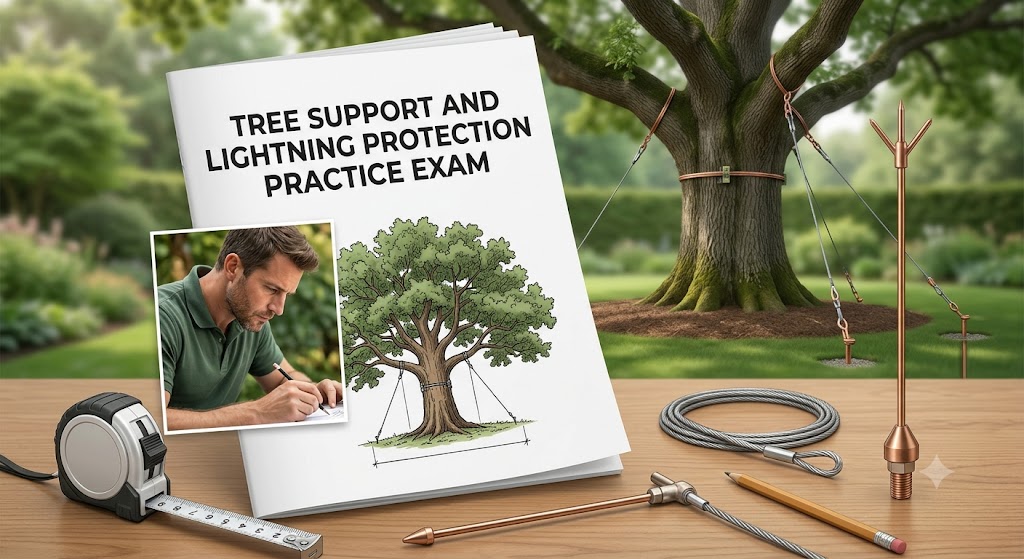
Additional Information
What the Course Entails and Exam Details
To master this material, candidates must demonstrate
thorough proficiency in two distinct but related categories. The support
portion of the curriculum focuses on understanding the mechanical physics of
tree growth and stress. This includes advanced structural analysis, determining
optimal cable placement, and evaluating dynamic and static bracing systems.
Candidates must also demonstrate expertise in materials science, identifying
the correct hardware—such as standard aircraft cable versus high-strength
polypropylene—for specific load requirements.
The lightning protection segment covers the scientific
principles of electrical grounding and risk assessment. Professionals will
learn to conduct thorough assessments of a tree’s species, unique structural
defects, and historical background to design effective systems. Topics include
installing specialized components like air terminals (lightning rods),
conducting copper or braided wire down conductors, and ensuring complex
grounding systems are compliant with industry-recognized safety standards (such
as ANSI A300).
What to Expect in
the Final Exam
The final certification exam for Tree Support and Lightning
Protection is typically a comprehensive proctored test administered by an
industry-recognized organization like the International Society of
Arboriculture (ISA). The exam format is often composed primarily of
multiple-choice and complex scenario-based questions that evaluate your
practical application of arboricultural standards.
In most proctored environments, you are provided with a
dedicated time limit, such as 90 to 120 minutes, for the completion of the
exam. A passing score, often established at a threshold of approximately 75% or
higher, is required to demonstrate professional competence and achieve the
official certification. Strict ethical rules are always in place; this is a
comprehensive, closed-book exam.
How to Study and
Exam Centers
Effective preparation requires a serious, disciplined study
plan. First, acquire and deeply internalize the foundational industry
standards. Key texts must include the relevant ANSI A300 Best Management
Practices manuals: one dedicated to structural cabling and bracing, and another
focusing specifically on lightning protection systems in trees. Practice by
regularly applying these principles on complex real-world field assessments:
evaluate a mature tree's architecture and design an entire hypothetical bracing
or lightning system based strictly on those strict standards.
While self-guided study is the baseline, you should take
advantage of organized review courses or intensive study workshops often
provided by local industry chapters or established educational academies. When
you are ready to take the final exam, it is typically scheduled through
professional testing services or dedicated industry portals. Candidates are
directed to a certified network of secure testing centers, such as those
provided by international computer-based testing networks or physical
facilities hosted by accredited schools and authorized training institutions.
Job Opportunities
from the Course
Successfully achieving the Tree Support and Lightning
Protection certification unlocks specialized, higher-paying job opportunities
across the private, public, and conservation sectors. Specialized practitioners
have direct career paths into key roles, including:
<!--[if mso & !supportInlineShapes & supportFields]> SHAPE \* MERGEFORMAT <![endif]--><!--[if gte vml 1]>
- Lead
Consulting Arborist (specializing in high-value asset preservation)
- Municipal
Forestry Supervisor or Urban Forest Manager
- Contracting
Arbo-Technician (focused on high-risk structural care)
- Landscape
Architect with an Ecology Specialty
- Tree
Care Safety Manager and Quality Assurance Inspector
- Botanic
Garden or Arboretum Curator of Valuable Specimens
Frequently Asked Questions
Reviews
5.0
Based on 0 reviews
Leave a Review
No reviews yet. Be the first to review!