
Type III EPA 608 Certification Practice Exam
$69.00
- Buy to unlock unlimited access to all Quiz questions and Answers in this Quiz.
- After purchase you can print a PDF of the whole quiz at any point. The PDF will contain the questions and the correct answers.
About this Exam
The Type III EPA 608 Certification is a mandatory requirement established by the U.S. Environmental Protection Agency (EPA) under Section 608 of the Clean Air Act. This specific certification is designed for technicians who maintain, service, repair, or dispose of low-pressure appliances. These appliances are typically large centrifugal chillers used in commercial and industrial air conditioning applications.
Earning this certification demonstrates that a technician possesses the essential knowledge regarding the environmental impact of refrigerants, EPA regulations, and the technical skills required for the safe and compliant handling of low-pressure systems. It is an indispensable credential for anyone pursuing a career specialized in commercial HVAC/R (Heating, Ventilation, Air Conditioning, and Refrigeration).
Ready to test your knowledge?
Buy Now to Access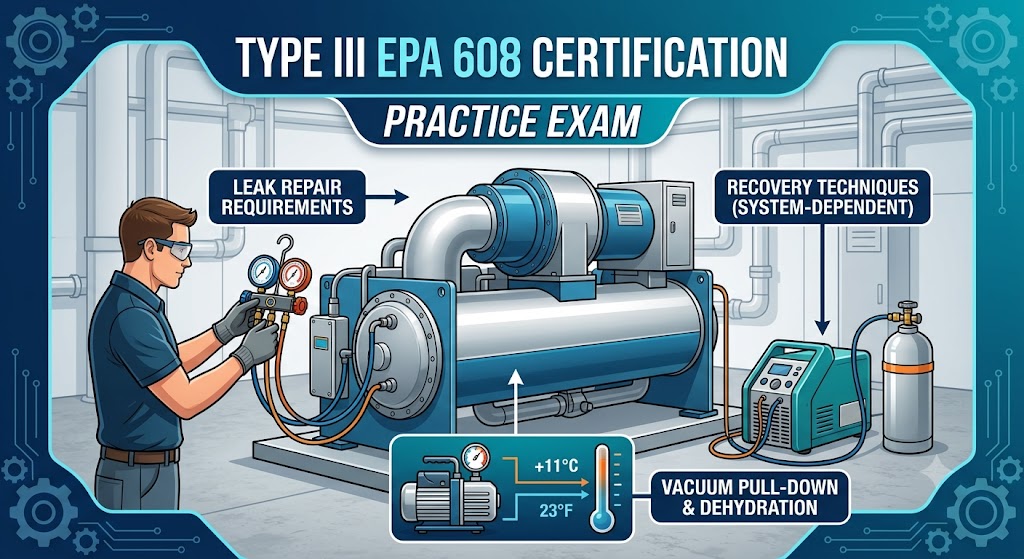
Additional Information
What the Course Entails and Exam Details
To prepare for the Type III exam, candidates usually engage
in specialized training courses offered by HVAC/R schools, unions, or approved
testing organizations. While "the course" refers to the comprehensive
training program, the certification is achieved by passing the standardized
exam itself.
The core topics and skills covered in the training and
subsequently tested include:
- Environmental
Impact: Understanding ozone depletion, global warming potentials, and
the properties of refrigerants used in low-pressure systems (like R-123
and R-11).
- EPA
Regulations: Deep knowledge of Section 608 regulations, including leak
repair requirements, technician certification mandates, and proper
record-keeping for low-pressure systems.
- Recovery
Techniques: Masterÿ of the required recovery levels, vacuum pull-down
requirements, and correct operation of recovery equipment. This includes
understanding system-dependent versus self-contained recovery methods.
- Leak
Detection and Repair: Proficiency in leak detection methods,
identifying common leak sites, and understanding the required leak rate
calculations for different appliance categories.
- Safety
Practices: Essential safety protocols when handling high-pressure and
low-pressure refrigerants, using proper personal protective equipment
(PPE), and operating recovery units safely.
- Refrigeration
System Fundamentals: A strong understanding of the low-pressure
refrigeration cycle and the specific components and operation of
centrifugal chillers.
The Type III exam focuses uniquely on the challenges of
low-pressure systems, which operate in a vacuum, requiring specialized
knowledge and distinct procedures compared to high-pressure (Type II) or small
appliance (Type I) systems.
What to Expect in the Final Exam
The Type III EPA 608 Certification exam is a closed-book,
proctored test. It does not have a practical component, meaning you are tested
on your knowledge rather than your ability to perform hands-on tasks in a
testing environment.
The final exam structure is as follows:
- Format:
The test consists of 25 multiple-choice questions.
- Content
Focus: The questions specifically cover the material related to
low-pressure appliances and regulations.
- Passing
Score: A passing score of 70% is required, which means you must
correctly answer at least 18 out of the 25 questions.
- Time
Limit: While the EPA does not set a rigid time limit for the
25-question section, the total proctored session (which may include the
mandatory Core exam section) typically allows for sufficient time, often
between 30 minutes to an hour for this standalone section.
- Core
Prerequisite: Crucially, to hold the Type III certification, you must
also pass the 25-question Core exam section, which covers general
environmental and regulatory information. If you take the Type III exam
section without having passed the Core, your passing score on the Type III
will not result in a valid certification until the Core requirement is
met. Both sections can be taken in the same session.
The exam requires focused reading and a good command of the
specific data and terminology related to low-pressure refrigerants.
How to Study and Exam Centers
Preparation is key to succeeding on the Type III exam. Here
are actionable study strategies:
- Utilize
Practice Exams: Practice tests are invaluable tools. They familiarize
you with the question format, highlight areas where you need more study,
and build your confidence. Take them frequently under timed conditions.
- Review
Official Study Guides: The organization through which you register
(e.g., HVAC Excellence, ESCO Group, ESCO Institute) will provide a
detailed study guide. This should be your primary resource.
- Understand
Leak Rate Calculations: Memorize the different allowable leak rates
and the required timelines for industrial process refrigeration versus
comfort cooling appliances, as this is a heavily tested topic.
- Create
Flashcards: Make flashcards for technical terms, specific vacuum
levels required for different recovery situations, and key safety
regulations.
- Attend
a Prep Course: Many HVAC schools and unions offer intensive one- or
two-day review courses that culminate in the exam. This is highly
effective for reinforcement.
You have several options for where and how to take the
proctored exam:
- Online
Portals (Remote Proctoring): Many EPA-approved testing organizations
now offer online proctoring, allowing you to take the exam securely from
your own computer, provided you meet certain system requirements.
- Specific
Physical Testing Centers: Approved testing centers across the country
administer the exam in person.
- Authorized
Schools: Accredited HVAC/R schools and technical colleges often host
test sessions for their students and sometimes for outside candidates.
- Local
Unions or Trade Associations: These organizations frequently offer
prep classes and proctor the exam.
Always ensure that the organization administering the exam
is explicitly EPA-approved to offer the 608 Section certification.
Job Opportunities
from the Course
Earning your Type III EPA 608 Certification signals to
employers that you have specialized expertise in a critical sector of the
HVAC/R industry. Commercial and industrial systems are complex and require
highly trained professionals.
Passing this exam and obtaining the credential unlocks
various career paths and job titles, including:
- Commercial
HVAC Technician: Specialized in servicing and installing large
centrifugal chillers and commercial AC systems.
- Industrial
Refrigeration Technician: Maintaining complex cooling systems used in
manufacturing or process industries.
- Chiller
Specialist Technician: Focused exclusively on the maintenance and
repair of major chiller units.
- Facilities
Maintenance Engineer: Often responsible for overseeing large-scale
climate control systems in office buildings, hospitals, and universities.
- Service
Manager: Advanced positions overseeing teams of technicians often
require full universal certification (Core + Types I, II, III).
- HVAC/R
Sales Engineer: Technical understanding is essential for selling
large-scale commercial HVAC/R systems.
Earning this certification can lead to higher earning
potential and greater job security, as specialized commercial technicians are
often in high demand.
Congratulations on taking the first step toward this
valuable certification! With dedicated study, particularly using practice exams
to refine your knowledge, you are well on your way to success in low-pressure
system service. Good luck!
Frequently Asked Questions
Reviews
5.0
Based on 0 reviews
Leave a Review
No reviews yet. Be the first to review!