
Ultrasound Vascular Registry Practice Test
$69.00
- Buy to unlock unlimited access to all Quiz questions and Answers in this Quiz.
- After purchase you can print a PDF of the whole quiz at any point. The PDF will contain the questions and the correct answers.
About this Exam
The term "Ultrasound Vascular Registry" refers to the comprehensive certification examinations that validate a sonographer's specialized knowledge in vascular technology. Earning this credential is a critical milestone for a Registered Diagnostic Medical Sonographer (RDMS) or Cardiovascular Credentialing International (CCI) professional, signifying they possess the advanced skills necessary to perform complex vascular exams. This certification is designed for dedicated healthcare professionals who specialize in visualizing the body’s intricate network of arteries and veins. By passing the vascular registry, you formally demonstrate your expertise in identifying and evaluating pathologies such as blood clots, arterial blockages, and venous insufficiency, thereby ensuring high-quality patient care and safety.
Ready to test your knowledge?
Buy Now to Access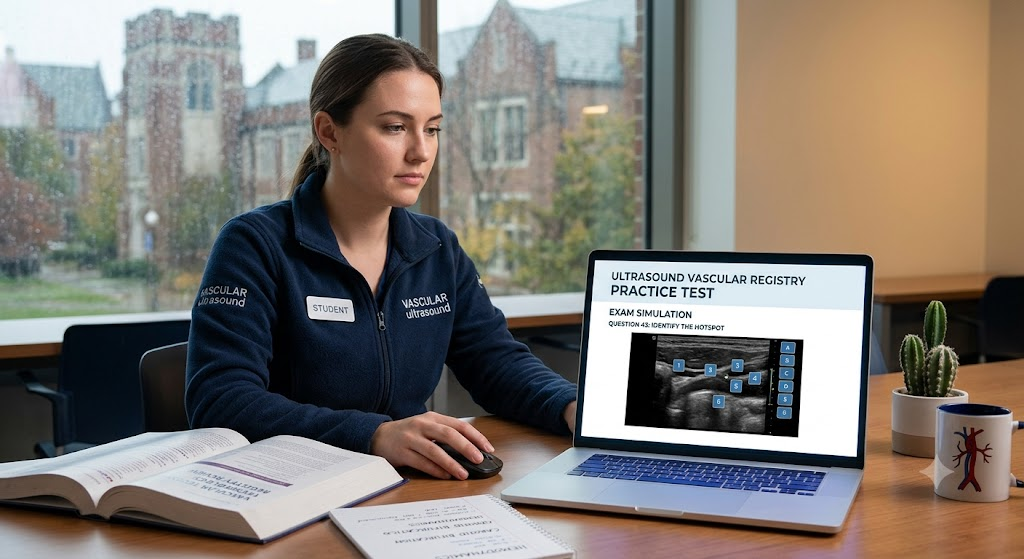
Additional Information
What the Course Entails and Exam Details
The specific course material will depend on whether you pursue certification through the American Registry for Diagnostic Medical Sonography (ARDMS) to become a Registered Vascular Technologist (RVT) or through Cardiovascular Credentialing International (CCI) to become a Registered Vascular Specialist (RVS). However, both pathways require profound mastery of standard vascular territories.
The core syllabus covers seven major domains. These include Cerebrovascular Examination, which focuses on the carotid and vertebral arteries. The study guide deeply covers Peripheral Arterial Examinations, including the analysis of the upper and lower extremities and physiologic testing like Ankle-Brachial Indices (ABI). Peripheral Venous Examinations focus on evaluating Deep Vein Thrombosis (DVT) and venous insufficiency. Beyond the extremities, the exam entails Abdominal and Visceral Vascular Evaluations of the aorta, renal, and mesenteric arteries. Candidates must also demonstrate an understanding of dynamic concepts including Ultrasound Physics and Hemodynamics, along with critical protocols for Surgically Altered Anatomy and Post-Intervention Assessment (e.g., bypass grafts and stents). Patient Care and Safety, along with unique scenarios like Hemodialysis Access examinations, are integrated throughout the assessment.
What to Expect in the Final Exam
You must prepare for a rigorous, computer-based examination administered at a secure testing center. While both the ARDMS VT and CCI RVS exams differ slightly, they share a similar structure. Generally, you can expect approximately 165 to 170 multiple-choice questions.
The exams have a strict time limit, typically three hours (180 minutes), leaving you with just over one minute per question. This pacing requires quick thinking and decisive action. A passing score is dynamic. For the ARDMS, a passing scaled score is 555 (on a scale of 300-700), while CCI uses a scaled score of 650 (on a scale of 200-900). Crucially, the exams are not just text-based. They include many visual questions, where you must interpret ultrasound images, identify vascular structures, and diagnose pathologies from provided static and sometimes video waveforms. There are no practical, hands-on components during the registry exam itself; you must have met those eligibility requirements beforehand.
How to Study and Exam Centers
Effective preparation requires a multi-pronged approach that blends active recall and spaced repetition. First, you must master standard diagnostic criteria cold. This involves creating detailed flashcards or summary tables for key velocity thresholds in every vascular bed, including carotid stenosis grading (e.g., internal carotid artery Peak Systolic Velocity (PSV) of >125 cm/s indicating 50-69% stenosis), renal artery stenosis ratios, and DVT compression criteria.
Utilizing a comprehensive study guide, like the one symbolized in the accompanying image, is essential. You must take at least three to five full-length, timed [Ultrasound Vascular Registry Practice Exams] to build stamina, manage your pacing, and become comfortable with the computerized format. Analyze your performance in these practice tests to pinpoint weakness. If you find you struggle with abdominal Doppler or the physical principles of spectral broadening, shift your focus. For visual practice, review image banks to ensure you can confidently identify anatomy and pathologic findings. For scheduling, you will need to apply for the exam through your specific credentialing body (ARDMS or CCI). Once deemed eligible, you can register and select a time slot at an authorized, secure testing center. For ARDMS, the testing vendor is Pearson VUE; for CCI, it is PSI. Both provide extensive networks of physical testing centers or, in some cases, online proctoring, though in-person remains standard for security and technological stability.
Job Opportunities from the Course
Earning your Vascular Registry credential dramatically increases your marketability and opens up diverse career opportunities within medical imaging. Once certified, you are a specialized expert rather than a generalist. Specific job titles you will unlock include Registered Vascular Technologist (RVT), Registered Vascular Specialist (RVS), Senior Vascular Sonographer, Lead Vascular Sonographer, Vascular Ultrasound Clinical Instructor, and Vascular Ultrasound Application Specialist. These roles are essential in diverse settings, including vascular surgery centers, dedicated vein clinics, university hospitals, non-invasive vascular laboratories, clinical research organizations, and advanced multi-specialty outpatient centers. Certified vascular specialists are always in high demand.
Frequently Asked Questions
Reviews
5.0
Based on 0 reviews
Leave a Review
No reviews yet. Be the first to review!