
Undercar Practice Test
$69.00
- Buy to unlock unlimited access to all Quiz questions and Answers in this Quiz.
- After purchase you can print a PDF of the whole quiz at any point. The PDF will contain the questions and the correct answers.
About this Exam
The Undercar Practice Test is an essential diagnostic tool for automotive technicians preparing for professional certification, such as ASE (Automotive Service Excellence) exams focused on suspension, steering, and brakes. This specialized practice test is specifically designed for technicians who wish to demonstrate advanced knowledge in diagnosing, repairing, and maintaining critical underear vehicle systems. By passing this exam, professionals validate their expertise in maximizing vehicle safety, stability, and handling, making them highly valuable to repair facilities. This study guide and accompanying practice exam serve as a critical stepping stone toward achieving full industry certification and career advancement.
Ready to test your knowledge?
Buy Now to Access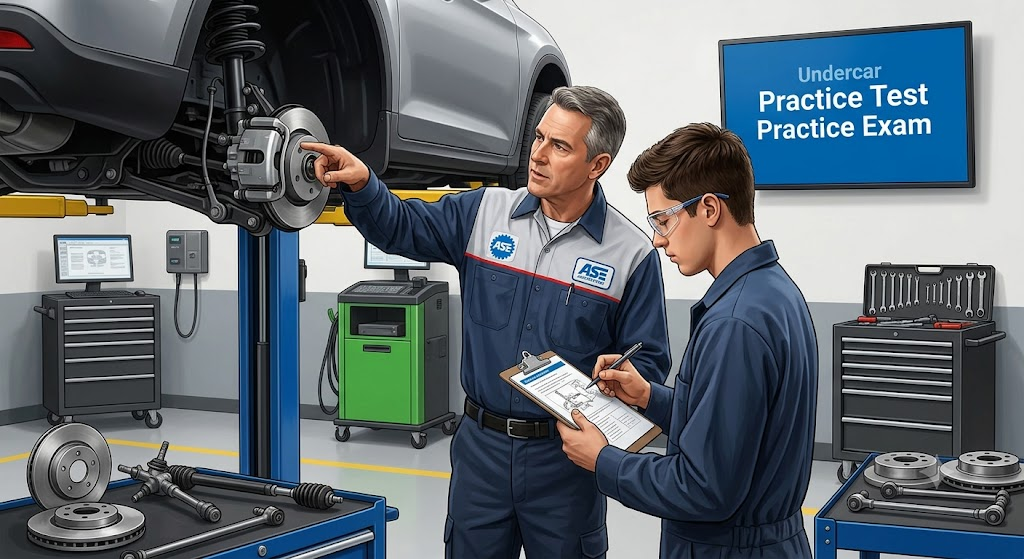
Additional Information
What the Course Entails and Exam Details
The Undercar Practice Test evaluates a technician’s knowledge and diagnostic skills across several key automotive areas. The full certification course typically entails comprehensive modules covering the following domains:
Suspension Systems: Comprehensive analysis of front and rear suspension types (macpherson struts, SLA, multi-link), including diagnosing and replacing springs, shock absorbers, struts, control arms, and bushings.
Steering Systems: Detailed understanding of various steering gears (rack-and-pinion, recirculating ball), power steering systems (hydraulic and electric), steering linkages, columns, and proper diagnostic procedures.
Brake Systems: Thorough coverage of hydraulic systems (master cylinders, calipers, wheel cylinders), power assist mechanisms, anti-lock braking systems (ABS), and the diagnosis of drum and disc brake components.
Wheel Alignment: Understanding the principles of wheel alignment (caster, camber, toe) and utilizing advanced equipment to measure and adjust steering and suspension geometry to vehicle specifications.
Tires and Wheels: Mastery of tire construction, sizing, speed ratings, wear patterns, and proper balance and mounting procedures.
What to Expect in the Final Exam
While the Undercar Practice Test is a crucial preparation tool, the final certification exam (e.g., an ASE A4 or A5) typically follows a rigorous format. Technicians can expect the following in their final certification environment:
Format: The official exam consists of multiple-choice questions designed to test practical application and diagnostic reasoning, not just recall. It often utilizes scenarios where you must determine the most likely cause of a vehicle malfunction.
Number of Questions: Final ASE certification exams often range from 40 to 50 scored questions, plus additional non-scored pre-test questions.
Passing Score Requirements: Passing scores are determined by a scaled score rather than a simple percentage. This scaled system ensures consistency across different exam versions.
Time Limits: You will be given a specific time limit to complete the exam, typically between one hour and 75 minutes.
Specific Rules: Final exams are usually proctored. You will be required to show valid identification. No reference materials or electronic devices are allowed during the test.
How to Study and Exam Centers
Preparation is paramount to passing any advanced automotive certification. Utilize these study strategies:
Utilize the Undercar Practice Test: Treat this practice exam as a core resource. Use it to identify your weaknesses, analyze your mistakes, and get accustomed to the style and phrasing of certification questions.
Study Official Guides and Manuals: Rely on official test preparation materials, service manuals (e.g., Mitchell 1, Alldata), and reputable automotive textbooks.
Hands-On Experience: The best study method is daily practical application. Connect the theories in the study guide directly to the vehicles you service. Focus on diagnosing and repairing the specific systems covered in the exam.
Form Study Groups: Collaborating with colleagues to discuss complex scenarios and diagnostic techniques can provide new perspectives and solidify understanding.
Where to Take the Final Exam:
Official certification exams (like ASE) are not taken on personal devices. They must be scheduled and taken at authorized testing centers. Prometric is a common partner for delivering ASE exams, offering standardized computer-based testing facilities globally. Technicians can locate testing centers and schedule exams through the official ASE or Prometric online portals.
Job Opportunities from the Course
A certification validated by a passing score on the Undercar Practice Test significantly enhances career prospects and earning potential for automotive professionals. Here are some key job opportunities and career paths unlocked by this achievement:
Undercar Specialist: A highly specialized role focused exclusively on suspension, brakes, steering, and alignments within busy shops.
Suspension and Steering Technician: Expertise in maintaining and upgrading advanced suspension systems and complex steering mechanisms.
Brake System Diagnostic Technician: A critical role specializing in modern electronic braking and safety systems (ABS, traction control).
General Automotive Service Technician: Advanced undercar knowledge increases versatility and value as a lead technician within general repair facilities.
Alignment Specialist: Using precision equipment to optimize vehicle handling and tire longevity.
Shop Foreman/Service Manager: Certification is often a prerequisite for leadership roles where managing technical teams and customer satisfaction is essential.
Frequently Asked Questions
Reviews
5.0
Based on 0 reviews
Leave a Review
No reviews yet. Be the first to review!