
Undergraduate Pilot Training (UPT) Phase 2.5 T6 – Aircrew Orientation Program (AOP) Practice Test
$69.00
- Buy to unlock unlimited access to all Quiz questions and Answers in this Quiz.
- After purchase you can print a PDF of the whole quiz at any point. The PDF will contain the questions and the correct answers.
About this Exam
Ready to test your knowledge?
Buy Now to Access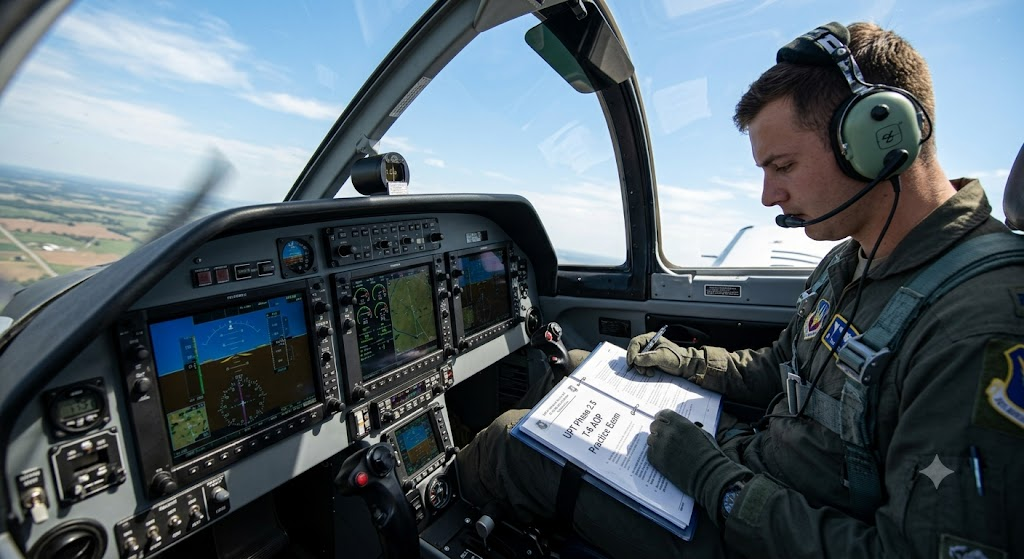
Additional Information
What the Course Entails and Exam Details
The Aircrew Orientation Program (AOP) is the academic foundation upon which primary flight training is built. The course bridges the gap between civilian academic knowledge and military aviation operations. The syllabus covered by this practice test includes:
T-6A Aircraft Systems: In-depth knowledge of the engine (PT6A-68), electrical, hydraulic, fuel, and environmental systems.
Flight Instruments and Navigation: Operational understanding of the Electronic Flight Instrument System (EFIS), GPS, and VOR/ILS navigation.
Operating Limits and Restrictions: Memorization of critical aircraft limitations, including airspeed, g-loading, and engine operating parameters.
Federal Aviation Regulations (FARs) and Military Instructions: Application of general flight rules (AFMAN 11-202 Vol 3) and T-6 specific visual flight rules (VFR) and instrument flight rules (IFR) operations.
Weather Analysis: Interpretation of aviation weather reports (METARs, TAFs) and chart analysis for mission planning.
Emergency Procedures (Critical Action Procedures): Although often tested separately via "Bold Face" dictation, the AOP exam tests the underlying knowledge required for handling non-critical and critical inflight emergencies.
What to Expect in the Final Exam
The formal AOP examination is a rigorous assessment administered at the conclusion of academic ground school. While formats may vary slightly by training wing, students should generally expect the following:
Exam Format: The test is predominantly a multiple-choice examination.
Time Limit: The exam is timed, typically requiring students to process information and answer questions rapidly, simulating the high-tempo cockpit environment.
Passing Score: The standard for passing is high, often requiring a minimum score of 80% or 85%. Failure to pass may result in training delays or a progress review.
Style of Questions: Questions are operational and scenario-based. Rather than just asking "what is the fuel capacity," the exam might ask, "Given current fuel burn and wind, what is your maximum endurance?"
Reference Material: This is typically a closed-book exam, requiring students to have a thorough recall of the T-6A flight manual (the "Dash-1").
How to Study and Exam Centers
Preparation for the AOP exam requires a disciplined and structured approach. The quantity of information can be overwhelming, so effective study strategies are critical:
Utilize the Practice Test Systematically: Do not just take the test once. Use it to identify specific weak areas (e.g., electrical system or navigation). After reviewing your references, retake the test to ensure mastery.
Deep Dive into the 'Dash-1' (T-6A Flight Manual): The flight manual is your primary source of truth. Read and reread the systems and operational procedures sections.
Group Study: Explaining complex aircraft systems to fellow students is one of the most effective ways to solidify your own understanding.
Create Flashcards: Use flashcards for operating limitations, airspeeds, and specific regulatory requirements.
"Chair Fly" the Scenarios: When the practice test presents a navigation or regulatory scenario, close your eyes and visualize performing the action in the cockpit.
Exam Centers:
The formal UPT Phase 2.5 T6 AOP evaluation is not taken at civilian testing centers. It is administered internally by the specialized undergraduate pilot training squadrons at U.S. military installations. These authorized testing locations include:
Vance Air Force Base, Oklahoma
Columbus Air Force Base, Mississippi
Laughlin Air Force Base, Texas
Sheppard Air Force Base, Texas (Euro-NATO Joint Jet Pilot Training)
Naval Air Station Whiting Field, Florida (for Joint Primary training)
Naval Air Station Corpus Christi, Texas (for Joint Primary training)
Job Opportunities from the Course
Successfully navigating UPT Phase 2.5 and passing the AOP exam is a mandatory milestone on the path to becoming a military aviator. It does not grant a specific civilian job but directly unlocks the advanced phases of military flight training, leading to specific career tracks:
US Air Force Pilot (Fighter, Bomber, Airlift, Special Operations, Trainer)
US Navy Naval Aviator (Tailhook, Rotary, Maritime)
US Marine Corps Aviator (Jet, Rotary, Tiltrotor)
T-6A Instructor Pilot (eventually, after operational tours)
Military Aviation Leadership and Operations Officer
Frequently Asked Questions
Reviews
5.0
Based on 0 reviews
Leave a Review
No reviews yet. Be the first to review!