
Union Pacific Air Brakes Practice Test
$69.00
- Buy to unlock unlimited access to all Quiz questions and Answers in this Quiz.
- After purchase you can print a PDF of the whole quiz at any point. The PDF will contain the questions and the correct answers.
About this Exam
The Union Pacific Air Brakes certification is a critical credential for railroad professionals, including conductors, engineers, and brake operators. This certification ensures that personnel possess the necessary knowledge and practical skills to safely operate, inspect, and maintain the complex air brake systems used on freight trains.
The exam is designed to validate a candidate's understanding of pneumatic principles, system components, safety protocols, and troubleshooting techniques. Obtaining this certification is essential for guaranteeing operational safety and regulatory compliance within the Union Pacific network.
Ready to test your knowledge?
Buy Now to Access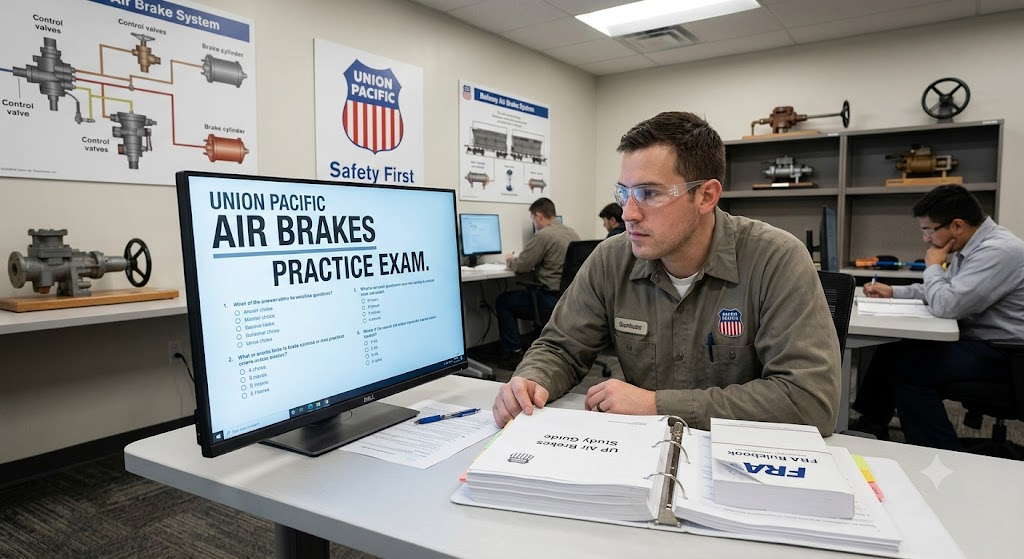
Additional Information
What the Course Entails and Exam Details
The course covers a comprehensive range of topics essential for mastering air brake systems. The curriculum is structured to provide both theoretical knowledge and practical understanding.
Key areas of focus include:
Fundamental Principles of Air Brakes: Understanding the physics of air pressure, compression, and the basic operation of a pneumatic braking system.
System Components: Detailed study of all critical parts, including compressors, reservoir tanks, brake valves, brake cylinders, and rigging.
Operating Procedures: Correct methods for applying and releasing brakes, managing air pressure in long train consists, and operating dynamic braking systems in conjunction with air brakes.
Inspection and Testing: Procedures for pre-departure inspections, initial terminal brake tests, intermediate brake tests, and identifying defect conditions.
Safety Regulations: Comprehensive review of FRA (Federal Railroad Administration) regulations and Union Pacific internal safety rules regarding brake systems.
Troubleshooting: Identifying common system failures, low-pressure situations, and appropriate remedial actions.
What to Expect in the Final Exam
The Union Pacific Air Brakes Final Exam is a rigorous assessment of the knowledge gained during the training course. It is a closed-book examination designed to test both recall of technical details and the application of principles to practical scenarios.
Exam Format: The exam typically consists of multiple-choice questions. These questions may be based on written descriptions, diagrams of brake systems, or hypothetical operational scenarios.
Passing Score: A high proficiency level is required, usually requiring a passing score of 80% or higher, reflecting the critical safety nature of the subject.
Time Limit: Candidates are usually given a strict time limit to complete the exam, often ranging from 90 to 120 minutes, depending on the specific iteration of the test.
Retake Policy: If a candidate does not pass on the first attempt, there is typically a mandatory waiting period before they are eligible to retake the exam, often requiring additional remedial training.
How to Study and Exam Centers
Preparation is key to succeeding in the Air Brakes Exam. Candidates should employ diverse study strategies to ensure a deep understanding of the material.
Study Official Manuals: The Union Pacific Air Brake Manual and the System General Operating Rules are the primary source materials. Memorizing components, color codes for diagrams, and regulatory requirements is essential.
Use Practice Exams: Taking practice tests is highly effective. Analyze incorrect answers to identify weak areas. Focus on the rationale behind correct procedures, not just memorizing the answer.
Practical Application: If possible, spend time with actual brake components or simulators. Physically identifying parts and visualizing the air flow can reinforce theoretical knowledge.
Study Groups: Discussing scenarios and system operations with peers can provide new insights and clarify complex topics.
Exam Centers: The exam is typically administered at authorized Union Pacific training facilities located at major service units. In some cases, for recurring certifications, it may be proctored through secure online portals. Candidates must register for the exam through the internal Union Pacific employee training management system.
Job Opportunities from the Course
Successfully obtaining the Air Brakes certification is a mandatory requirement for several high-responsibility operational roles within Union Pacific. It is a foundational certification that opens the door to a career in train operations.
Specific job titles that require this certification include:
Freight Conductor
Locomotive Engineer
Brakeman / Switchman
Remote Control Operator (RCO)
Yardmaster
Manager of Train Operations (MTO)
Frequently Asked Questions
Reviews
5.0
Based on 0 reviews
Leave a Review
No reviews yet. Be the first to review!