
Union Pacific Conductor Practice Test
$69.00
- Buy to unlock unlimited access to all Quiz questions and Answers in this Quiz.
- After purchase you can print a PDF of the whole quiz at any point. The PDF will contain the questions and the correct answers.
About this Exam
The Union Pacific Conductor role is a cornerstone of the American railway industry, responsible for managing train crews, safe freight movement, and direct coordination with other train operations. Achieving certification as a Conductor at Union Pacific (UP) requires demonstrating a comprehensive understanding of complex operating rules, safety protocols, and mechanical systems. This specific Union Pacific Conductor Practice Test is an indispensable study tool designed to prepare aspiring railroad professionals for the rigors of the final certification exams required for this career path. Whether you are a new trainee navigating classroom material or an experienced railroader aiming for a refresher, this practice test simulates the essential knowledge and challenging question formats you will encounter on the official examination. It focuses on practical application, safety critical knowledge, and procedural accuracy required by Union Pacific.
Ready to test your knowledge?
Buy Now to Access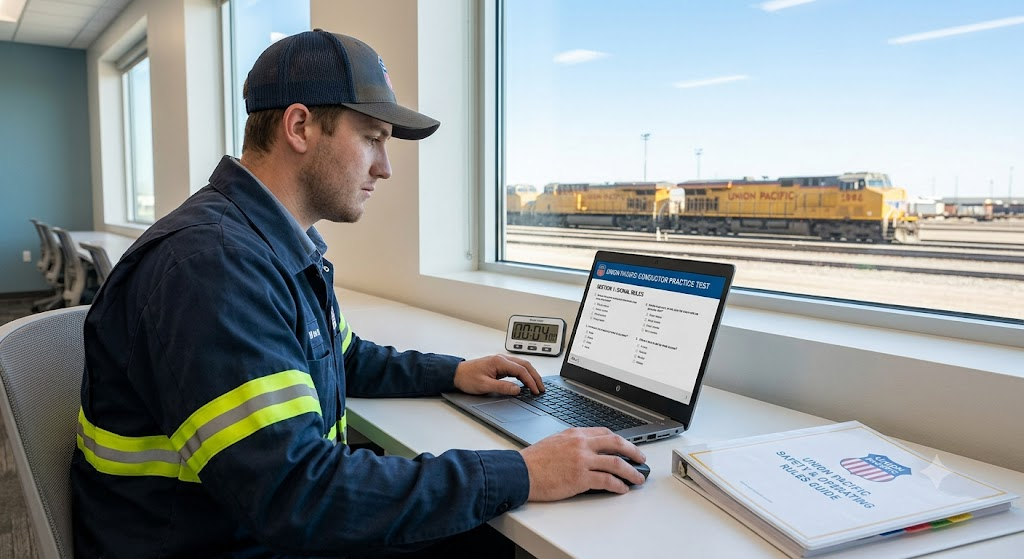
Additional Information
What the Course Entails and Exam Details
Preparing for the final conductor exam involves a blend of classroom instruction and on-the-job training (OTJ) provided internally by Union Pacific. This practice test mirrors the key core topics covered in the training curriculum, which are critical to the conductor’s role and include:
General Code of Operating Rules (GCOR): In-depth knowledge of standard U.S. railroad operating procedures, signaling, and safety regulations.
Union Pacific System Special Instructions (SSI): UP-specific rules and variations from GCOR, crucial for safe operations on their extensive network.
Air Brake & Train Handling Rules: The technical details of braking systems, safety checks, and movement dynamics for freight trains.
Safety Rules & Procedures: Personal safety protocols, equipment handling, emergency response, and Red Zone procedures.
Train Crew Responsibilities & Communication: Understanding the hierarchy, effective radio communication, hand signals, and managing crew interactions.
Switching and Yard Operations: Knowledge of car movement, coupling/uncoupling, yard limits, and relevant safety practices.
Freight Car and Locomotive Systems: Basic mechanical knowledge and inspection requirements for different rolling stock.
The official final conductor exam within UP’s training program typically consists of multiple-choice and true/false questions, designed to test a comprehensive range of these subjects. Passing requires a high degree of proficiency due to the safety-critical nature of the role.
What to Expect in the Final Exam
While the exact structure of the practice test may vary slightly from the actual internal Union Pacific examination, it is designed to prepare you for the general expectations and rigor of the final conductor certification test. Here is what to expect in the final assessment for UP Train Crew trainees:
Format: The exam will primarily be comprised of multiple-choice and true/false questions. These questions are carefully constructed to assess your theoretical understanding and, crucially, your ability to apply safety and operating rules to specific railroad scenarios.
Content: Questions will cover all the core areas detailed above, with a significant emphasis on GCOR, UP System Special Instructions, and safety procedures. Expect scenarios that test your ability to interpret signals, understand track movement authorities, and apply emergency protocols.
Passing Score: The passing score for Union Pacific conductor exams is very high, typically requiring trainees to achieve a percentage in the range of 80% to 90%, and sometimes even higher for specific critical safety sections. Maintaining an excellent academic standing throughout training is paramount.
Time Limits: The actual internal exam is typically timed to ensure a sufficient pace of response, just as decisions must be made quickly on the job. Our practice test is also designed to help you build speed while maintaining accuracy.
Rules & Conditions: Official internal exams are conducted under strict, proctored conditions at designated Union Pacific training facilities. Cell phones and unauthorized materials are strictly prohibited. The focus is on demonstrating individual competence.
How to Study and Exam Centers
Effective Study Strategies:
Master the Rules: The General Code of Operating Rules and Union Pacific System Special Instructions are your most important study materials. Read them carefully, understand the intent of each rule, and be able to visualize scenarios where they apply. Do not rely solely on memorization.
Use the Practice Test Repeatedly: Take this practice test multiple times to build familiarity with the question types and content. Focus not just on getting the correct answer but on understanding why that answer is correct and why other options are not. Review the detailed rationales provided for each question to reinforce your learning.
Focus on Your Weaknesses: Identify the areas where you consistently struggle and dedicate extra study time to those specific topics (e.g., specific brake system rules or signal interpretations).
Create Flashcards: Use flashcards for key definitions, signal aspects and their indications, specific rule numbers, and critical procedures. This is excellent for rapid recall.
Study Groups: If possible, form study groups with other trainees in your class. Explaining concepts to others and discussing scenarios can significantly deepen your understanding.
Simulate Exam Conditions: Set a timer and take the practice test without interrupting yourself to build stamina and experience the time pressure.
Actively Engage with Training: Pay close attention during all classroom sessions and ask questions when you are unsure about any material. During OTJ training, ask your crew members to explain procedures and rule applications in real-time.
Exam Centers & Access:
Practice Test Access: Our Union Pacific Conductor Practice Test is accessible online, giving you the flexibility to study from anywhere with an internet connection. It is not tied to a specific physical testing center.
Official Final Exam Location: The official, final conductor certification exam for trainees is conducted by Union Pacific. This typically takes place at designated Union Pacific training centers (e.g., in Omaha, NE, or other regional training facilities) under the supervision of UP instructors and proctors. Access to these internal exams is restricted to employees currently enrolled in the conductor training program.
Pre-Employment Assessments: Note that the initial online skill, personality, and aptitude assessments before you are hired are taken through specific online portals as directed by the Union Pacific recruiting team. Any physical ability tests are conducted at authorized third-party or UP physical testing locations. The practice test described here is primarily a prep tool for the comprehensive rules and knowledge exams given to trainees.
Job Opportunities from the Course
Successfully navigating the Union Pacific Conductor training program and passing the required final exams opens direct career paths within the company's vast operational structure. Certification as a conductor allows for job placement and potential advancement in the following roles:
Conductor
Assistant Conductor
Train Crew Member
Switchman / Brakeman
Remote Control Operator (RCO) - often as an additional qualification or job assignment
Future pathway to Locomotive Engineer, following further training and certification
Opportunities for progression into Operational Management, Dispatch, or other safety and supervisory roles within Union Pacific and the broader railroad industry
Frequently Asked Questions
Reviews
5.0
Based on 0 reviews
Leave a Review
No reviews yet. Be the first to review!