
Union Pacific Switching Practice Test
$69.00
- Buy to unlock unlimited access to all Quiz questions and Answers in this Quiz.
- After purchase you can print a PDF of the whole quiz at any point. The PDF will contain the questions and the correct answers.
About this Exam
The Union Pacific Switching Practice Test is a critical step for individuals pursuing a career as a Conductor, Brakeman, or Switchman with the Union Pacific Railroad, one of the leading Class I railroads in North America. This test evaluates practical knowledge and safety protocols essential for managing locomotive movements, car coupling, and uncoupling operations within terminal yards. It is designed for entry-level candidates who want to prove their understanding of these high-stakes railway procedures, demonstrating they possess the foundational skills necessary for safe and efficient switching operations in an industrial environment.
Ready to test your knowledge?
Buy Now to Access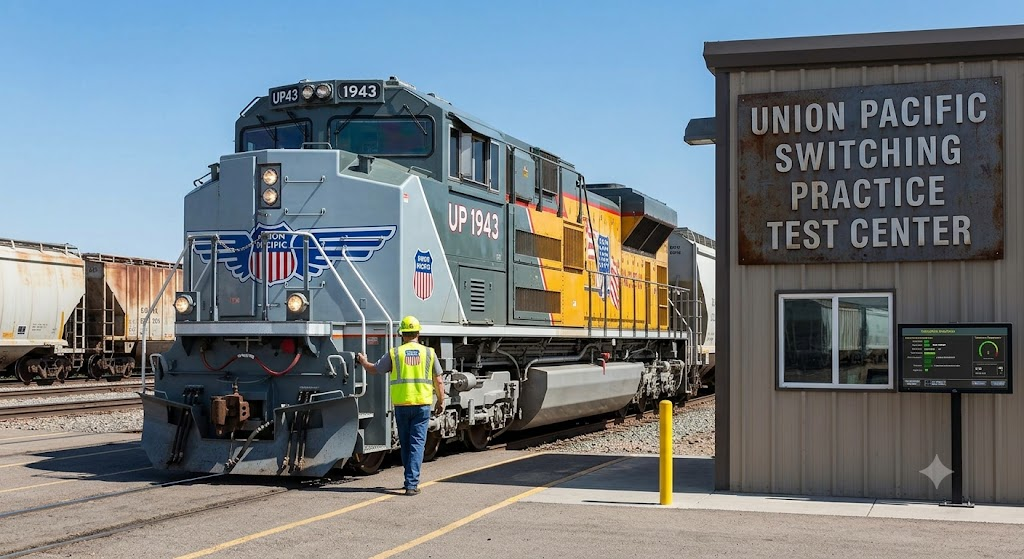
Additional Information
What the Course Entails and Exam Details
This comprehensive study guide and the associated practice test focus on the essential rules and procedures outlined in the General Code of Operating Rules (GCOR) and Union Pacific’s specific Safety and Switching rules. Core topics covered include:
Standard switching terminology and definitions.
Coupling and uncoupling procedures for various car types.
Hand brake operation and testing.
Protection of switching movements and employees.
Radio communication protocols for clear instructions.
Operating within restricted limits and using derails.
Recognizing and avoiding common switching hazards.
Proper hand signals and locomotive control movements.
What to Expect in the Final Exam
The actual Union Pacific Switching exam (not just this practice test) typically involves both a comprehensive written (or computer-based) examination and a critical practical field evaluation. The computer-based test is a multiple-choice exam assessing theoretical knowledge. You can expect questions focused on interpreting scenarios, rule applications, and identifying safety violations in practical switching diagrams. The field evaluation is a pass/fail practical assessment where you must demonstrate your ability to execute basic switching operations safely and accurately, including coupling and uncoupling cars under observation. While specific time limits for the computer exam may vary (e.g., 60-90 minutes), the field evaluation is based on task completion and safety compliance, with zero tolerance for safety violations.
How to Study and Exam Centers
A successful approach to the Union Pacific Switching exam requires dedicated study of official GCOR rules and UP internal training manuals provided during the hiring process.
Study Strategies:
Review official Union Pacific rules and safety publications.
Participate fully in UP-provided training classes and on-the-job mentorship.
Practice visualization: mentally walk through common switching scenarios.
Utilize this practice test to identify knowledge gaps.
Focus heavily on mandatory safety rules; safety has priority over all.
Exam Locations:
The formal Union Pacific examinations and practical evaluations are administered directly by Union Pacific training and safety personnel. These tests are usually conducted during your official conductor or switchman training academy. Written exams may be taken in dedicated testing rooms within UP’s regional training centers, while the vital practical field evaluations occur on active tracks at their major railway terminals and yards across the United States. They are not available through common public testing centers like Pearson VUE; they are internal to the railroad.
Job Opportunities from the Course
Successfully passing this switching practice test and the subsequent formal examinations is crucial for securing a range of operational positions within the Union Pacific Railroad. Key career paths unlocked include:
Conductor
Switchman
Brakeman
Remote Control Locomotive Operator (after additional training)
Yardmaster
Future career progression into operational management and dispatcher roles.
Frequently Asked Questions
Reviews
5.0
Based on 0 reviews
Leave a Review
No reviews yet. Be the first to review!