
Unit Deployment Manager (UDM) Basic Practice Test
$69.00
- Buy to unlock unlimited access to all Quiz questions and Answers in this Quiz.
- After purchase you can print a PDF of the whole quiz at any point. The PDF will contain the questions and the correct answers.
About this Exam
The Unit Deployment Manager (UDM) Basic Practice Test is a vital stepping stone for military personnel and defense contractors aiming to become key enablers of global power projection. This simulated exam is specifically designed for individuals who have completed the initial phase of their UDM training, providing a comprehensive assessment of their functional knowledge before proceeding to advanced certifications or operational roles. It targets emerging logistics planners, mobilization specialists, and readiness non-commissioned officers (NCOs) who are responsible for ensuring that personnel and equipment are perfectly postured for rapid, effective deployment in support of contingency operations, exercises, and humanitarian missions.
Ready to test your knowledge?
Buy Now to Access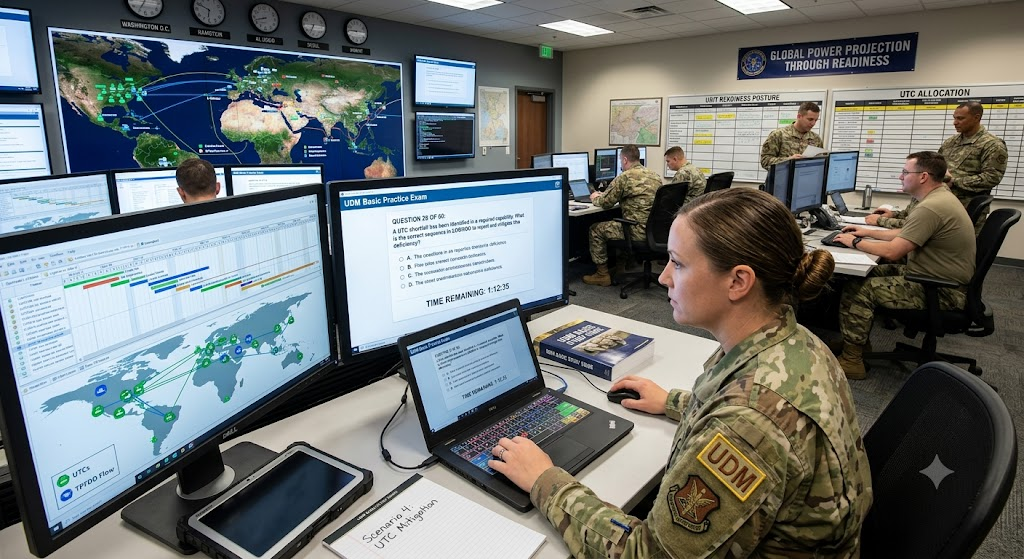
Additional Information
What the Course Entails and Exam Details
The core training curriculum covered by the UDM Basic Practice Test focuses on the fundamental pillars of unit readiness and deployment execution. Mastery of these concepts ensures a seamless transition from garrison to an expeditionary environment. The simulated exam evaluates proficiency in the following critical areas:
Deployment Planning & Execution: Understanding the deployment lifecycle, from initial tasking to retrograde, and how to develop and execute unit deployment plans.
Unit Type Codes (UTCs) & Authorizations: The ability to configure, posture, and maintain UTCs, which are the building blocks of military capabilities, ensuring they align with major command requirements.
Readiness Tracking & Reporting: Proficiency in measuring and reporting unit combat capability, focusing on personnel, equipment, and training status, primarily through the Defense Readiness Reporting System (DRRS).
Logistics & Personnel Systems: Practical application of essential software tools like the Logistics Module (LOGMOD) for cargo and personnel movement, and the Deliberate and Crisis Action Planning and Execution Segments (DCAPES) for deployment posturing and tasking management.
Regulatory Compliance: Navigating and applying key service-specific and joint regulations, such as Air Force Instructions (AFIs) related to operations planning and deployment, to ensure all activities are legally sound and operationally compliant.
What to Expect in the Final Exam
While specific formats vary by service branch and schoolhouse, the real UDM Basic Certification Exam is typically a comprehensive, formal assessment. However, the UDM Basic Practice Test is engineered to accurately mimic the pressure and style of the final evaluation. Here is a breakdown of what to expect:
Format: The practice test is a computer-based, multiple-choice examination.
Number of Questions: The test contains 50 to 70 randomized questions.
Time Limit: You will typically be given 90 to 120 minutes to complete the test, demanding efficient time management.
Passing Score: The standard for most basic UDM certifications is a minimum of 80%.
Key Skills Tested: The exam focuses heavily on "know-how" over simple memorization. Prepare for scenario-based questions that ask how to resolve a UTC shortfall, correct a readiness discrepancy in a reporting system, or validate personnel eligibility based on deployment availability codes.
How to Study and Exam Centers
Successfully passing the UDM Basic requires a balanced blend of doctrinal study and practical system application. Because this is a practice test for a specialized military special duty, standard "civic" test centers are not relevant. Here are the most effective ways to prepare:
Actionable Study Strategies:
Master the Systems: The most critical step is spending time on a training or test environment of LOGMOD, DCAPES, and DRRS. Practice creating UTC packages, scheduling personnel for deployment, and running readiness reports. Hands-on experience is irreplaceable.
Review Official Doctrine: Study the specific instructions and regulations that govern your service’s deployment processes. For the Air Force, for instance, focus on AFI 10-401 (Operations Planning) and AFI 10-403 (Deployment Planning). Create flashcards for key terms like TPFDD, UTC, ULN, and PID.
Engage with Mentors: Talk to experienced UDMs. Ask them about their real-world deployment challenges and how they use the tools and regulations to solve problems. They can provide valuable, practical insights not found in manuals.
Take Multiple Practice Tests: Use randomized practice tests to simulate exam-day pressure. Analyze every incorrect answer to understand the specific doctrinal or practical error you made.
Exam Centers and Access:
Official Certification: The actual UDM Basic certification is a military special duty qualification. To take the final exam, you must be officially nominated by your unit commander and assigned a training slot.
Location: The final exam is administered at a service’s formal schoolhouse (e.g., a Logistics Readiness Squadron's training flight or a major command's UDM training center) or, in some cases, via authorized and proctored online portals within a secure military network.
Practice Tests: Simulated practice tests like this one are available through official service-specific distance learning portals (e.g., Air Force’s myLearning), specialized training squadrons, or a unit’s internal readiness training resources.
Job Opportunities from the Course
Obtaining a UDM Basic certification, backed by successful practice and evaluation, is a prerequisite for a critical special duty assignment within the military. It unlocks numerous opportunities in the fields of logistics, planning, and operational readiness, making it a powerful career enhancer for both military personnel and defense contractors.
Specific Job Titles and Career Paths Include:
Unit Deployment Manager (UDM)
Deployment Specialist
Mobilization Coordinator
Ready NCO (Non-Commissioned Officer)
Logistics Readiness Officer (LRO) – with specialized deployment experience
Installation Deployment Readiness Cell (IDRC) Analyst
Operations Planner (Contingency and Exercise)
Logistics Contractor (supporting DoD deployment operations)
Readiness Reporting and Analysis Specialist (DRRS Manager)
Frequently Asked Questions
Reviews
5.0
Based on 0 reviews
Leave a Review
No reviews yet. Be the first to review!