
Unit Deployment Manager (UDM) Module 1 Practice Test
$69.00
- Buy to unlock unlimited access to all Quiz questions and Answers in this Quiz.
- After purchase you can print a PDF of the whole quiz at any point. The PDF will contain the questions and the correct answers.
About this Exam
The Unit Deployment Manager (UDM) Module 1 Practice Test is the initial assessment step for United States Air Force personnel appointed to the critical role of Unit Deployment Manager. Designed for both military members and DoD civilians, this module and its accompanying practice exam establish the foundation for ensuring a unit's personnel and equipment are organized, trained, and equipped to deploy in support of global operations. The certification is mandatory for those charged with translating a commander’s operational requirements into deployment execution.
Ready to test your knowledge?
Buy Now to Access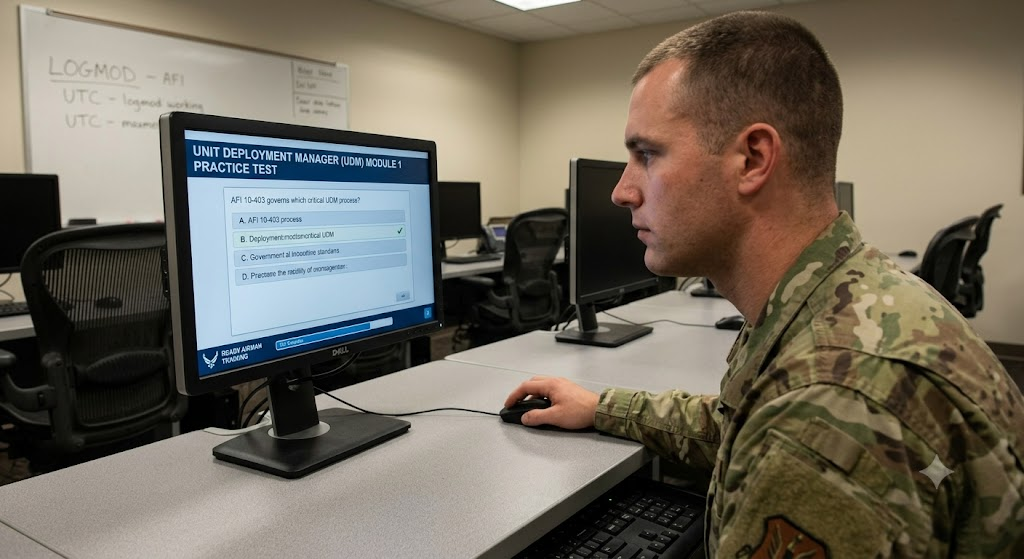
Additional Information
What the Course Entails and Exam Details
The UDM Module 1 course, and the associated practice test, focus heavily on fundamental knowledge required of every newly appointed UDM. It serves as the baseline for the entire Air Force Unit Deployment Manager training pipeline. The key areas covered in this module typically include:
UDM Roles and Responsibilities: An in-depth look at the UDM's relationship with the Unit Commander, the Installation Deployment Officer (IDO), and other critical readiness functions.
AFI 10-403, Deployment Planning and Execution: Mastering the primary Air Force Instruction that governs deployment operations.
Logistics Module (LOGMOD): Understanding how to utilize the primary system for managing unit movement data, personnel, and cargo.
Air Force Force Generation (AFFORGEN) and Unit Type Codes (UTC): The fundamental language of force presentation, including how UTCs define capabilities and how they are managed and reported in the AEF (Air and Space Expeditionary Force) reporting tool.
Time-Phased Force Deployment Data (TPFDD): An essential framework for understanding how force requirements are sourced and timed for movement.
Personnel and Cargo Readiness: The criteria and systems, such as ASIMS and e-DRC, used to validate that an Airman or piece of equipment is fully ready for deployment.
What to Expect in the Final Exam
The UDM Module 1 Practice Test is designed to mimic the format and difficulty of the end-of-module assessment within the official Air Force course. The exam is typically a formal Computer-Based Training (CBT) assessment. It consists of multiple-choice and true/false questions designed to test your comprehension of the complex regulations, systems, and processes learned in the module. While practice test scores do not carry the weight of the official certification, you should aim for a high passing score (typically 80% or higher, mirroring the official standard) to validate your readiness. The test has a specific time limit (e.g., 60 minutes for 30-40 questions), demanding swift and accurate retrieval of information. You must prove proficiency in interpreting scenarios, identifying the correct Air Force publication for a situation, and selecting the appropriate action in a readiness system.
How to Study and Exam Centers
The most important step in preparing for the UDM Module 1 Practice Test is to utilize the actual resources you will manage in the role. Do not rely solely on summarized notes. Your primary study tools must include:
Air Force Job Qualification Standard (AFJQS) 8U000: This is the official guide for UDM training. It outlines every task and the technical references you must know.
The UDM Training Courseware: Thoroughly review all course materials, noting that the content is structured to align with the core competencies tested.
Official Air Force Publications: Focus your study on AFI 10-403 (Deployment Planning and Execution), and be familiar with related instructions for LOGMOD, TPFDD, and UTC management.
Practical System Navigation: If you have access, practice within the actual training or production environments of LOGMOD and the AEF reporting systems to build familiarity.
The official Unit Deployment Manager certification is not administered at commercial testing centers like Pearson VUE. It is an internal Air Force qualification. The final, graded exam for the UDM course is typically taken as a CBT on a military installation, administered through the Air Force's designated learning management system (e.g., Air Force MyLearning). Practice tests are also integrated into this same digital ecosystem.
Job Opportunities from the Course
Upon successful completion of the entire UDM certification pipeline, which begins with passing Module 1, individuals are qualified to hold key readiness positions within Air Force units. The course unlocks and is a prerequisite for roles including:
Unit Deployment Manager (UDM)
Deployment Manager
Ready Airman Training (RAT) Program Manager
Installation Deployment Readiness Cell (IDRC) Liaison
Unit Readiness Manager
Logistics Plans (specialized roles in deployment and execution)
DoD Civilian Deployment and Readiness Specialist
Frequently Asked Questions
Reviews
5.0
Based on 0 reviews
Leave a Review
No reviews yet. Be the first to review!