
United States Air Force Academy (USAFA) Knowledge Test (K-Test) Practice
$69.00
- Buy to unlock unlimited access to all Quiz questions and Answers in this Quiz.
- After purchase you can print a PDF of the whole quiz at any point. The PDF will contain the questions and the correct answers.
About this Exam
The United States Air Force Academy (USAFA) Knowledge Test, commonly known as the K-Test, is a rigorous assessment designed exclusively for fourth-class cadets (freshmen), affectionately known as 'Doolies.' This exam is a cornerstone of the professional and military development program at the Academy. It ensures that every prospective Air Force officer possesses a robust, standardized foundation of knowledge essential for leadership, heritage, and service discipline. While practice tests are available online, the actual K-Test is an internal challenge that cadets must master to progress through their training and ultimately earn their commission in the United States Air Force. This guide is designed to help Doolies prepare effectively for this critical developmental milestone.
Ready to test your knowledge?
Buy Now to Access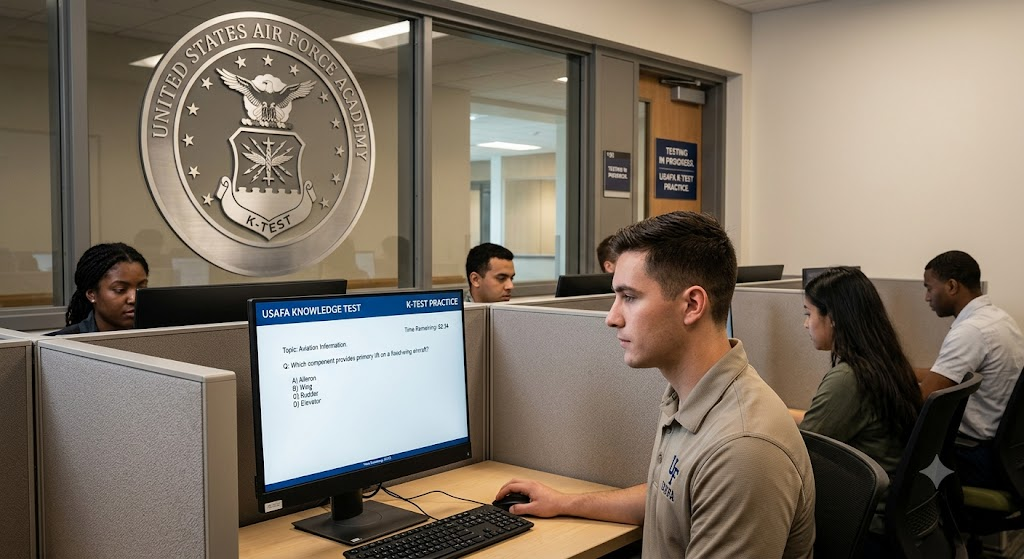
Additional Information
What the Course Entails and Exam Details
The USAFA K-Test does not cover academic subjects like calculus or physics; instead, it focuses intensely on professional military education and heritage. The core curriculum for this assessment is centered on the officially sanctioned cadet knowledge database. Cadets are required to memorize, understand, and recall specific information, including:
USAFA and Air Force History: Key milestones, significant historical figures, and the evolution of the service.
Military Heritage: Traditions, military protocol, and the history of the Doolie year.
Customs and Courtesies: Proper saluting, addressing officers and NCOs, and protocol within the military structure.
Air Force Doctrine: Fundamental principles of airpower and joint operations.
Leadership Principles: Core values, ethics, and the role of an Air Force leader.
Chain of Command: Knowing the structure from the President of the United States down to the cadet squadron leadership.
Aircraft Recognition: Identifying major USAF and allied/adversary aircraft.
The Doolie Book (Contrails): A primary source containing the core list of required knowledge.
The K-Test represents a crucial assessment of a Doolie's discipline, commitment, and attention to detail.
What to Expect in the Final Exam
When cadets sit for the actual USAFA K-Test, they must expect a high-stakes, time-compressed environment. The final exam typically features the following characteristics:
Format: The primary format is usually a combination of rapidly administered multiple-choice questions and sometimes short-answer or fill-in-the-blank responses, testing for precise recall of details.
Passing Score: The standard for mastery is exceptionally high. Cadets often need to score 80% or 90% or higher to pass, reflecting the Air Force's demand for perfection in foundational knowledge.
Time Limits: The test is usually timed very strictly, allowing only seconds per question, simulating the high-pressure decision-making environment of military operations.
Rules: The final K-Test is administered internally at USAFA in designated testing halls. It is proctored by upper-class cadets or Air Force officers. No notes, electronics, or collaboration are permitted. Success depends entirely on prepared, internalized knowledge. Failure requires dynamic remedial study and retaking the assessment until proficiency is demonstrated.
How to Study and Exam Centers
Preparation for the USAFA K-Test is as much about discipline as it is about study. Here are actionable strategies used by successful cadets:
Flashcards, Physical and Digital: Create flashcards for every required piece of information. Apps like Anki can help automate the repetition of complex facts (e.g., historical dates, chain of command).
The 'Doolie Book' as a Bible: "The Contrails" (or the updated digital equivalent) is the primary source material. Know every page.
Recitation Under Pressure: Practice reciting the knowledge out loud with your roommates or study group. Successful cadets often drill while doing simple tasks, forcing the recall to become automatic.
Mock 'Prog' (Progression) Drills: Simulate the test environment by having friends ask random questions quickly. Practice responding instantly and correctly.
Understand, Don't Just Memorize: While rote memorization is necessary for facts, understanding the context (why that custom exists, why that leader is important) aids in long-term retention.
Exam Centers: The final, official USAFA Knowledge Tests (K-Tests) are administered internally by the United States Air Force Academy leadership in Colorado Springs, Colorado. There are no external testing centers like Pearson VUE for the official K-Test. Access is restricted to USAFA cadets. Practice versions and study materials can often be found through authorized cadet academic support portals and official internal USAFA websites, but the final certification happens exclusively on the Academy grounds.
Job Opportunities from the Course
The USAFA K-Test is not a professional certification leading to immediate employment outside the military. Instead, it is a developmental milestone required for commissioning as an Air Force officer. Mastering this knowledge base is critical to progressing through the Academy curriculum. Successful completion of the Doolie year, which includes passing the K-Tests, eventually leads to graduation, a Bachelor of Science degree, and commissioning as a Second Lieutenant in the United States Air Force. The professional opportunities unlocked by completing USAFA are vast:
Air Force Officer (2nd Lieutenant): The primary immediate outcome.
Pilot: Fighter, Bomber, Mobility, Special Operations, and Remotely Piloted Aircraft.
Combat Systems Officer (CSO): Navigators, Electronic Warfare Officers.
Air Battle Manager (ABM): Command and control of air assets.
Cyberspace Operations Officer: Defending Networks and conducting offensive cyber ops.
Intelligence Officer: Analyzing and disseminating critical strategic intelligence.
Space Operations Officer: Commanding satellite systems and space lift operations.
Engineer: Civil, Electrical, Mechanical, Aeronautical.
Logistics Readiness Officer: Managing complex global logistics chains.
Security Forces Officer: Leading base defense and police forces.
These paths lead to dynamic careers with immense responsibility and leadership challenges globally.
Frequently Asked Questions
Reviews
5.0
Based on 0 reviews
Leave a Review
No reviews yet. Be the first to review!