
United States Coast Guard Captains License Practice Exam
$69.00
- Buy to unlock unlimited access to all Quiz questions and Answers in this Quiz.
- After purchase you can print a PDF of the whole quiz at any point. The PDF will contain the questions and the correct answers.
About this Exam
The United States Coast Guard (USCG) Captain’s License, often referred to as a Merchant Mariner Credential (MMC), is the gold standard professional qualification for mariners seeking to legally operate commercial vessels in the United States. This certification validates a mariner's proficiency in essential maritime skills, including navigation, safety procedures, deck seamanship, and regulatory knowledge. Earning a captain's license is essential for individuals who intend to charge a fee for carrying passengers, operate commercial towing vessels, deliver yachts, or engage in other compensated marine activities. Depending on the specific license level (such as OUPV/6-Pack, Master 100 GT, or Master 200 GT), it is designed for individuals ranging from charter fishing guides on small bays to captains of large commercial supply vessels and ferries.
Ready to test your knowledge?
Buy Now to Access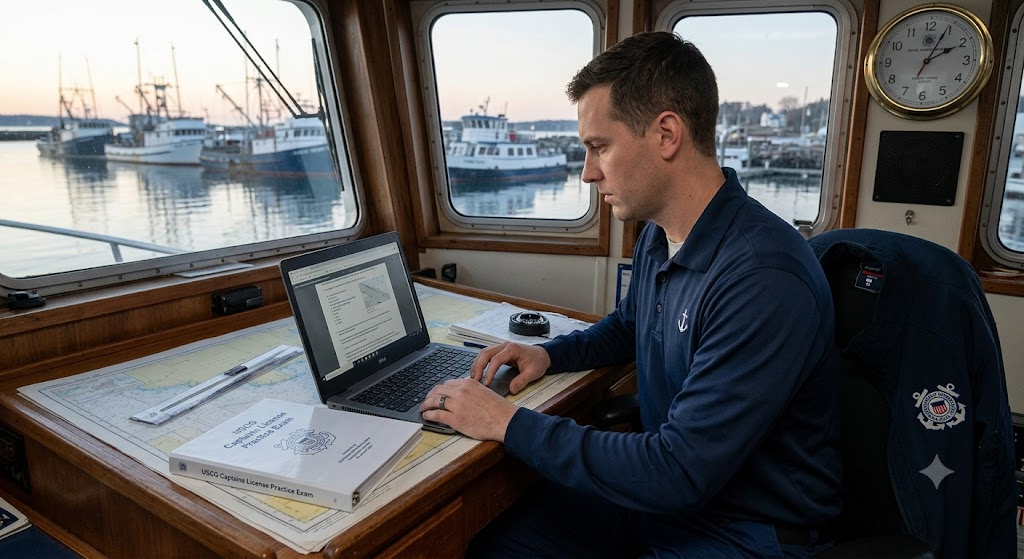
Additional Information
What the Course Entails and Exam Details
Preparing for the USCG Captain’s License exam requires a deep understanding of several critical maritime disciplines. Most comprehensive study courses are structured to cover the four primary modules required by the Coast Guard. These are the cornerstones of safe commercial operation:
Rules of the Road (International and Inland): This module covers navigation rules for preventing collisions at sea. It includes understanding vessel right-of-way, sound and light signals, and safe piloting practices in various visibility conditions.
Navigation General: This section tests your knowledge of charts, publications, navigational instruments, compass systems, tidal currents, and electronic navigation aids.
Chart Plotting: This practical module requires the physical plotting of courses, determination of position using dead reckoning and piloting, calculation of speed, time, and distance, and accounting for set and drift.
Deck General and Safety: This module encompasses a wide range of essential topics, including seamanship, vessel stability, marlinspike seamanship, firefighting, lifesaving equipment, emergency procedures, and USCG regulations applicable to commercial operations.
What to Expect in the Final Exam
The USCG Captain’s License exam is not a single test, but rather a series of comprehensive multiple-choice examinations broken down by module. While the exact number of questions can vary slightly depending on the specific license grade (e.g., OUPV vs. Master), you can generally expect the following:
Rules of the Road: Approximately 30 questions. The required passing score is typically 90%.
Navigation General: Approximately 20–30 questions. The passing score is 70%.
Chart Plotting: Approximately 10–20 comprehensive problems requiring physical plotting. The passing score is 70%.
Deck General and Safety: Approximately 50–70 questions. The passing score is 70%.
The exams are proctored, and you are provided with necessary charts, plotting tools, and calculators for the practical portions. Time limits are structured for each module, providing ample time but demanding efficiency, especially during chart plotting. There is zero tolerance for cheating or unauthorized materials.
How to Study and Exam Centers
Successfully passing the USCG exams requires dedication and a blend of theoretical knowledge and practical skill development.
Enroll in an Approved Course: While self-study is possible, the vast majority of successful candidates enroll in USCG-approved maritime training schools. These courses are designed by maritime professionals specifically to prepare students for the exams, offering structured lessons and often incorporating the final proctored exam as the course finale.
Master Chart Plotting: The Chart Plotting module is frequently cited as the most challenging section due to its practical application. Invest significant time in physically plotting on actual nautical charts using parallel rulers, dividers, and pencils. Online simulation tools and extensive practice problems are crucial.
Utilize Practice Exams: Rigorous use of practice exams and practice question databases is the most effective way to gauge your readiness, identify weak areas, and become comfortable with the multiple-choice format.
Rules of the Road Memorization: Aim for near-total recall in the Rules of the Road section. The required 90% pass rate is high for a reason; safe operations depend on split-second recall of right-of-way and signals.
Where to take the exam:
USCG Regional Exam Centers (RECs): This is the traditional route, where you schedule and take the exams directly with the Coast Guard after submitting your license application.
USCG-Approved Maritime Training Schools: Most approved training programs possess "designated examiner" status. This allows them to administer the final proctored exam at their facility upon completion of the course, providing a streamlined experience for students.
Online/Remote Proctoring: Some approved schools now offer hybrid or online courses with remote proctoring options for the final exams, expanding accessibility.
Job Opportunities from the Course
Earning a USCG Captain’s License significantly enhances your career prospects and professional standing in the maritime industry. The specific jobs available to you are dependent on your license grade (tonnage and route), but here is a clear list of career paths that this certification unlocks:
Charter Fishing Captain
Tour and Sightseeing Boat Captain
Water Taxi Operator
Dive Boat Captain
Commercial Fishing Vessel Master
Supply Vessel Captain
Ferry Captain (based on tonnage)
Towing Vessel Operator (Endorsement needed for Assistance Towing)
Sailing Instructor (often requiring a Sailing Endorsement)
Yacht Delivery Captain
Marina Manager or Harbor Master
Marine Transportation Specialist
Corporate Charter Captain
Frequently Asked Questions
Reviews
5.0
Based on 0 reviews
Leave a Review
No reviews yet. Be the first to review!