
United States Parachute Association (USPA) A License Practice Exam.
$69.00
- Buy to unlock unlimited access to all Quiz questions and Answers in this Quiz.
- After purchase you can print a PDF of the whole quiz at any point. The PDF will contain the questions and the correct answers.
About this Exam
The United States Parachute Association (USPA) A License is the definitive gateway certification for anyone serious about making skydiving a standalone sport. It is the first internationally recognized milestone that transitions a student jumper to a certified, unsupervised skydiver. This license signifies that an individual has demonstrated the basic knowledge, skills, and safety consciousness necessary to skydive without instructor supervision, pack their own main parachute, and participate in basic group jumps. It is designed for students who have completed an Accelerated Freefall (AFF) course or a similar integrated student program, and who have accumulated the prerequisite number of jumps to prove proficiency.
Ready to test your knowledge?
Buy Now to Access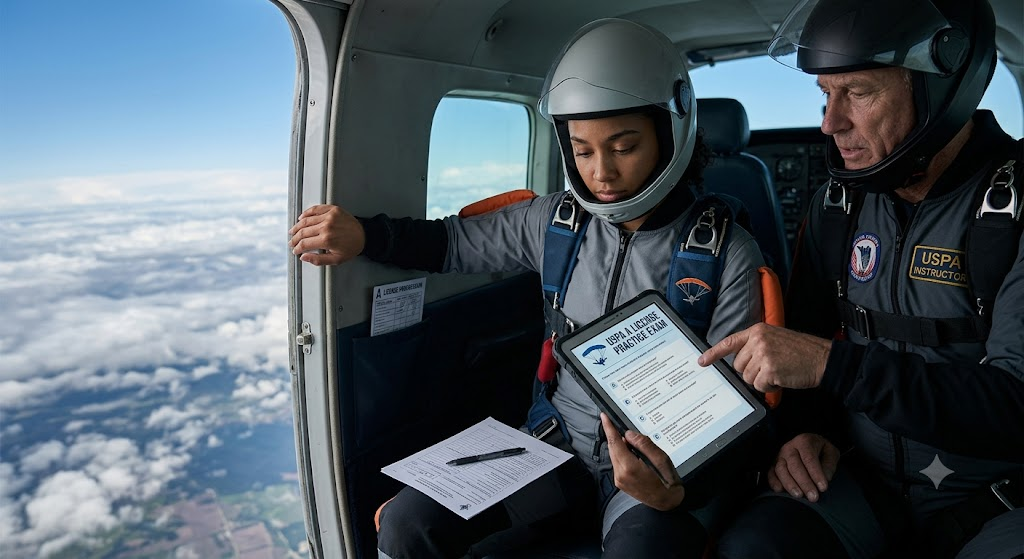
Additional Information
What the Course Entails and Exam Details
To achieve the USPA A License, a student doesn’t just take a final exam; they must complete a comprehensive integrated syllabus. The journey includes approximately six hours of intensive ground school followed by a specific progression of logged jumps, including at least 25 freefall skydives. The curriculum covers a wide range of essential skills. Key areas of focus include: ground evaluation of equipment, landing patterns, and emergency procedures; freefall maneuvers like stability control, turns, tracking, and docking; canopy flight fundamentals and advanced piloting topics; equipment maintenance, inspection, and the pivotal skill of packing a main parachute unassisted. Finally, all students must complete an oral and written knowledge test covering safety regulations, equipment, and flight theory.
What to Expect in the Final Exam
The final validation for the USPA A License consists of two primary components. The first is a written examination, which is a comprehensive multiple-choice test developed by the USPA. This exam covers questions derived from ground school and the Skydiver's Information Manual (SIM), detailing everything from Basic Safety Requirements (BSRs) and emergency protocols to equipment operations. A high passing score, often 75% or 80%, is required to demonstrate knowledge retention. The second, and perhaps more critical component, is the A License Check Dive. This is a final, scored skydive performed with a licensed instructor or examiner. During this check dive, the student must demonstrate a complete "heads-up" skydive: executing an unstable exit, regaining stability, performing precise turns, tracking away efficiently for separation, and deploying their parachute at the designated altitude, followed by a controlled landing.
How to Study and Exam Centers
Preparation for the A License exam begins during ground school. Students are encouraged to use the Skydiver's Information Manual (SIM) as their primary study resource, specifically Sections 2, 4, 5, and 6, which outline all requirements and safety recommendations. Using online A License practice exams is an excellent way to familiarize oneself with the test format and identify knowledge gaps. Many schools also provide study guides and review sessions. The practical check dive should be treated as a performance; visualizing the dive flow and practicing maneuvers during preceding jumps is key. Regarding locations, the A license written test and practical check dive are exclusively administered at USPA Group Member Drop Zones. These authorized schools and facilities have USPA-rated instructors and examiners available to conduct and sign off on all qualification cards and official exams.
Job Opportunities from the Course
Earning a USPA A License is the crucial first qualification needed to enter the professional side of skydiving. It opens several immediate career paths within a drop zone and sets the trajectory for advanced ratings and roles. Here is a list of specific job titles and career steps that this certification unlocks:
Parachute Packer: The most common entry-level professional job. An A-licensed skydiver is certified to pack their own main canopy, which is the foundational skill to become a professional, high-volume packer for tandems and students (requires FAA rigger supervision).
Drop Zone Staff / Ground Crew: The license demonstrates a fundamental understanding of safety and logistics, making holders excellent candidates for manifest, ground control, or aircraft loading roles.
Skydiving Coach in Training: While the B License is required to officially hold the USPA Coach Rating, earning an A license allows jumpers to begin accumulating the necessary jump numbers (100) and mentoring other students.
Video and Camera Flyer: The A license is the prerequisite needed to begin training for the USPA C license (200 jumps required) and eventually earning a USPA PRO rating, necessary for advanced camera work.
Jump Pilot (Prerequisite): While flying requires aviation credentials, many commercial pilots use a USPA license as proof of familiarity with skydiver operations to secure coveted jump pilot positions.
Pathway to Instructor (AFF, Tandem): A successful A license is the mandatory first step on the progression to earning USPA B, C, and D licenses, which are prerequisites for all instructor-level ratings.
Frequently Asked Questions
Reviews
5.0
Based on 0 reviews
Leave a Review
No reviews yet. Be the first to review!