
Unity Certified Associate – Artist Practice Test
$69.00
- Buy to unlock unlimited access to all Quiz questions and Answers in this Quiz.
- After purchase you can print a PDF of the whole quiz at any point. The PDF will contain the questions and the correct answers.
About this Exam
The Unity Certified Associate Artist exam is designed for aspiring digital artists who are ready to validate their entry-level skills within the Unity game engine. It is the ideal next step for students, hobbyists, and professionals who have a foundational understanding of game design principles and at least 150 hours of hands-on experience in Unity. This certification confirms your ability to understand a pipeline, create and manage assets, and construct engaging interactive experiences, giving you a competitive edge as you begin your career in game development, technical art, or interactive visualization.
Ready to test your knowledge?
Buy Now to Access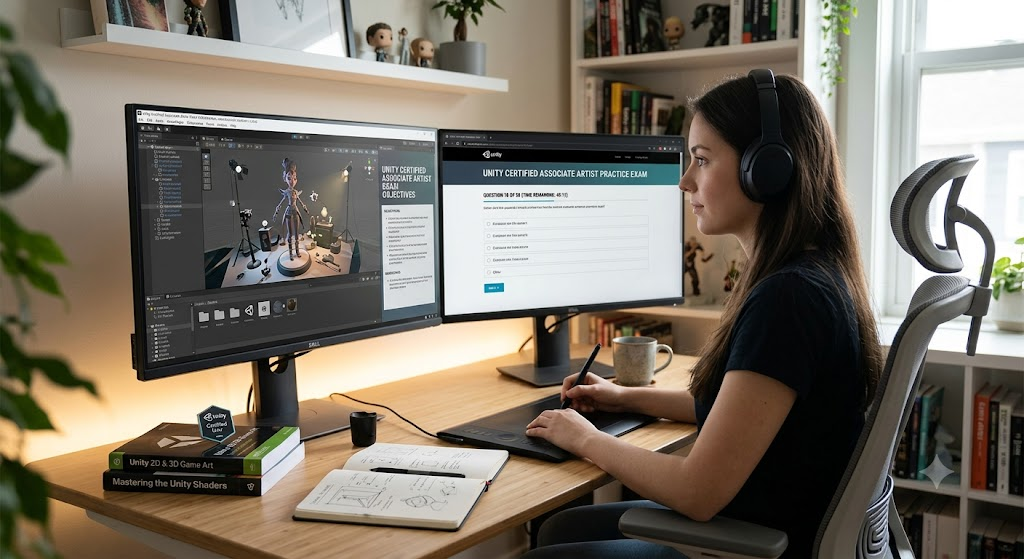
Additional Information
What the Course Entails and Exam Details
To succeed, a candidate must demonstrate intermediate-level competence across a spectrum of essential art and asset management tasks within the Unity Editor. The core syllabus includes, but is not limited to, the following domains: Asset Management (importing FBX and OBJ files, 9-slicing spritesheets, creating and modifying Prefabs, asset organization), Scene Content Design (prototyping with white-boxing/grey-boxing techniques, using the Transform tools, editing terrain with materials and masks), and Lighting, Cameras, and Materials Implementation (working with the standard shader, understanding various light types and their settings, configuring single camera setups for dynamic field of view, and understanding real-time and mixed lighting). Candidates are expected to know how to resolve common performance issues related to art assets.
What to Expect in the Final Exam
The official final exam is administered by Pearson VUE and is a linear exam. While specific details may evolve, you can expect a comprehensive set of approximately 50 to 70 questions that you must complete within a time limit, which is typically 90 minutes. The exam format is multiple-choice, multiple-response, and matching, testing both conceptual knowledge and practical application, but does not include a direct live-lab section. Candidates will need a minimum passing score of roughly 70% to receive their certification. The exam is closed-book and closely proctored to ensure academic integrity.
How to Study and Exam Centers
For practical preparation, the most critical step is purchasing the official Unity Certified Associate Artist Practice Test, which provides over 100 sample questions with full rationales for every correct and incorrect answer. Combine this with the recommended Unity Learn pathways, such as the Creative Core, which covers the specific domains. Beyond theoretical knowledge, invest significant time into building small, functional projects that force you to import custom 3D models, configure materials, implement lightmaps, and create complete, optimized scenes.
You can register for and take the exam through Pearson VUE. The platform offers two primary choices: taking the proctored exam at any authorized physical Pearson VUE testing center or utilizing their OnVUE online proctoring service. The online option allows you to take the exam from the comfort of your home or office, provided you meet specific system and environmental requirements. Be sure to check the available time slots well in advance.
Job Opportunities from the Course
Earning the Unity Certified Associate Artist certification is a strong validator for entry-level roles within the interactive media industry. It unlocks various career paths where Unity engine expertise is essential. Some of the specific job opportunities available to certified individuals include:
Junior 3D Artist: Creating 3D models, environments, and assets for games and simulations.
Junior 2D Artist: Creating concepts, user interface (UI) elements, and 2D background art.
Technical Artist (Entry-Level): Bridging the gap between art and programming, focusing on optimization, shaders, and pipeline tools.
Junior Lighting Artist: Developing mood and realism by configuring lighting, shadows, and post-processing.
Level Designer: Designing and building the layout, interactions, and player flow of individual levels.
Game Artist: A generalized role encompassing 2D/3D asset creation and scene construction.
Environment Artist: Specializing in the creation of comprehensive outdoor and indoor locations.
VR/AR Artist: Designing art specifically optimized for immersive virtual and augmented reality experiences.
Frequently Asked Questions
Reviews
5.0
Based on 0 reviews
Leave a Review
No reviews yet. Be the first to review!