
Unity Certified Programmer Practice Test
$69.00
- Buy to unlock unlimited access to all Quiz questions and Answers in this Quiz.
- After purchase you can print a PDF of the whole quiz at any point. The PDF will contain the questions and the correct answers.
About this Exam
The Unity Certified Programmer certification is a professional-level credential designed for individuals who want to validate their technical expertise and demonstrate their ability to contribute to a full development life cycle, from conceptualization to launch and beyond. This exam is meticulously crafted for mid-career creators, specifically targeting programmers with approximately two years of experience in creating interactive games and applications using Unity. Earning this certification is an official stamp of approval on your proficiency in C# scripting, core interactions, performance optimization, and application architecture, proving to employers that you are ready to take on complex, technical leadership roles.
Ready to test your knowledge?
Buy Now to Access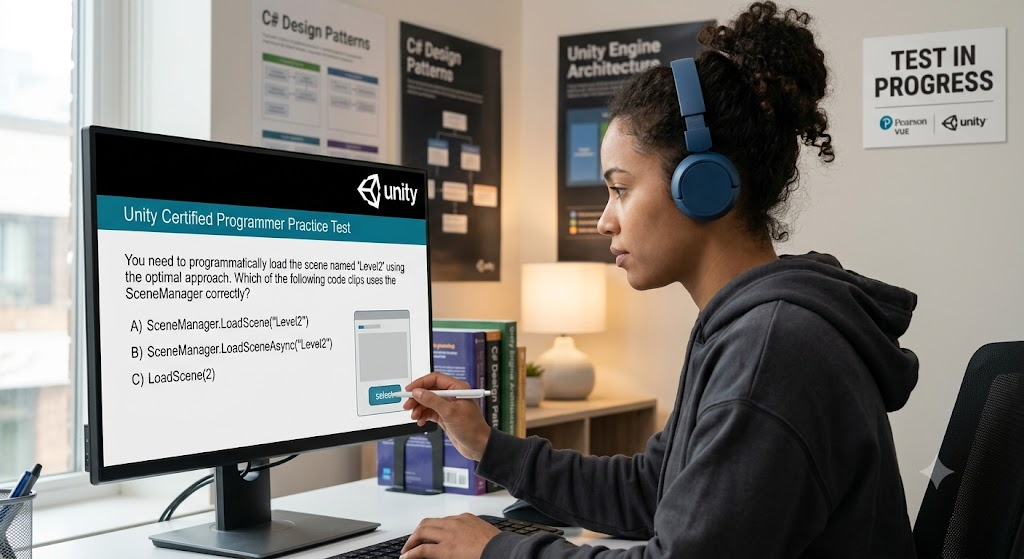
Additional Information
What the Course Entails and Exam Details
Preparing for the final certification requires understanding the core curriculum, often referred to as the exam objectives or syllabus. The content is rigorously structured and encompasses a wide range of professional-level programming competencies. Key pillars of knowledge include:
C# Programming Constructs: Understanding advanced C# features, scripting logic, data collections, and error handling.
Asset and Data Management: Managing game assets, ScriptableObjects, and understanding memory optimization.
Graphics and Rendering: Interfacing with the visual pipeline, shader fundamentals, and post-processing systems.
Core Game Mechanics: Implementing physics, AI navigation, input systems, and complex player controls.
Scene and Level Design: Programmatic creation of levels, loading scenes, and managing game state transitions.
Performance Optimization: Diagnosing bottlenecks, memory leaks, and optimizing for specific target platforms.
Team Collaboration and Tools: Utilizing version control (Git), understanding professional workflow management, and Unit Testing.
Mathematics for Interactive Development: Applying vectors, quaternions, matrix operations, and trigonometric functions to game logic.
What to Expect in the Final Exam
The final Unity Certified Programmer exam is a formidable test of theoretical knowledge and practical application. Candidates should not expect a simple memory test. Instead, the exam requires analyzing problems and selecting the best programmatic solutions within the Unity engine environment.
Format: The exam typically uses a linear format featuring a mix of multiple-choice, multiple-response, and matching question types. Many questions are based on real-world development scenarios, presented as short case studies or visual problems that require you to interpret code clips, identify errors, or choose the optimal API method.
Practical Component: While not a "live coding" environment, the exam often includes performance-based questions that ask you to interact with a simulated Unity IDE or choose a correct code path for a specific visual outcome.
Number of Questions: You can generally expect between 60 to 70 questions.
Time Limit: The total time allotted is usually 90 minutes.
Passing Score: The passing score is 700 on a scale of 100 to 1000. This is a scaled score, not a direct percentage, but it reflects a high standard of competence.
How to Study and Exam Centers
To succeed on the Certified Programmer exam, your study strategy must be multi-faceted and combine theoretical study with extensive hands-on practice.
Effective Study Methods:
Start with the Syllabus: Download the official "Exam Objectives" document from Unity's website. It is your ultimate checklist. Do not skip any section.
Official Unity Courseware: Unity provides structured learning paths, specifically a "Professional Programmer" path that covers the required domains. This often includes coding challenges, assessments, and guided projects.
Simulate a Real-World Project: Take a small-to-medium concept and build it entirely. Focus on areas outside your comfort zone, such as setting up a complete UI system with events, managing a multi-scene architecture, and implementing local data storage.
Practice with Real Practice Tests: This is crucial. Use the Unity Certified Programmer Practice Test (the focus of this article) to familiarize yourself with the question types, pacing, and difficulty. A good practice test should provide detailed explanations for correct and incorrect answers.
Analyze Your Results: After taking a practice exam, focus your remaining study time only on the sections where you performed poorly.
Where and How to Take the Exam: Unity partners with Pearson VUE to administer its professional certifications globally. You can register for and take the exam in two ways:
In-Person Testing Centers: Pearson VUE operates thousands of physical authorized testing centers worldwide. You can locate a center near you via their website and schedule an appointment to take the exam in a proctored environment.
Online Proctored Exam (OnVUE): This is a convenient option that allows you to take the exam from your own computer at home or in an office. It requires a private space, a reliable internet connection, and a functional webcam and microphone. A remote proctor will verify your identity and monitor your entire session.
Job Opportunities from the Course
Achieving this certification can be a significant career accelerator, serving as a powerful differentiator in a competitive job market. Employers use this credential as a verification of technical competence for a wide range of positions.
Specific job titles and career paths this certification unlocks include:
Senior Unity Developer
Game Programmer (Generalist)
Technical Artist (Programming Focus)
Simulation and Training Developer
AI Programmer for Real-Time Apps
Performance and Optimization Engineer
Lead Unity Engineer
Interactive Media Programmer
AR/VR Application Developer
Frequently Asked Questions
Reviews
5.0
Based on 0 reviews
Leave a Review
No reviews yet. Be the first to review!