
Unity Certified User – Artist Certification Practice Exam
$69.00
- Buy to unlock unlimited access to all Quiz questions and Answers in this Quiz.
- After purchase you can print a PDF of the whole quiz at any point. The PDF will contain the questions and the correct answers.
About this Exam
The Unity Certified User – Artist Certification is an entry-level credential designed for aspiring digital artists who want to prove their proficiency in creating 2D and 3D content for games, interactive applications, and augmented and virtual reality (AR/VR) experiences using Unity.
It validates essential skills in asset management, scene design, lighting, cameras, and material implementation, providing a solid foundation for a career in real-time creation. This certification is ideal for students, recent graduates, and professionals making a career pivot, typically requiring approximately 150 hours of Unity software experience.
By earning this industry-recognized badge, you demonstrate to employers that you have the basic technical knowledge to succeed in entry-level art and design roles in the competitive game and real-time development industries.
Ready to test your knowledge?
Buy Now to Access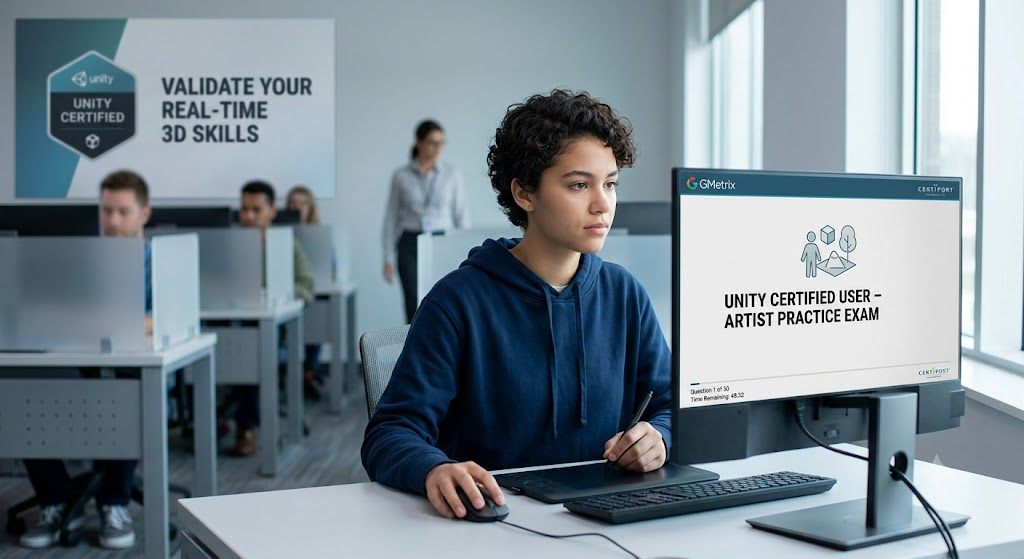
Additional Information
What the Course Entails and Exam Details
The course and exam cover fundamental aspects of the digital art pipeline within the Unity editor. Mastery of these skills proves you can contribute effectively to an interactive project. The major skill areas, or "Modules," include:
Module 1: Asset Management
Import and configure 2D and 3D assets, such as FBX and OBJ files, including setting up textures and materials.
Use the Unity Asset Store effectively to find and implement content.
Slice spritesheets for use in 2D scenes, including utilizing the Sprite Editor and 9-slicing techniques.
Identify essential mesh components like vertices, edges, and polygon faces.
Create and manage Prefabs for workflow efficiency and project organization.
Utilize the Animation window to create keyframes and manipulate animation curves in the Curve Editor.
Module 2: Scene Content Design
Master the Transform tools (Move, Rotate, Scale) and the Transform component in the Inspector.
Construct prototype scenes (whiteboxing/greyboxing) using Unity primitives and low-poly meshes to plan levels and interactivity.
Utilize the Terrain tool to create and sculpt landscapes, paint textures, and manage masks and material properties.
Module 3: Lighting, Cameras, and Materials Implementation
Apply and modify materials using the Standard Shader, adjusting properties like albedo, specular, normal maps, and transparency.
Implement basic lighting types, including directional, point, spot, and area lights, and adjust their settings (e.g., color, intensity, and shadows).
Configure a single-camera setup, choosing between isometric and perspective projections, and adjusting components like culling masks, clipping planes, field of view (FOV), and background.
Given specific scenarios, demonstrate knowledge of which rendering pipeline (e.g., Built-in, URP) should be selected.
What to Expect in the Final Exam
The final exam is a comprehensive assessment that often combines traditional question formats with performance-based scenarios. Candidates should expect the following details:
Exam Format: The exam primarily consists of multiple-choice and matching questions. Many of these are considered "performance-based," meaning they present a scenario within the Unity environment and ask the examinee to select the correct action or answer based on that visual and functional context.
Scoring: The exam is scored on a scale from 100 to 700. The standard passing score is 500.
Time Limit: You will generally have approximately 50 minutes to complete the entire exam.
Rules: The exam is a closed-book, proctored experience. No external study materials, personal devices, or internet searches are allowed during the test.
How to Study and Exam Centers
Effective preparation is key to success. For this entry-level exam, practical hands-on experience is paramount. Follow these actionable study strategies:
Actionable Study Strategies:
Hands-on Unity Experience: Aim for the recommended 150 hours of software use. Build small projects, practice all the actions listed in the exam objectives, and explore how changes in one tool (e.g., material settings) affect the final scene.
Utilize Official Courseware: Access any recommended learning materials. The search indicates specialized courseware is available and should be your primary study guide.
Leverage GMetrix CertPREP Practice Tests: The search confirms official practice tests, powered by GMetrix, are a core component of preparation. These offer two critical modes:
Training Mode: Provides a self-paced environment with step-by-step guidance and immediate feedback, allowing you to learn the material thoroughly.
Testing Mode: Simulates the actual exam experience with a timer and question format, helping you build time management skills and realistic expectations.
Study Objective by Objective: Systematically go through each module listed in Section 2 above and ensure you can perform every task.
Exam Centers:
The Unity Certified User – Artist exam is distributed globally through approved testing networks:
Online Portals: Many certifications can be taken remotely, proctored online.
Pearson VUE: The main test distribution partner. You can find Pearson VUE authorized testing centers in almost every major city.
Certiport: A partner focused on academic and commercial distribution, often used for online and institutional testing.
Authorized Schools and Physical Centers: Specific academic institutions or physical locations can be designated as testing sites. Check the Certiport or Pearson VUE websites to locate a center near you.
Job Opportunities from the Course
Successfully achieving the Unity Certified User – Artist certification can unlock various entry-level career paths. Here is a non-exhaustive list of specific job titles and career paths this certification validates your skills for:
3D Artist: Creating 3D objects, models, and environments and optimizing their visual performance.
2D Artist: Developing 2D assets, sprites, backgrounds, and optimizing graphics; potentially performing storyboard and concept art tasks.
Lighting Artist: Specializing in setting up and optimizing lighting, shadows, and post-processing effects (e.g., bloom, ambient occlusion, depth of field).
Visual Effects (VFX) Artist: Creating realistic or stylized visual effects such as fire, smoke, and explosions, and implementing physical properties.
Animator: Creating and optimizing motion for characters, objects, and ensuring motion and lighting interact effectively.
Technical Artist: Bridging the gap between art and programming, helping to implement and optimize assets within the final engine.
Game / Level Designer: Utilizing art skills for prototyping, whiteboxing, and environmental layout, translating gameplay mechanics into playable worlds.
Digital Artist: A broad term for creators across various non-game industries that utilize real-time technology, such as automotive visualization, architecture (AEC), and film/virtual production.
The Unity Certified User – Artist Practice Exam title is reflected in the following image, illustrating a student engaging with the official, simulation-based practice tools.
Frequently Asked Questions
Reviews
5.0
Based on 0 reviews
Leave a Review
No reviews yet. Be the first to review!