
University of Central Florida (UCF) ANT2511 The Human Species Practice Exam 1
$69.00
- Buy to unlock unlimited access to all Quiz questions and Answers in this Quiz.
- After purchase you can print a PDF of the whole quiz at any point. The PDF will contain the questions and the correct answers.
About this Exam
The UCF ANT2511 course, "The Human Species," is a compelling introduction to biological anthropology. This foundational course is designed for any University of Central Florida student interested in understanding the long and complex journey that led to modern humanity. It explores the core scientific principles of how our species evolved, adapted, and diversified. Whether you are an anthropology major starting your academic path or a non-major satisfying a general education requirement in the sciences, this course provides essential knowledge about our shared biological heritage. This practice exam is a crucial tool to help you measure your understanding of the initial concepts before the first major test.
Ready to test your knowledge?
Buy Now to Access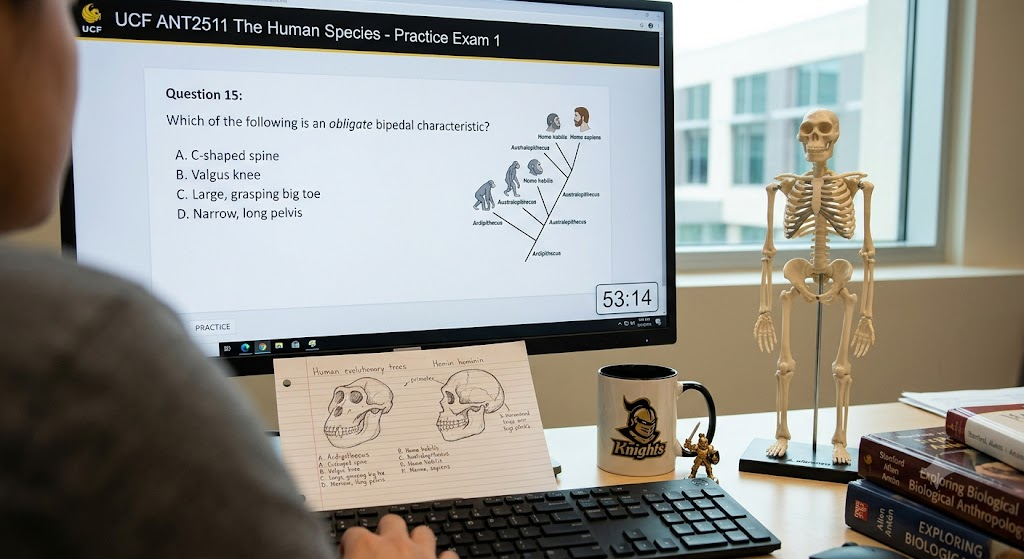
Additional Information
What the Course Entails and Exam Details
ANT2511 is a comprehensive exploration of human biological variety, both in the past and the present. The course syllabus typically covers five major thematic areas:
1. Evolutionary Theory and Genetics: Students learn the history of evolutionary thought, the principles of natural selection, and the basics of genetics, including Mendelian inheritance and population genetics, to explain how evolutionary change occurs.
2. Human Osteology and Variation: A critical component involves studying the human skeleton (mammalian osteology), directional terms, and how to identify cranial and post-cranial bones. This knowledge is applied to understanding modern human variation as an adaptation to different environments.
3. Non-Human Primates: The course investigates our closest living relatives, the primates. This includes their taxonomy, characteristics, behavior, and social structures, which provide essential insights into our common ancestry.
4. The Fossil Record and Hominin Evolution: This is the core of the course, tracing the timeline from the first human-like ancestors (hominins) to modern Homo sapiens. Key topics include bipedalism, brain expansion, tool use, migration, and the emergence of diverse hominin species.
5. Applied Biological Anthropology: Students learn how this knowledge is utilized in specialized fields, such as forensic anthropology and bioarchaeology.
As a UCF General Education Program (GEP) course, ANT2511 emphasizes information literacy, critical thinking, and the application of scientific methods. Practice Exam 1 will focus specifically on the material from the initial modules, which often include the introduction to anthropology, evolutionary history, genetics, and primate characteristics.
What to Expect in the Final Exam
While every instructor structures their class slightly differently, the exams in UCF ANT2511 are typically non-cumulative, meaning each test covers a specific set of new modules. For Practice Exam 1, you should anticipate a similar online format, designed to be completed within a specific timeframe, such as 60 to 90 minutes.
Expect a mixture of question types, primarily focused on objective assessment:
Multiple Choice: Selecting the single best answer from a list.
True/False: Determining the validity of statements.
Matching: Linking terms with their definitions or characteristics.
Diagram Identification: Identifying specific bones, evolutionary relationships, or genetic concepts.
A "passing score" for a practice exam is entirely self-determined, but a good target is 70% to 80% or higher. This indicates a robust grasp of the material and helps identify precise areas where you need further review before the real graded exam.
How to Study and Exam Centers
Preparation for ANT2511 exams requires active engagement with the course material. Success often depends less on rote memorization and more on understanding the conceptual connections.
Actionable Study Strategies:
Prioritize Lecture Notes: Based on student feedback, the professor’s lectures are the most critical resource. Create organized summaries of every lecture, focusing on terms, concepts, and diagrams presented in class.
Master the Vocabulary: Biological anthropology uses precise terminology. Make flashcards for every new term, especially regarding osteology, genetics, and primate taxonomy.
Complete All Quizzes: If your course includes low-stakes module quizzes, use them as your first line of practice. Many instructors draw exam questions directly from or model them after these quizzes.
Engage with the Text: If an Open Educational Resource (OER) textbook like "Explorations" is assigned, read the relevant sections to reinforce the lecture content. Do not use it as your sole source but as a supplementary tool.
Form Study Groups: Collaborating with peers is highly effective. You can quiz each other, discuss complex ideas, and share study resources.
Take Practice Exams Seriously: Simulate actual exam conditions. Set a timer, remove distractions, and try to answer all questions without notes before checking your answers.
Exam Centers and Access:
For the vast majority of students taking ANT2511, exams, including the final exam, are conducted online through the university's learning management system, Webcourses@UCF (Canvas). You will receive a specific time window, often 24 to 48 hours, during which you can start the timed exam.
It is extremely rare for a large introductory lecture course to require physical testing at a specialized center like Pearson VUE. The default expectation is an at-home, online examination.
Job Opportunities from the Course
A strong performance in ANT2511 can be the first step towards numerous diverse and impactful career paths in the sciences and social sciences. While many of these require advanced degrees, the course unlocks a broad spectrum of opportunities:
Biological Anthropologist
Paleoanthropologist
Forensic Anthropologist
Bioarchaeologist
Primatologist
Primate Enrichment Specialist
Osteologist
Human Variation Researcher
Genetic Counselor
Epidemiologist / Public Health Officer
Museum Curator or Exhibit Designer
Zookeeper / Wildlife Conservationist
Medical Illustrator
College Professor / Academic Researcher
Science Writer / Educator
Frequently Asked Questions
Reviews
5.0
Based on 0 reviews
Leave a Review
No reviews yet. Be the first to review!