
University of Central Florida (UCF) ANT2511 The Human Species Practice Exam 2
$69.00
- Buy to unlock unlimited access to all Quiz questions and Answers in this Quiz.
- After purchase you can print a PDF of the whole quiz at any point. The PDF will contain the questions and the correct answers.
About this Exam
Welcome to your essential resource for mastering the UCF ANT2511 The Human Species course. This foundational biological anthropology course takes a deep dive into the evolutionary journey of our species, exploring the mechanisms that shape human variation and our place within the primate order. Our Comprehensive Practice Exam 2 is designed specifically for University of Central Florida students seeking to validate their knowledge, identify critical study gaps, and build the confidence necessary to excel in the second major assessment and the final exam. Whether you're tracking ancient ancestors or decoding genetic patterns, this practice guide is an indispensable tool for achieving academic success in this captivating subject.
Ready to test your knowledge?
Buy Now to Access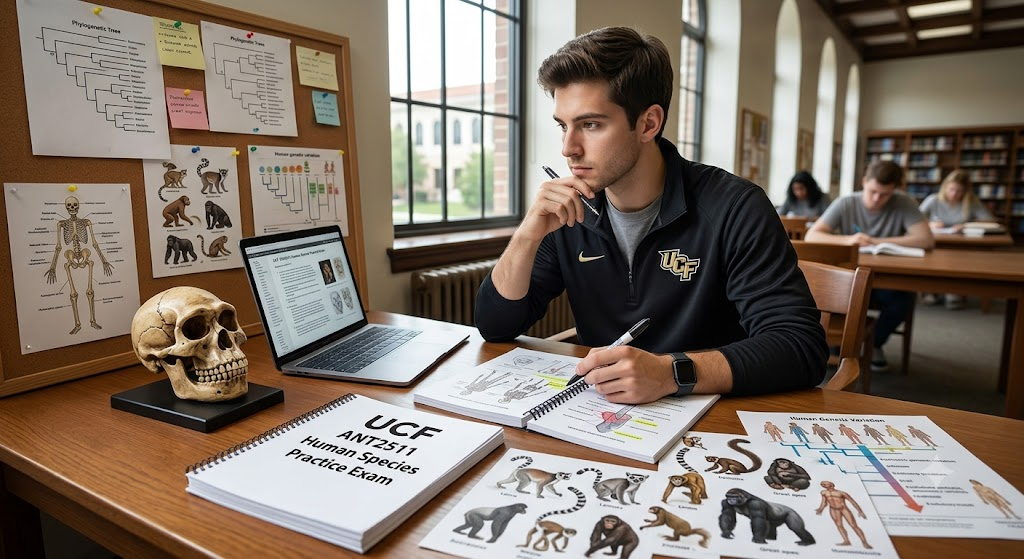
Additional Information
What the Course Entails and Exam Details
UCF ANT2511 The Human Species covers a wide range of topics related to biological anthropology, focusing on the dynamic processes that have influenced the development of humanity. The core curriculum typically addresses areas such as the principles of evolution, basic genetics and heredity, and human skeletal biology. You will also explore primate anatomy, behavior, and the fossil evidence for human evolution, tracing the lineages that lead from ancient hominins to modern Homo sapiens.
Exam 2 usually builds upon the foundations established earlier in the semester. It will deeply probe your understanding of primate evolution and diversity, hominin development, and the significance of biological and cultural adaptations. Expect questions on specific hominin species (e.g., Australopithecus, Homo habilis, Homo erectus), dating methods, and key anatomical changes over time, including bipedalism and encephalization. The exam is structured to test not only your factual recall but also your ability to synthesize biological concepts and evolutionary theory.
What to Expect in the Final Exam
While formats can vary, the official midterm and final exams for UCF ANT2511 are typically robust. They consist primarily of multiple-choice questions, which evaluate knowledge across the full breadth of the syllabus. However, students should also prepare for potential variations, which might include True/False questions, fill-in-the-blank terminology, or perhaps identification of skeletal casts.
The exam aims to assess your comprehensive grasp of biological anthropology concepts, asking you to apply knowledge in different scenarios. For instance, you might interpret genetic crosses, identify primate features from images, or place hominin finds in correct chronological contexts. While the practice exam environment is flexible, your actual university exam will be timed (often matching a class period, e.g., 50-75 minutes) and proctored. Understanding the time constraints is a key part of your final exam preparation.
How to Study and Exam Centers
Effective preparation requires a multi-faceted approach. Start by actively engaging with your course lectures and detailed readings. Create clear summaries of key terms, mechanisms like natural selection, and detailed timelines of hominin evolution. Utilize diagrams to visualize primate traits and human skeletal changes. Active recall, through methods like flashcards for definitions and primate group features, is highly effective. Review previous quizzes and focus heavily on concepts emphasized in your instructor's review sessions. Take our Comprehensive Practice Exam 2 multiple times under timed conditions to improve your recall speed and stamina, while identifying weaker areas for focused study. Collaborate with peers to discuss complex topics.
For information on taking your official ANT2511 exams, consult the official UCF course syllabus and announcements from your instructor. These examinations are administered directly by the University of Central Florida, usually in a scheduled classroom setting or via official university online platforms (e.g., Webcourses using digital proctoring tools). They are not available through external testing centers like Pearson VUE, which are used for separate professional certifications rather than individual university course credits. Always confirm specific exam locations, dates, and required identification procedures through your official UCF student account and communication channels.
Job Opportunities from the Course
A strong foundation in biological anthropology provided by courses like ANT2511 can lead to diverse and rewarding career paths. While many require advanced degrees, the skills in critical thinking, biological analysis, and evolutionary understanding developed here are highly transferable. Potential careers include:
Biological Anthropologist (Advanced Study Required)
Primate Conservationist
Skeletal Biologist/Osteologist
Museum Curator or Educator in Anthropology and Natural History
Genetics Counselor Assistant (Pathway to Advanced Role)
University or College Professor (Ph.D. typically required)
Forensic Anthropologist (Requires extensive specialization)
Science Educator or Science Communicator
Health Sciences Researcher (With further study)
Archaeology Technician (Many projects involve both cultural and biological remains)
Anthropology and Biology Lab Assistant
Zoo or Primate Center Specialist
Cultural Resource Management (CRM) Specialist (Where biological analysis is needed)
Policy Analyst in Public Health or Genetics-related Fields
Data Analyst in Evolutionary Biology Research Projects
The deep understanding of the human species, variation, and evolutionary processes provides a unique perspective valuable across educational, scientific, research, and conservation organizations.
Frequently Asked Questions
Reviews
5.0
Based on 0 reviews
Leave a Review
No reviews yet. Be the first to review!