
University of Central Florida (UCF) AST2002 Astronomy Final Practice Exam
$69.00
- Buy to unlock unlimited access to all Quiz questions and Answers in this Quiz.
- After purchase you can print a PDF of the whole quiz at any point. The PDF will contain the questions and the correct answers.
About this Exam
The UCF AST2002 Astronomy course, "Introduction to Astronomy," is a captivating, foundational survey designed for students of all academic backgrounds. It offers a modern overview of the Universe, our place within it, and the scientific processes we use to understand the cosmos. This final practice exam is a powerful study tool created for students enrolled in AST2002 who are determined to consolidate their learning and achieve peak performance on the cumulative final exam. This practice test helps students assess their understanding of a wide range of topics, from planetary science to cosmology, in preparation for the culminating assessment of the course.
Ready to test your knowledge?
Buy Now to Access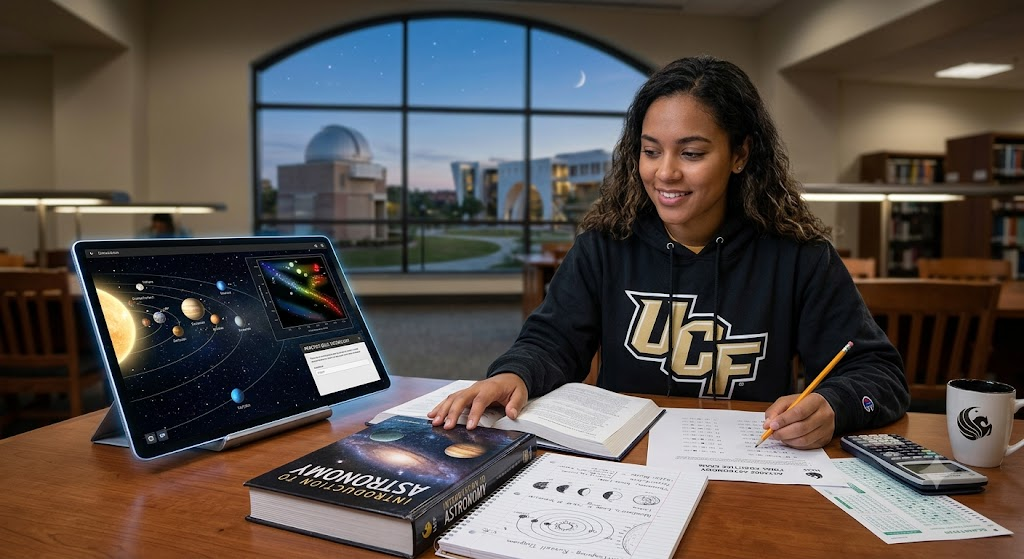
Additional Information
What the Course Entails and Exam Details
This comprehensive course, worth 3 credits, provides an engaging examination of our Universe. The AST2002 curriculum covers a broad range of core topics, including the scale and history of the Universe; patterns in the night sky; the reason for seasons; phases of the Moon; and the history of astronomical science. Students explore the principles of Newton’s Laws, conservation laws, gravity, light, and telescopes. A major segment details the formation, structure, and dynamics of our Solar System, including terrestrial planets, Jovian planets, satellites, and small bodies like asteroids and comets. Beyond our home, the course delves into exoplanets, the Sun, stellar properties and the Hertzsprung-Russell diagram, star clusters, the evolution of low and high-mass stars, including endpoints like white dwarfs, neutron stars, and black holes. Finally, it explores our Milky Way galaxy, the broader universe of galaxies, the birth of the universe, dark matter, dark energy, and the intriguing search for life in the universe. The final practice exam is designed to mimic the comprehensive nature of the actual final exam.
What to Expect in the Final Exam
The actual AST2002 final exam is a cumulative, in-person assessment, typically weighted heavily, often up to 40% of the final course grade. Students can expect a testing experience similar to the course's midterms, consisting of approximately 40 to 45 multiple-choice questions, which may include matching and true/false formats. A significant number of questions, around 10, may require the use of a scientific calculator for mathematical manipulations involving astronomical distances, units, and principles. The exam is closed-book, and students are required to bring their UCF ID, PID, a scientific calculator, a #2 pencil, and a Scantron, which is sometimes available for free through the UCF Student Government.
How to Study and Exam Centers
Effective preparation for the cumulative final requires a multi-faceted approach. First, prioritize mastering all lecture content, which is the primary source for the exam. Review every single lecture slide set, focusing on key terms, processes, and quantitative examples, particularly those from the official "Study Guides" provided by instructors. Read all assigned chapters from the official textbooks (often specified parts of The Essential Cosmic Perspective or the OpenStax astronomy book). Form study groups to practice answering varied question types, paying special attention to calculation-based problems and brain-teasers. Re-solve all previous midterm exams and homework assignments to identify knowledge gaps. This final practice exam should be used to simulate test conditions and identify weak areas for targeted study. The actual final exam is held physically in a designated classroom on the UCF main campus during the University's official final exam week. Verify the specific location and time via the official class announcements and university schedule.
Job Opportunities from the Course
While an introductory astronomy course like AST2002 does not directly unlock professional certifications, it serves as a critical first step towards a variety of careers. Successful completion, as part of a science or natural world intellectual foundation, demonstrates critical thinking, quantitative reasoning, and scientific inquiry—skills valued in any profession. For students who go on to pursue specialized degrees in physics, astronomy, or a related science, this course is a essential building block for the following career paths:
Research Astronomer
Astrophysicist
University Professor
NASA Research Scientist
Observatory Support Personnel
Telescope Operator
Planetarium Director
Science Journalist or Writer
Aerospace Engineer
Data Scientist
Meteorologist
Climatologist
Science Teacher (K-12 with certification)
Frequently Asked Questions
Reviews
5.0
Based on 0 reviews
Leave a Review
No reviews yet. Be the first to review!