
University of Central Florida (UCF) BOT3015 Principles of Plant Science Practice Exam 1
$69.00
- Buy to unlock unlimited access to all Quiz questions and Answers in this Quiz.
- After purchase you can print a PDF of the whole quiz at any point. The PDF will contain the questions and the correct answers.
About this Exam
The UCF BOT3015 Principles of Plant Science Practice Exam 1 is a foundational assessment designed for students enrolled in the Principles of Plant Science course at the University of Central Florida. This practice exam serves as a critical study tool to help undergraduates, often majoring in biology, environmental science, or related fields, gauge their understanding of essential plant biology concepts early in the semester. It is designed to simulate the format and challenge of the official in-class Exam 1.
The primary audience is UCF students who are aiming to reinforce their knowledge, identify knowledge gaps, and build confidence before taking the actual high-stakes exam that contributes significantly to their final course grade.
Ready to test your knowledge?
Buy Now to Access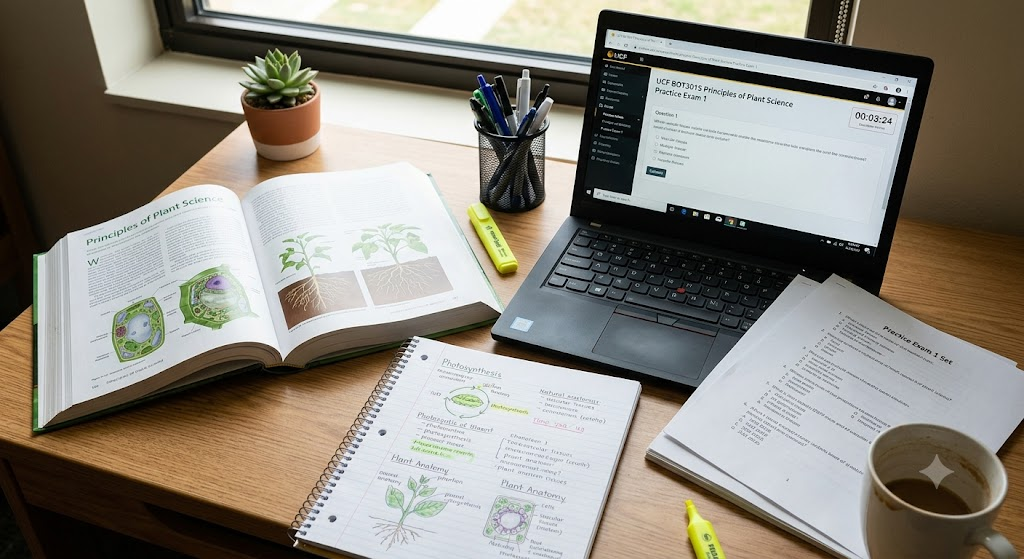
Additional Information
What the Course Entails and Exam Details
The underlying course, BOT3015 Principles of Plant Science, is a comprehensive introduction to the biological study of plants. The curriculum is structured to build from the cellular level up to whole-plant function and ecological relevance.
This Practice Exam 1 specifically covers the initial core topics discussed in the first few weeks of the semester. These fundamental areas include:
Plant Cell Structure and Function: Understanding the unique organelles of plant cells, such as the cell wall, chloroplasts, central vacuole, and plasmodesmata, and how they differentiate plants from other organisms.
Plant Anatomy and Tissues: Distinguishing between different types of plant tissues, including dermal, ground, and vascular tissues (xylem and phloem), and their roles in plant growth and transport.
Fundamental Plant Physiology: Key metabolic processes like photosynthesis (light-dependent and light-independent reactions) and respiration are central to this section.
The Scientific Method in Botany: Understanding how biological questions about plants are formulated and tested through experimentation.
The practice exam typically mirrors the level of detail and critical thinking required in the official course, challenging students to apply concepts rather than just recall definitions.
What to Expect in the Final Exam
While this is a practice exam, it is designed to align with the structure of the official University of Central Florida BOT3015 Exam 1.
The format is usually a computer-based or paper-based test consisting of:
Multiple Choice Questions: These form the majority of the exam and test conceptual knowledge, ability to differentiate related terms, and application of biological principles.
Short Answer/Diagram Labeling: Students may be required to label diagrams of plant cells, tissues, or physiological processes, and to provide brief explanations of specific functions.
Time Limit: Similar to the in-class exam, this practice test often comes with a suggested time limit (e.g., 50–75 minutes) to encourage students to practice time management.
Scoring: A passing score is not strictly defined for the practice exam itself, as it is a diagnostic tool. However, standard UCF grading applies to the final class, where a score below 60–70% on the final Exam 1 often signals a need for significant additional study.
This structure allows students to practice not only the content but also the pacing required for success on test day.
How to Study and Exam Centers
How to Study for UCF BOT3015 Exam 1
Achieving success on this exam requires active engagement with the material.
Utilize Lecture Material: This is your primary source. Review lecture slides, your personal notes, and any "learning objectives" provided by the instructor for the first unit. Pay close attention to definitions, diagrams, and processes.
Actively Engage with Textbooks: Read the assigned chapters in the textbook. Rather than passive reading, create outlines, flashcards, or concept maps for complicated topics like the Calvin cycle or tissue classification.
Practice Drawing Diagrams: Practice drawing and labeling a plant cell, the internal structure of a leaf, and the process of water transport from memory. Visualizing these structures is highly effective.
Form a Study Group: Collaborating with peers from your UCF lecture can clarify difficult concepts. Explaining a topic to someone else is a powerful way to reinforce your own understanding.
Use the Practice Exam as a Diagnostic: Take the practice exam under timed conditions after you have studied. Identify the questions you missed and, more importantly, why you missed them. Was it a lack of knowledge, a misinterpretation, or a rushed decision?
Exam Centers and How to Take the Practice Exam
As a practice test for a specific UCF course, this is not administered via major public testing centers like Pearson VUE.
Online Course Portal (Webcourses@UCF): The most common location for practice materials, including this practice exam, is within the BOT3015 course shell on Webcourses@UCF. Instructors often post previous years' exams or specifically created review quizzes here.
Instructor-Provided Handouts: Occasionally, practice questions or whole exams may be distributed during lecture as physical handouts.
Teaching Assistant (TA) Review Sessions: TAs often hold review sessions before Exam 1 and may distribute or work through practice exam questions in these sessions.
Students must ensure they are properly enrolled in the course and have active access to Webcourses to utilize this practice material.
Job Opportunities from the Course
Completing BOT3015 Principles of Plant Science provides the necessary foundational biology knowledge for a wide array of career paths related to plant science, agriculture, and environmental conservation. Success in this entry-level course is the first step toward specialized fields.
Career paths unlocked or supported by proficiency in this content include:
Botanist
Plant Biologist
Agricultural Scientist / Agronomist
Conservation Biologist
Horticulturalist
Plant Geneticist
Plant Ecologist
Extension Agent (Agricultural Services)
Environmental Consultant
Science Educator (K-12 or higher education)
These fields exist in various sectors, including governmental agencies (e.g., USDA, EPA), private biotechnology firms, non-profit environmental organizations, and academic research institutions.
Frequently Asked Questions
Reviews
5.0
Based on 0 reviews
Leave a Review
No reviews yet. Be the first to review!