
University of Central Florida (UCF) BSC1005 Biological Principles Practice Exam 2
$69.00
- Buy to unlock unlimited access to all Quiz questions and Answers in this Quiz.
- After purchase you can print a PDF of the whole quiz at any point. The PDF will contain the questions and the correct answers.
About this Exam
The UCF BSC1005 Biological Principles course is designed as an engaging introduction to the essential concepts of biology, specifically tailored for students not majoring in the life sciences. It provides a comprehensive foundation in the rules governing living systems, from cellular structure to global ecosystems. This specific BSC1005 Biological Principles Practice Exam 2 serves as a vital assessment tool for students navigating the middle portion of the semester. It is engineered to help learners evaluate their mastery of core physiological and metabolic concepts before facing their final unit exam. The practice material is indispensable for those in various academic paths—including nursing pre-requisites, allied health fields, or general education—who must prove their competency in fundamental biological knowledge.
Ready to test your knowledge?
Buy Now to Access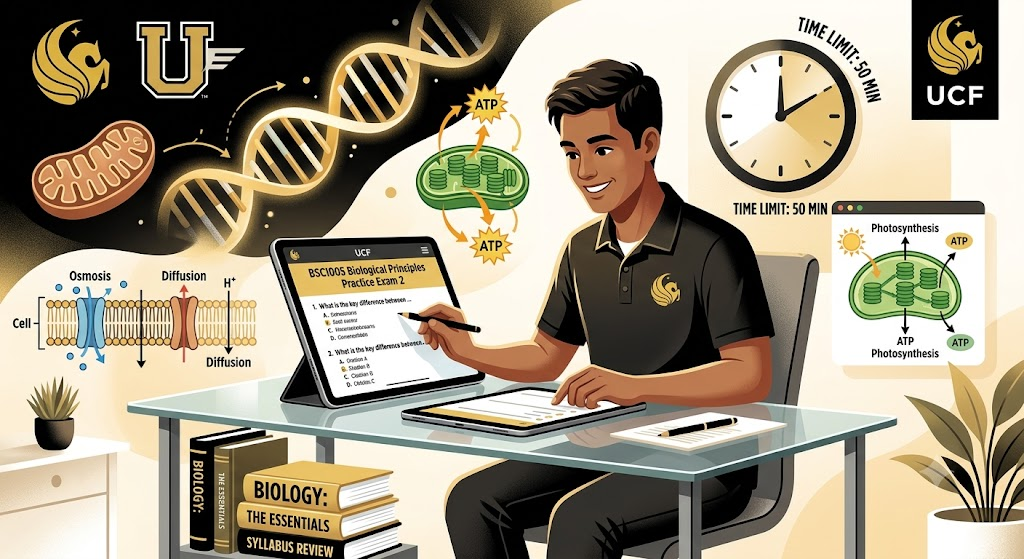
Additional Information
What the Course Entails and Exam Details
This section of the BSC1005 course builds upon the basic themes of life by diving deep into the intricate mechanisms that allow cells to capture, convert, and use energy. The core focus of the unit that Exam 2 covers is Energy Flow in Living Systems and Metabolism. Students exploring this module will engage with a syllabus that covers a breakdown of cellular respiration, the complex light-dependent and Calvin cycle reactions of photosynthesis, the function and regulation of enzymes, and the structures involved in these energetic pathways, such as mitochondria and chloroplasts. Furthermore, it may include crucial understanding of cellular transport mechanisms like diffusion and osmosis, and introductory principles of how genes direct cellular function through protein synthesis and introductory gene regulation. The practice exam details aim to mirror the actual unit exam's structure, offering multiple practice questions to build familiarity and speed.
What to Expect in the Final Exam
While the exact final unit exam can vary slightly, students must be prepared for a definitive format. UCF’s BSC1005 exams typically consist of approximately 40 multiple-choice questions derived from lecture materials, recommended textbook readings, chapter quizzes, and active learning assignments. Each exam is unit-specific and non-cumulative, making the focus on the specified topics absolute. You should expect questions that test both recall of key terms and your ability to apply concepts to real-world scenarios. Students generally have the standard class duration (e.g., 50 to 75 minutes) to complete the test. A critical detail is that passing requirements generally demand a thorough understanding of the material to achieve the standard university-wide letter grade boundaries (A, B, C, etc.); some instructors do not round up, and there are typically no extra credit opportunities on individual exams. Students must bring a valid photo ID and a specific type of scantron (the 'raspberry' version from the UCF bookstore is often specified).
How to Study and Exam Centers
Effective preparation for this critical unit requires an active, structured approach. Your study strategy should prioritize merging your lecture notes with chapter summaries and the specific learning objectives provided in the syllabus. Creating concept maps to visualize the relationship between metabolic pathways (e.g., the input and output of glycolysis versus the citric acid cycle) is highly recommended. You must utilize the weekly quizzes and previous assignments in UCF’s Webcourses, treating them as low-stakes practice. For this BSC1005 practice exam, time yourself during attempts to simulate actual test conditions. The physical exam center for your actual unit exam is almost always your regularly scheduled lecture hall or, for online-asynchronous sections, an designated testing center on a UCF campus, such as the main campus or a regional location. Online versions of practice materials can be taken via UCF Webcourses. For official placement or CLEP-style testing related to biological principles, specific authorized schools or testing centers like Pearson VUE would be utilized, but for regular course exams, trust the specific instructor’s directions and UCF’s official campus facilities.
Job Opportunities from the Course
While completing BSC1005 and its related practice exams is a prerequisite step and not a final certification, the knowledge and the pathway it contributes to unlock a range of essential careers, particularly as foundational learning for professional programs. This course is an indispensable stepping stone for numerous rewarding paths, including:
Registered Nurse (RN) / Licensed Practical Nurse (LPN): Where this course serves as a core general science and physiology pre-requisite.
Clinical Laboratory Technician: For entry-level roles supporting diagnostic services.
Veterinary Technician: Applying biological principles to animal care.
Healthcare Administrative Support: For roles requiring a foundational vocabulary in life sciences.
Pharmacy Technician: Understanding cellular responses is a necessary foundation.
Phlebotomist: Biological principles aid in understanding patient physiology.
Biology Education Assistant: Assisting in primary or secondary science classrooms.
Occupational Therapy Assistant: Fundamental knowledge of body systems is required.
Physical Therapy Assistant: A prerequisite for advanced study in movement science.
Respiratory Therapist: Building blocks for respiratory physiology.
Public Health Educator: Communicating basic science concepts to the public.
Frequently Asked Questions
Reviews
5.0
Based on 0 reviews
Leave a Review
No reviews yet. Be the first to review!