
University of Central Florida (UCF) BUL3130 Legal and Ethical Environment of Business Practice Exam 2
$69.00
- Buy to unlock unlimited access to all Quiz questions and Answers in this Quiz.
- After purchase you can print a PDF of the whole quiz at any point. The PDF will contain the questions and the correct answers.
About this Exam
Welcome to your essential roadmap for the University of Central Florida (UCF) BUL3130 Legal and Ethical Environment of Business Practice Exam 2. This practice exam is designed to be a comprehensive and realistic assessment of your understanding of a critical subset of business law and ethical concepts. It serves as a pivotal checkpoint for undergraduate business majors—who are often juniors or above—preparing for their mid-semester examination.
By simulating the environment and content of the actual test, this practice exam helps students master fundamental legal principles, legal reasoning, and ethical frameworks necessary to navigate the complex world of modern business operations. It is an invaluable resource to sharpen critical thinking skills and build the confidence required to succeed in one of the primary core requirements of the UCF College of Business.
Ready to test your knowledge?
Buy Now to Access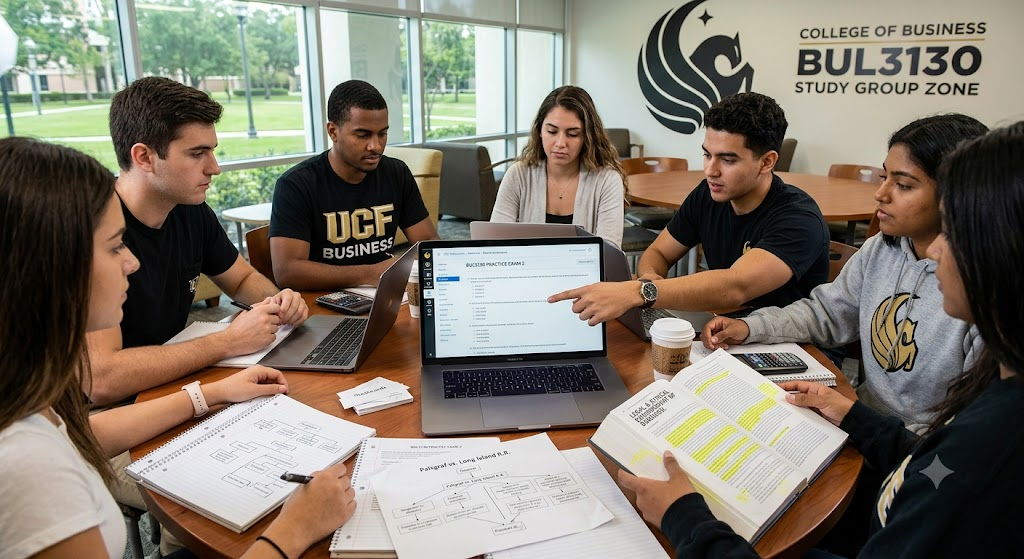
Additional Information
What the Course Entails and Exam Details
The BUL3130 course, the Legal and Ethical Environment of Business, provides students with an introduction to the law as it relates to and impacts the operations of business. The course is an analysis of the law as a dynamic, social, and political institution.
For Practice Exam 2, the content generally shifts focus from foundational legal systems to substantive areas of law. Students should expect intense coverage and assessment on the following core topics:
Torts: A primary focus, including a detailed exploration of negligence, intentional torts, strict liability, and corresponding defenses (e.g., comparative negligence, assumption of risk).
The Law of Contracts: Essential principles of contract formation, performance, and breach, including an introduction to the Uniform Commercial Code (UCC).
Criminal Law in Business: Corporate criminal liability, white-collar crime, and relevant constitutional protections.
Property Law: Introduction to real, personal, and intellectual property (e.g., trademarks, patents, copyrights).
Ethical Decision Making: Analyzing business dilemmas through various ethical theories and frameworks.
The purpose of this practice exam is to test your ability to not only recall these definitions but to apply them to specific fact patterns, simulating the application-based nature of the real examination.
What to Expect in the Final Exam
The real UCF BUL3130 mid-semester exam, which this practice exam mirrors, typically takes place during your scheduled class time. Students should prepare for a rigorous assessment that challenges their comprehension of the course materials.
Expected Format: Multiple Choice and True/False questions. The test is often closed-book and closed-notes, requiring thorough pre-examination study. While the final exam might be comprehensive and span over 100 points, Exam 2 generally focuses on the current 4-6 chapters covered since the previous test.
Time Limits: For mid-semester exams, students are typically allotted the standard class period, usually 75 minutes.
Proctoring and Specific Rules: The exam will likely be administered through your UCF Webcourses (Canvas) portal. For in-person sections, this often means bringing a laptop to class to access the secure testing environment. Strict rules regarding academic integrity and approved aids will apply; generally, only a pen/pencil and blank scratch paper are permitted. Any deviation is handled according to the UCF Golden Rule.
How to Study and Exam Centers
The key to success on the BUL3130 exam is active, application-based studying. Here are actionable strategies to prepare:
Practice with Multiple Attempts: If the practice exam is available through Webcourses, take it multiple times. This helps you identify weak points and become familiar with the phrasing of questions.
Prioritize Your Lecture Notes: Professors often stress the significance of specific cases or stories told in class; these are highly probable exam questions. If a professor highlights an "A" question, take extra note.
Engage with the "Palsgraf" Cases: For tort law, understand the nuance of classic cases (like Palsgraf). Practice drawing diagrams to illustrate concepts like 'realm of thought' and 'proximate cause.'
Active Reading and Recall: Don't just read the textbook; summarize concepts. Create flashcards for key terms, definitions, and rule-based tests (e.g., the four elements of a contract).
Exam Centers: The primary exam is taken during your scheduled class time, making your classroom the designated testing area, or via your personal computer in a secure location if a distance learning section. For specialized proctoring needs (e.g., through Student Accessibility Services), exams may be scheduled at a university-authorized facility such as the University Testing Center (UTC) on the main campus.
Job Opportunities from the Course
Successfully mastering the legal and ethical principles of business isn't just about passing a class; it’s a prerequisite for any leadership position. This course, as a part of the core UCF Business curriculum, builds the baseline knowledge required for diverse and rewarding career paths:
Management Trainee / Operations Manager
Human Resources Specialist / Manager
Compliance Officer
Healthcare Administrator
Corporate Ethics Advisor
Risk Management Specialist
Government Relations Manager
Sales and Contract Administrator
Entrepreneur / Small Business Owner
Mastery of this material demonstrates a sophisticated understanding of a business's external environment, an essential skill for long-term career growth.
Frequently Asked Questions
Reviews
5.0
Based on 0 reviews
Leave a Review
No reviews yet. Be the first to review!