
University of Central Florida (UCF) CHM2045C Chemistry Fundamentals I Practice Exam 1
$69.00
- Buy to unlock unlimited access to all Quiz questions and Answers in this Quiz.
- After purchase you can print a PDF of the whole quiz at any point. The PDF will contain the questions and the correct answers.
About this Exam
University of Central Florida's (UCF) CHM2045C, Chemistry Fundamentals I, is the foundational gateway for students aspiring to careers in engineering, medicine, biology, and all other physical sciences. This course is designed to provide a rigorous and thorough introduction to the core principles of chemistry, moving beyond simple introductory concepts to critical, analytical problem-solving. Practice Exam 1 is a critical diagnostic tool. It is specifically crafted for students already enrolled in CHM2045C who need to assess their understanding of the first several weeks of material before the first high-stakes midterm. This practice test mimics the structure and difficulty of the actual exam, offering invaluable insights into both key content gaps and test-taking speed.
Ready to test your knowledge?
Buy Now to Access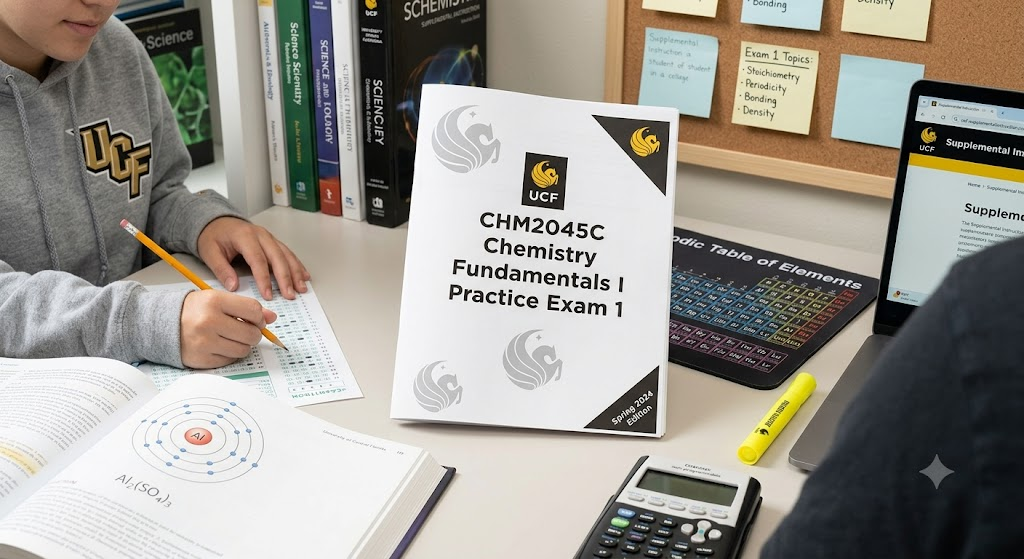
Additional Information
What the Course Entails and Exam Details
CHM2045C focuses on building a deep conceptual understanding of matter and its interactions. Practice Exam 1 specifically targets the fundamental topics covered in the initial portion of the syllabus. Students can expect to be tested on their mastery of:
The Scientific Method and Measurement: Applying dimensional analysis and using the metric system for precise units and conversions.
Classification of Matter: Differentiating between pure substances (elements and compounds) and mixtures (homogeneous and heterogeneous).
Atomic Theory and Structure: Demonstrating knowledge of subatomic particles, isotopes, and atomic mass calculations.
The Periodic Table: Understanding organization and identifying major groups.
Molecules, Ions, and Compounds: Naming ionic and molecular compounds using specific nomenclature rules.
Stoichiometry: Mastering the mole concept, molar mass, and basic chemical formula calculations, such as percentage composition and empirical formulas.
Physical and Chemical Properties/Changes: Correctly identifying examples of extensive/intensive properties and physical/chemical changes.
Practice Exam 1 typically mirrors the actual 50-minute, multi-chapter midterm. It is a computer-graded, multiple-choice assessment, challenging students to apply algebraic skills and reasoning to solve calculation-based and conceptual problems.
What to Expect in the Final Exam
While Practice Exam 1 is a key stepping stone, it is a crucial preparation for the course’s cumulative challenge: the Final Exam. In CHM2045C, the cumulative final is a standardized exam produced by the American Chemical Society (ACS). This powerful assessment requires you to integrate knowledge from all four midterms and seven quizzes. The format is 70 multiple-choice questions, and you are given a strict 110-minute time limit to complete it. It demands a sophisticated level of critical thinking and time management. Performing well on your midterm practice exams, starting with Exam 1, is the most effective strategy for ensuring you have the comprehensive knowledge base needed for the final, ACS-standardized test.
How to Study and Exam Centers
Effective preparation for UCF’s CHM2045C Practice Exam 1 hinges on active learning. This is not a test you can memorize your way through. To succeed, integrate these strategies:
Take the Official Practice Exam: Go through the official practice material provided by your instructor or the UCF Supplemental Instruction (SI) program first. Use it to identify your weakest areas.
Work End-of-Chapter Problems: The key to mastering stoichiometry and calculations is repetition. Work as many recommended problems from your OpenStax textbook as possible. Do not just read the solutions; solve them.
Attend Supplemental Instruction (SI) and Office Hours: Utilize the free resources UCF offers. SI sessions provide structured peer-led review and specific practice question sets for each exam. Your professor’s office hours are invaluable for clear, direct clarification on difficult concepts.
Simulate Exam Conditions: When taking a practice exam, give yourself exactly 50 minutes and use only an approved, non-programmable calculator. This will train you for the pace of the real test.
Access to practice exams and the official testing procedures are managed through your section's Webcourses@UCF (Canvas) portal. While the official practice exam is taken online, your instructor will provide specific details on where to find it. The four midterm exams, including the real Exam 1, are traditionally held in your scheduled lecture classroom during regular class time.
Job Opportunities from the Course
A single foundational course like CHM2045C does not directly unlock specific job titles on its own. However, it is an essential and non-negotiable building block that is required to access higher-level coursework and degree programs. Succcessfully completing CHM2045C is the necessary first step on the academic path to unlocking a wide array of prestigious career opportunities, including:
Chemical Engineer
Lab Technician
Research Assistant
Chemist (Analytical, Organic, etc.)
Pharmacist
Medical Doctor / Healthcare Professional
Forensic Scientist
Materials Scientist
Quality Control Specialist
Water Quality Analyst
Think of CHM2045C as the cornerstone of your scientific training; it gives you the fundamental toolkit to build a future in any of these high-demand fields.
Frequently Asked Questions
Reviews
5.0
Based on 0 reviews
Leave a Review
No reviews yet. Be the first to review!