
University of Central Florida (UCF) CHM2211L Organic Laboratory Techniques I Final Practice Exam
$69.00
- Buy to unlock unlimited access to all Quiz questions and Answers in this Quiz.
- After purchase you can print a PDF of the whole quiz at any point. The PDF will contain the questions and the correct answers.
About this Exam
Welcome to the comprehensive study guide for the University of Central Florida (UCF) CHM2211L Organic Laboratory Techniques I Final Practice Exam. This guide is designed to help students currently enrolled in or preparing for the CHM2211L course to successfully navigate their end-of-semester evaluation. The actual CHM2211L Final Exam is the capstone assessment for the first semester of organic chemistry laboratory, a required course for a wide array of science and health-related majors, including chemistry, biology, forensic science, and pre-medical tracks.
This course, and its final exam, are designed to transition students from passive observation to active, hands-on application of chemical principles. It focuses on mastering the foundational practical skills that define a competent organic chemist. The exam does not just test memory; it tests your ability to plan, execute, analyze, and troubleshoot a scientific experiment safely and effectively.
Ready to test your knowledge?
Buy Now to Access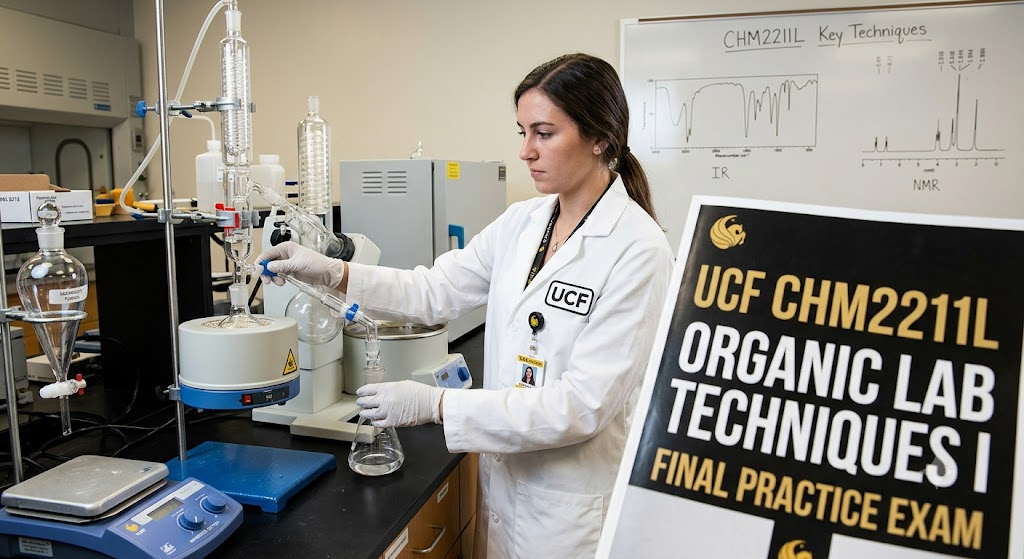
Additional Information
What the Course Entails and Exam Details
UCF's CHM2211L Organic Laboratory Techniques I is a one-credit hour, intensive laboratory course. It provides students with their first immersion into the specialized methods of microscale and macroscale organic synthesis, purification, and analysis.
Core Topics and Syllabus Covered:
The course and final exam assess proficiency in the following foundational areas:
Laboratory Safety: Mastery of personal protective equipment (PPE), proper chemical handling, waste disposal protocols (flammable, aqueous, chlorinated, solid), emergency response, and recognizing hazardous situations.
Scientific Reporting and Documentation: maintaining a legally defensible and scientifically accurate laboratory notebook, with detailed procedures, observations, and data.
Fundamental Techniques:
Separation and Purification: liquid-liquid extraction (using acid-base properties), simple and fractional distillation, steam distillation, recrystallization, and filtration.
Chromatography: Thin Layer Chromatography (TLC) to monitor reaction progress and determine purity, and Column Chromatography for preparative separation.
Synthesis: carrying out classic organic reactions (e.g., nucleophilic substitution, elimination, esterification) with emphasis on stoichiometry, percent yield, and limiting reagents.
Physical Characterization: obtaining and interpreting melting points, boiling points, and refractive indices.
Spectroscopic Analysis: fundamental identification of organic compounds using Infrared (IR) Spectroscopy to identify functional groups and introduction to interpreting Nuclear Magnetic Resonance (NMR) data.
What to Expect in the Final Exam
The CHM2211L Final Exam at UCF is typically a written exam that focuses on the practical application of the knowledge gained throughout the semester. While some instructors may include a practical "hands-on" component, the primary evaluation is a standardized written test designed to confirm that each student understands the "why" and "how" behind every lab procedure.
Exam Format and Structure:
Multiple-Choice and Short Answer: The core of the exam is usually a set of multiple-choice questions designed to test knowledge of specific techniques, safety, and calculations. These may be supplemented by short-answer questions requiring the description of a procedure or a short analysis.
Case Studies and Troubleshooting: Expect questions that present a laboratory scenario, such as a reaction that failed to produce a product, and ask you to identify the error, suggest an alternative purification method, or interpret a confusing piece of data.
Calculation Intensive: A significant portion of the exam will test your ability to perform crucial laboratory calculations. This includes determining limiting reagents, theoretical yield, percent yield, molar ratios from NMR, and interpreting TLC Rf values.
Spectroscopy Interpretation: You will be given IR and introduction to NMR spectra and asked to identify a compound from a provided list of options or a specific functional group present.
Passing Score and Time Limit: The passing score is a minimum of 60%, with a time limit that is usually between 90 and 120 minutes.
Specific Rules: You will not be permitted to use a programmable calculator or external notes. All safety rules must be followed if there is a practical portion.
How to Study and Exam Centers
Preparation for a laboratory final requires a unique strategy that combines conceptual understanding with technical detail.
Actionable Study Strategies:
Master the Calculations: This is the most common pitfall. Do not just read your old pre-labs. Re-write the calculations from every experiment. Practice calculating the moles, limiting reagent, and percent yield for at least five different reactions from your manual. Make a cheat-sheet of every useful formula.
Technique Master List: Create a grid for every major technique (e.g., recrystallization, column chromatography). For each, list: (A) Its Purpose, (B) The step-by-step procedure (e.g., "Add hot solvent until..."), (C) The visual cues for success (e.g., "crystals should form slowly"), and (D) Common errors and their remedies.
Review the 'Why': Why must the recrystallization solvent be hot? Why do we add sodium sulfate to the organic layer? Why is fractional distillation more efficient than simple distillation for some mixtures? These 'why' questions are prime exam material.
Practice with Spectroscopy: Go through the IR interpretation charts and test yourself on 10-15 sample spectra until you can reliably identify major functional groups like carbonyls, alcohols, and carboxylic acids.
Review Previous Quizzes and Reports: Go back through every quiz, pre-lab, and lab report. Understand what you got wrong and read your TA's feedback.
Exam Centers and Access:
As a current UCF student, you will take the actual CHM2211L Final Exam at a designated on-campus testing facility, typically arranged by the UCF Department of Chemistry or in your scheduled laboratory section. The exact date, time, and location will be provided on your course syllabus and through the Webcourses@UCF portal. For self-guided learning, this Practice Exam Guide is your initial study tool.
Job Opportunities from the Course
A strong performance in CHM2211L is more than just a grade; it is evidence of professional-level practical laboratory skill. This certification of technical competence unlocks numerous initial job titles in science, particularly for those on a bachelor's degree path.
Career Paths and Job Titles:
Pharmaceutical Research Assistant / Technician
Quality Control (QC) or Quality Assurance (QA) Analyst
Chemical Laboratory Technician
Forensic Science Technician
Environmental Chemical Analyst
Biotechnology Laboratory Assistant
R&D Assistant (Chemistry, Materials, or Consumer Products)
Scientific Sales Representative
This course also provides the absolute foundation required for advanced study as an Organic Chemist, Medical Doctor, Pharmacist, or Patent Attorney specializing in scientific innovation.
Frequently Asked Questions
Reviews
5.0
Based on 0 reviews
Leave a Review
No reviews yet. Be the first to review!