
University of Central Florida (UCF) CIS3360 Security in Computing Final Practice Exam
$69.00
- Buy to unlock unlimited access to all Quiz questions and Answers in this Quiz.
- After purchase you can print a PDF of the whole quiz at any point. The PDF will contain the questions and the correct answers.
About this Exam
The University of Central Florida (UCF) CIS3360 Security in Computing course is a critical foundational step for students aspiring to become cybersecurity professionals. This upper-division course provides an in-depth overview of the fundamental principles, practices, methods, and technologies that secure organizational and institutional computing systems. It is specifically designed for Information Systems Technology and Computer Science majors who need a robust understanding of how to protect information and infrastructure from an ever-evolving landscape of threats.
Ready to test your knowledge?
Buy Now to Access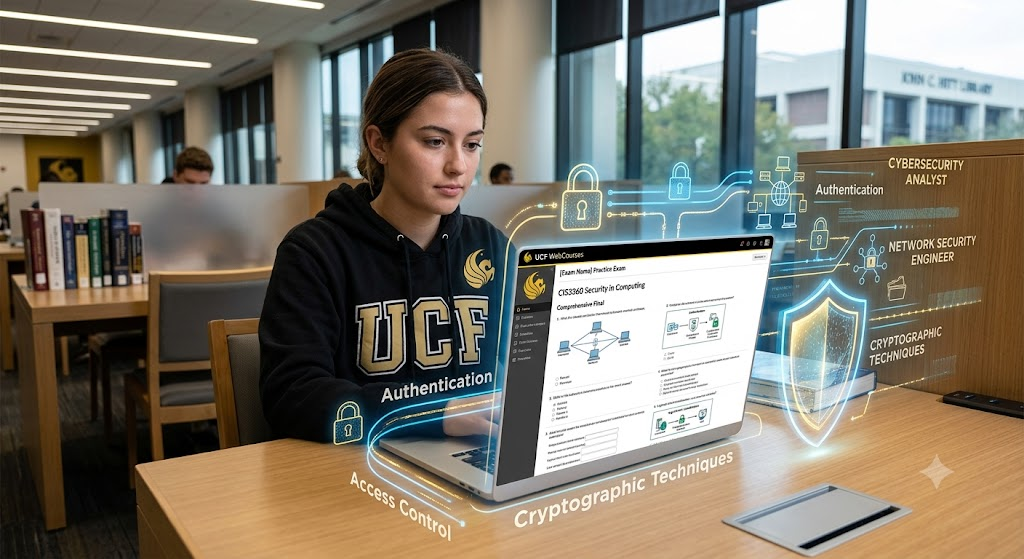
Additional Information
What the Course Entails and Exam Details
The course curriculum covers a broad range of topics, ensuring that students can not only explain security concepts but also apply them to solve real-world problems. The core competencies include:
Information Security Concepts: Understanding and distinguishing between confidentiality, integrity, and availability (the CIA triad), as well as authenticity and accountability.
Cryptography: Implementing and assessing symmetric and asymmetric cryptographic techniques, hashing algorithms (e.g., AES, RSA, Diffie-Hellman, SHA-256), and key management infrastructures (PKI).
Authentication and Access Control: Designing and using diverse multi-factor authentication (MFA) and access control systems (e.g., DAC, MAC, RBAC).
Attacks and Countermeasures: Analyzing social engineering, malware (viruses, worms, Trojan horses), denial-of-service (DoS/DDoS) attacks, and network-based exploits (e.g., buffer overflows, SQL injection, XSS).
Network Security: Configuring and understanding network controls like firewalls, intrusion detection systems (IDS), virtual private networks (VPNs), honeypots, and honeynets.
Legal, Ethical, and Professional Issues: Identifying laws and codes of ethics governing information protection, such as copyrights, patents, and trade secrets.
What to Expect in the Final Exam
The CIS3360 Final Exam is a comprehensive assessment designed to test your mastery of all course outcomes. Here is what you need to prepare for:
Format: While midterms can vary, the final exam is typically an online, timed assessment, released via UCF WebCourses. It often takes the form of a combination of question types, including multiple choice, short answers, problem-solving, and potentially a analysis of a practical security scenario or small programming tasks.
Time Limit: You will typically have a specific time window, such as 24 hours, within which to complete and submit the exam once it is released, though it may have a shorter, continuous timer once you begin.
Passing Score: The exam makes up a significant portion of your final grade (often around 25%). Achieving at least 70% proficiency across all assessed outcomes is generally a benchmark for demonstrating competency in the material and passing the course.
Academic Honesty: UCF enforces a strict no-collaboration policy. You are not permitted to discuss exam questions with anyone.
How to Study and Exam Centers
Your preparation should focus on both theoretical understanding and practical application.
Actionable Study Strategies:
Master the Math: Be fluent in base conversions (binary, decimal, hexadecimal) and modular arithmetic, as these are frequently tested in relation to cryptography.
Review Course Projects and Homework: These assignments are precursors to the practical application questions you may encounter. Go through your solutions, especially those related to encryption/decryption, password security, and attack analysis.
Use the Recommended Textbooks: "Security in Computing" by Pfleeger & Pfleeger, and "Computer Networking: A Top-Down Approach" are standard references for the course.
Create Concept Maps: Connect different concepts, such as how specific authentication methods and access controls are combined to implement security models like RBAC.
Exam Centers:
Because the exam is administered through UCF's WebCourses, you do not need to visit a physical testing center like Pearson VUE. It is designed to be taken remotely, providing you with flexibility, but you must ensure you have a stable internet connection and a conducive environment free from interruptions for the duration of the exam.
Job Opportunities from the Course
Successfully completing this course and its final exam unlocks a clear path to numerous in-demand cybersecurity roles, including:
Cyber Security Analyst
Information Security Analyst
Network Security Engineer
Security Administrator
Information Assurance Analyst
Junior Penetration Tester
Security Consultant
SOC (Security Operations Center) Analyst
IT Auditor
Frequently Asked Questions
Reviews
5.0
Based on 0 reviews
Leave a Review
No reviews yet. Be the first to review!