
University of Central Florida (UCF) COM3311 Communication Research Methods Practice Exam 1
$69.00
- Buy to unlock unlimited access to all Quiz questions and Answers in this Quiz.
- After purchase you can print a PDF of the whole quiz at any point. The PDF will contain the questions and the correct answers.
About this Exam
Are you currently enrolled in COM3311 Communication Research Methods at the University of Central Florida?
This essential course is designed to equip communication students with the fundamental principles of social science research within the discipline.
It provides crucial foundational knowledge for understanding, designing, and conducting effective communication research.
This practice exam 1 is your invaluable tool for assessing your understanding of the initial course material and identifying areas for improvement before the high-stakes final assessment.
Whether you're a prospective student wanting to know more or a current student gearing up for success, this guide is here to support your journey.
Ready to test your knowledge?
Buy Now to Access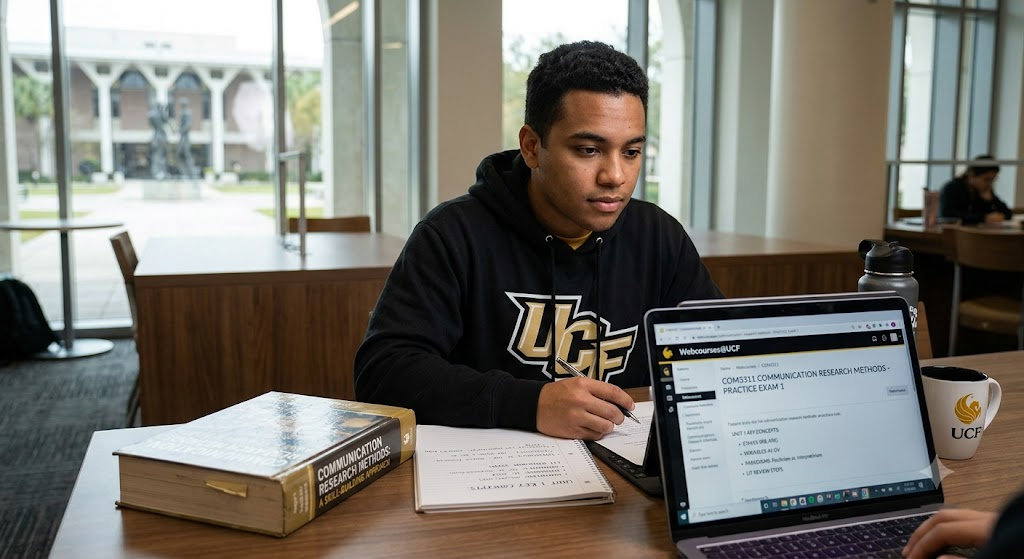
Additional Information
What the Course Entails and Exam Details
The COM3311 curriculum is comprehensive, taking you on a journey through the theoretical underpinnings and practical applications of communication research.
You will delve into topics such as understanding different research paradigms (qualitative versus quantitative) and their unique strengths and limitations.
Expect to explore crucial concepts like formulating research questions and hypotheses, evaluating sampling methods, and designing effective instruments for data collection, from surveys and experiments to in-depth interviews and focus groups.
Ethical considerations in human subject research are paramount, ensuring you learn how to conduct studies responsibly and with integrity.
Furthermore, you'll gain an introduction to data analysis techniques, learning how to interpret statistical results and draw meaningful conclusions from your findings.
This practice exam specifically targets the knowledge and application of these fundamental methods and concepts.
What to Expect in the Final Exam
The final COM3311 exam typically features a comprehensive format, evaluating your holistic understanding of all course materials.
It is common for these types of university exams to comprise a mix of multiple-choice questions, short answer prompts, and potentially some larger application-based scenarios or data analysis interpretation questions.
Expect a time limit, which varies, but generally, students are given 2-3 hours to complete the assessment, necessitating good time management skills.
While specific passing scores and detailed instructions will be provided by your instructor, consistency in your study and practice is key.
The final exam will challenge your ability to not only recall terms and definitions but also to apply research concepts to real-world communication scenarios.
How to Study and Exam Centers
Effective preparation is paramount to success.
Here are actionable strategies to excel in COM3311:
Active Class Participation: Attend all lectures, engage in discussions, and diligently take notes. Understanding key concepts as they are taught is foundational.
Thorough Reading: Diligently read all assigned materials, including textbooks and supplemental readings. Look for definitions, examples, and methodologies.
Leverage Your Study Guide and Textbook: Utilize provided study guides and the course textbook as primary resources. Create flashcards for key terms, definitions, and research method types.
Practice, Practice, Practice: Utilize this very practice exam effectively. Take it under timed conditions initially, then thoroughly review all answers, understanding why correct choices are correct and why incorrect choices are wrong. Create additional practice questions yourself.
Form Study Groups: Collaborating with classmates can offer diverse perspectives and help clarify complex topics through discussion and peer explanation.
Seek Instructor Support: Don't hesitate to attend office hours or email your instructor with questions or clarifications.
Regarding exam centers: Unlike external professional certifications, university course exams are typically administered internally.
You will complete this final exam either in a designated classroom on the UCF campus or using a proctored online platform (like Webcourses@UCF with Honorlock, for example, if applicable to your section), as specified by your instructor and the course syllabus.
There are generally no external exam centers like Pearson VUE involved for standard course assessments.
Job Opportunities from the Course
While COM3311 is a single course rather than a full certification, the skills you develop are highly sought after across numerous industries.
Gaining proficiency in communication research methods unlocks diverse career paths, including:
Market Research Analyst: Understanding consumer behavior, conducting surveys, and analyzing data to guide business decisions.
Communication Researcher: Analyzing communication patterns, audience reception, and media impact.
Public Relations Specialist: Using research to develop effective communication strategies and assess public sentiment.
Marketing Coordinator/Analyst: Employing research findings to optimize marketing campaigns.
Media Planner: Utilizing research data to determine the most effective media outlets for advertising.
User Experience (UX) Researcher/Analyst: Collecting and analyzing user feedback to improve product design and usability.
Social Media Manager (Research Focus): Analyzing social media metrics and user interactions.
Public Opinion Pollster: Conducting surveys and analyzing data related to public views and political trends.
The knowledge and practical research skills honed in this course form a vital foundation for excelling in any communication-related role that relies on data-driven insights.
Frequently Asked Questions
Reviews
5.0
Based on 0 reviews
Leave a Review
No reviews yet. Be the first to review!