
University of Central Florida (UCF) COP3330 Object Oriented Programming Final Practice Exam
$69.00
- Buy to unlock unlimited access to all Quiz questions and Answers in this Quiz.
- After purchase you can print a PDF of the whole quiz at any point. The PDF will contain the questions and the correct answers.
About this Exam
The UCF COP3330 Object Oriented Programming course and its final exam are critical components for computer science students. It is designed to move beyond foundational procedural programming and immerse you in the modern software development paradigm of objects and classes. This course, and particularly the final, validates your understanding of how to structure complex programs to be modular, reusable, and maintainable. Whether you are aiming to be a software engineer, a data scientist, or an IT professional, mastering object-oriented concepts is non-negotiable, and a practice exam is an essential step to solidify your knowledge and build confidence before the final.
Ready to test your knowledge?
Buy Now to Access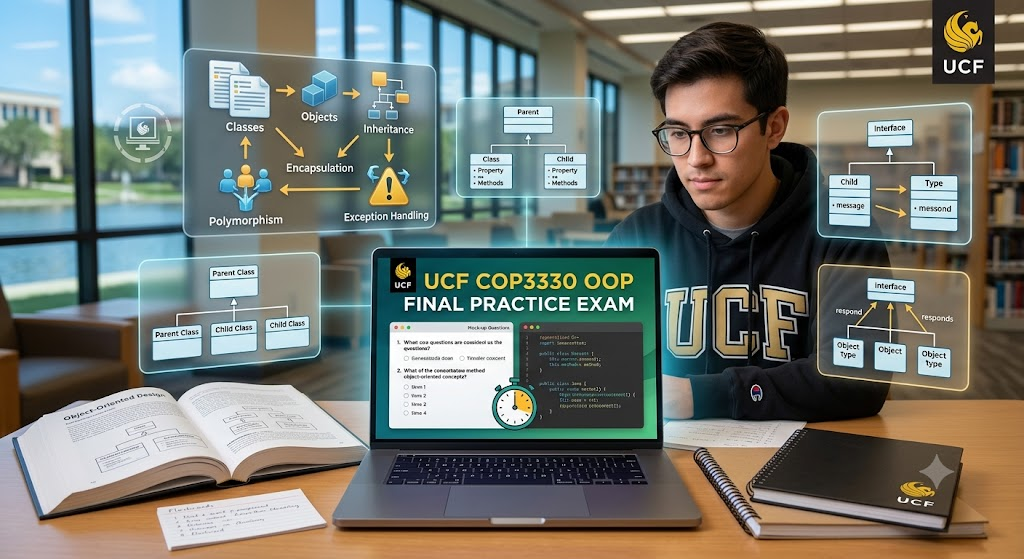
Additional Information
What the Course Entails and Exam Details
This comprehensive course, often taught in languages like Java or C++ at UCF, covers a robust syllabus designed to make you a proficient OOP developer. A final practice exam typically focuses on core areas to assess your readiness. Key topics you can expect to find include:
OOP Fundamentals: Solidifying concepts like Classes, Objects, Inheritance, Polymorphism, and Encapsulation.
Encapsulation & Access Control: Proper use of public, private, and protected modifiers.
Inheritance & Polymorphism: Creating class hierarchies, implementing interfaces/abstract classes, and exploiting dynamic binding for flexible code.
Exception Handling: Designing robust code that gracefully handles errors.
Data Structures & Collections: Understanding the role of fundamental data structures and how to use collections (e.g., lists, maps, sets in Java; vectors and standard containers in C++).
Input/Output (I/O) Streams: Working with file and system I/O.
Dynamic Memory Management: Allocation, deallocation, and the role of pointers or the garbage collector (depending on the language).
Operator Overloading (C++ specific): Implementing and understanding custom operator behavior.
UML (Unified Modeling Language): Interpreting and designing with UML class diagrams.
The specific language used and depth can vary, so ensure your practice covers the exact language version and specific course notes from your iteration of COP3330 at UCF.
What to Expect in the Final Exam
While the exact structure can vary slightly depending on the instructor and course version, a typical UCF COP3330 final is a comprehensive, timed exam. You can expect a mix of formats designed to test both conceptual knowledge and practical coding skills. A typical breakdown might include:
Multiple Choice & True/False Questions: Testing fundamental definitions, conceptual differences, syntax rules, and standard practices.
Conceptual & Short Answer Questions: Asking you to define terms, compare different OOP principles (e.g., overloading vs. overriding), or interpret UML diagrams.
Code Tracing & Debugging: Presenting code snippets for you to predict the exact output or identify and correct syntax/logical errors. This tests your understanding of execution flow, variable scope, and language-specific behavior.
Coding & Program Development: A significant portion where you will be required to write complete classes, functions, or programs to solve a given problem based on specified requirements, demonstrating proper OOP structure and language use.
Important details to remember:
Passing Score: Usually, a percentage in the range of 60-70% is required to pass, but the exact requirement will be specified by your professor and in the course syllabus.
Time Limit: Typically ranges from 2 to 3 hours, a standard final exam slot. Effective time management during practice is key.
Rules: The final is almost always proctored and closed-book, though specific rules might allow a one-page cheat sheet or access to a limited programming environment. No external electronic devices or unauthorized materials are permitted.
How to Study and Exam Centers
Effective study requires a strategic mix of review and active practice. This final covers a large amount of material, so a deep dive into active coding is crucial.
Review Lecture Notes and Textbook Chapters: Start with a thorough pass of the main concepts and examples presented in class. Re-read difficult sections in your textbook.
Rewrite Every Program: Don't just read code. Manually rewrite every assignment, lab, and major class example. Change elements and see what happens.
Practice with Real Problems: Work through textbook problems, online programming challenges, and, crucially, any past or provided practice exams for COP3330 at UCF.
Form Study Groups: Collaborating can help clarify difficult topics and expose you to different problem-solving approaches.
Create Your Own Practice Questions: Try to think like a professor. What concepts are likely to be tested? Design multiple-choice questions or coding scenarios for a classmate.
Practice with Timed Conditions: Simulate the exam experience. Set aside time for a full practice run under timed, quiet conditions.
Seek Clarification: Don't let questions linger. Utilize professor office hours and TA support to get clarification on challenging concepts or specific practice problems.
Where to Take the Exam and Practice:
Practice Exams and Resources: Material is typically found within your specific UCF online course portal (e.g., Webcourses/Canvas), on the professor's or university's department website, or directly provided by your instructor or TAs. This is where you will access practice guides.
Actual Final Exam: The actual proctored final exam for COP3330 at UCF is typically held within a designated university classroom or testing center on campus during the final exam week. Your official course schedule and professor will provide precise location details closer to the exam period. Be sure to confirm the exact date, time, and location.
Job Opportunities from the Course
A strong performance in OOP at UCF isn't just about passing a class; it's a foundational skill that unlocks a vast range of rewarding career paths. Successfully mastering these concepts can lead to job opportunities including:
Software Developer
Software Engineer
Java Developer
C++ Developer
Web Application Developer
Systems Analyst
Programmer Analyst
Backend Engineer
Mobile Application Developer
Your object-oriented programming foundation is a highly valued and transferable skill across diverse technology roles, making this course a pivotal step in your professional journey. Use this comprehensive practice guide and the image below to focus your efforts and achieve success in your UCF COP3330 final. Good luck!
Frequently Asked Questions
Reviews
5.0
Based on 0 reviews
Leave a Review
No reviews yet. Be the first to review!