
University of Central Florida (UCF) DEP2004 Developmental Psychology Practice Exam 4
$69.00
- Buy to unlock unlimited access to all Quiz questions and Answers in this Quiz.
- After purchase you can print a PDF of the whole quiz at any point. The PDF will contain the questions and the correct answers.
About this Exam
The University of Central Florida (UCF) DEP2004 Developmental Psychology Practice Exam 4 is a vital study resource designed specifically for students enrolled in UCF's DEP 2004: Developmental Psychology course. This comprehensive practice exam serves as a final check for students preparing for the final, or 'Exam 4', in the lifespan development sequence.
This particular exam focuses heavily on the later stages of human development, bridging the gap from adolescence into young adulthood, and continuing through middle and late adulthood. For students aiming to achieve a high score in this foundational course, this practice tool is an essential step towards mastering complex theories and identifying critical transitions within the human lifespan.
Ready to test your knowledge?
Buy Now to Access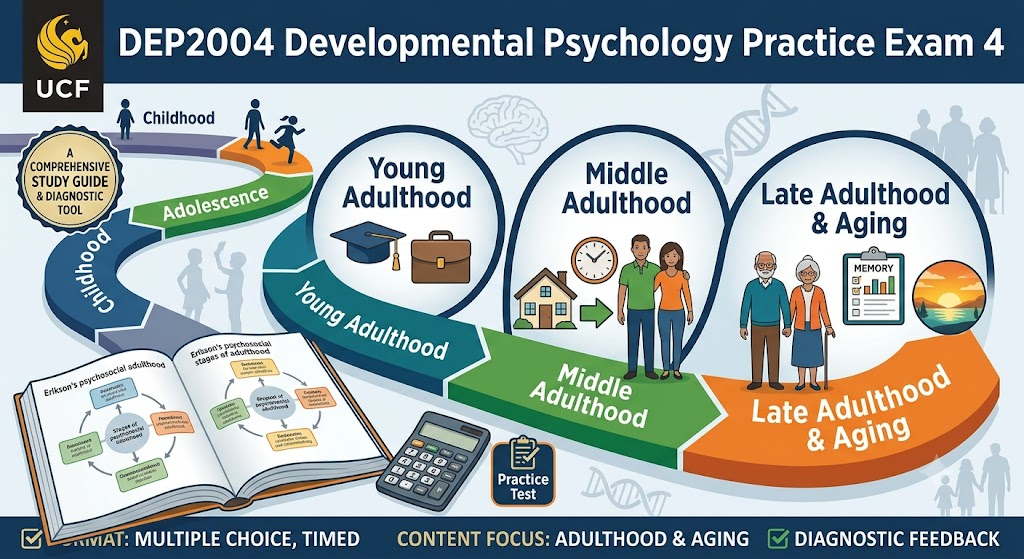
Additional Information
What the Course Entails and Exam Details
UCF's DEP 2004 is a survey course that introduces students to the major biological, psychological, and social changes that occur throughout the entire human lifespan. It covers human growth and development from conception all the way to death. While earlier exams in the sequence focus on prenatal development, infancy, and childhood, Exam 4 specifically zeroes in on the concluding stages of this journey.
Core topics covered in this segment of the course and tested on this exam include:
Adolescence: Transition to adulthood, identity formation, and socioemotional changes.
Young Adulthood: Physical development peak, cognitive maturity, career choices, and establishing intimate relationships.
Middle Adulthood: The 'midlife' transition, changes in sensory abilities, health, generativity vs. stagnation, and cognitive shifts (crystallized vs. fluid intelligence).
Late Adulthood and Aging: Physical changes (senescence), cognitive aging (memory, dementia), social emotional changes, Erikson’s final stage (integrity vs. despair), and the psychology of death, dying, and bereavement.
The primary goal of this section is for students to understand the diverse trajectories, challenges, and opportunities presented by aging and to apply psychological principles to understand the adult experience.
What to Expect in the Final Exam
While the exact structure may vary by instructor, the final exam (Exam 4) for DEP 2004 at UCF typically follows a comprehensive, multiple-choice format, often with additional matching, true/false, or short-answer questions. The practice exam mimics this format to build your test-taking speed and accuracy.
Expect the final exam to consist of approximately 50 to 100 questions, which must be completed within a set time limit, typically 60 to 90 minutes. For a practice exam of this caliber, a standard practice session should aim to replicate these conditions. A recommended "passing score" to feel confident for the real test is 80% or higher on practice material. Students should consult their specific course syllabus for the official grading rubric and point values assigned to the final.
The real exam may be administered in-person on the UCF main campus, at authorized regional campuses, or online through UCF’s learning management system, with or without remote proctoring, depending on the section's modality.
How to Study and Exam Centers
Effective preparation for this exam requires a multi-faceted approach. Your primary tools should be the course textbook and your lecture notes. Start by reviewing key terms, major theories (e.g., Erikson’s stages of adulthood, Sternberg’s triangular theory of love, Baltes' SOC model), and significant developmental milestones.
We highly recommend using this practice exam not just as a one-time test, but as a diagnostic tool. Take the exam under timed conditions, then thoroughly review every question you missed. Read the answer explanations for all choices to understand why the correct answer is correct and why the distractors are wrong. Additionally, form study groups, use flashcards for terms like multidirectionality, kinkeeper, and palliative care, and attend any review sessions offered by your UCF instructor or teaching assistants.
For the actual final exam, your location is determined by your class registration. In-person exams are held at the UCF Main Campus in Orlando, at specific lecture halls or testing centers. For those taking the course through UCF Online, the exam will be accessible via Webcourses@UCF. In some cases, a proctoring service like Honorlock or an authorized external physical testing center may be required; consult your syllabus for confirmation.
Job Opportunities from the Course
A foundation in developmental psychology is relevant to numerous career paths, particularly those that involve working with or advocating for individuals across different life stages. While advanced roles often require a Master's or Doctorate, a strong grade in DEP 2004 contributes to the necessary foundation for these future steps:
Behavioral Health Specialist: Works with people of all ages to manage behavioral and emotional disorders.
Educational Assistant/Aide: Supports teachers and students in schools, often focused on specific age groups or special needs.
Research Assistant: Conducts studies on human development, data collection, and analysis in academic or clinical settings.
Social Services Assistant: Assists social workers and case managers in connecting individuals and families with needed services.
Hospice/Grief Counselor: Supports individuals and families experiencing terminal illness, death, and bereavement.
Activity Coordinator for Senior Living: Designs and implements programs to enhance the well-being and social engagement of older adults.
Preschool/Childcare Worker: Applies understanding of early development to care for and educate young children.
Patient Advocate: Helps patients navigate the healthcare system, ensuring their developmental needs and preferences are met.
Frequently Asked Questions
Reviews
5.0
Based on 0 reviews
Leave a Review
No reviews yet. Be the first to review!