
University of Central Florida (UCF) ECO3203 Intermediate Macroeconomics Practice Exam 1
$69.00
- Buy to unlock unlimited access to all Quiz questions and Answers in this Quiz.
- After purchase you can print a PDF of the whole quiz at any point. The PDF will contain the questions and the correct answers.
About this Exam
The UCF ECO3203 Intermediate Macroeconomics course is a pivotal step for economics and business students, designed to deepen their understanding of aggregate economic behavior.
This specific practice exam, ECO3203 Intermediate Macroeconomics Practice Exam 1, is an essential tool tailored for students currently enrolled in the course at the University of Central Florida.
It serves as a low-stakes diagnostic resource, allowing students to gauge their comprehension of the foundational macro concepts covered in the initial weeks of the semester before facing their first graded midterm examination.
Completing this practice exam helps identify areas of strength and weakness, ensuring students can focus their studying effectively and approach the actual exam with confidence.
Ready to test your knowledge?
Buy Now to Access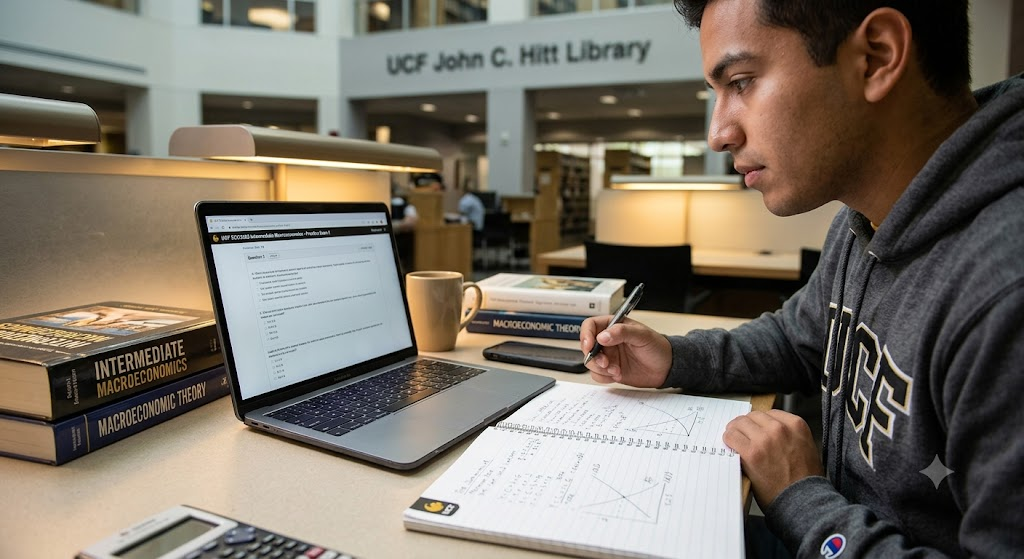
Additional Information
What the Course Entails and Exam Details
Intermediate Macroeconomics (ECO3203) builds significantly upon introductory macroeconomics, moving beyond basic concepts to focus on the construction and application of formal economic models.
This first practice exam typically evaluates understanding of the following core areas:
Measurement of macroeconomic data, including detailed analysis of GDP (expenditure and income approaches), inflation indices (CPI, GDP deflator), and unemployment metrics.
Classical macroeconomic theory, focusing on the determination of national income, the role of factors of production, and the loanable funds market in a closed economy.
The function and impact of the monetary system, including money supply determination and the tools of the Federal Reserve.
Initial introductions to long-run economic growth theories, such as the Solow Growth Model, analyzing factors determining a nation’s standard of living over time.
What to Expect in the Final Exam
While the format of the actual, graded Midterm 1 will ultimately be determined by the course instructor, UCF ECO3203 practice exams are generally structured to mirror the real testing environment.
Here is what you can typically expect regarding the format:
Format: Practice Exam 1 most commonly utilizes a multiple-choice question format, focusing on testing conceptual clarity, analytical reasoning, and graphical analysis of economic models.
Duration: Practice exams are often designed to be completed within a standard class period (typically 50 to 75 minutes), encouraging students to practice time management skills.
Scoring: As this is a practice test, the score is primarily diagnostic and is usually not factored directly into the student's final course grade. However, achieving a strong score demonstrates a solid command of the material.
Delivery: These practice assessments are frequently administered online through the university's learning management system (Webcourses@UCF) or provided as review materials directly by the instructor.
How to Study and Exam Centers
Preparation is key to success in intermediate economics courses. For this practice exam, we recommend a focused study strategy:
Review Lecture Notes and Assigned Readings: Your primary resource should be the material covered in class and the relevant chapters in your textbook (often textbooks by Mankiw or Blanchard).
Active Problem Solving: Do not just read about economic models; practice solving problems using them. Redo homework assignments, work through end-of-chapter textbook problems, and use any supplemental materials provided by teaching assistants or peer tutors.
Focus on Key Models: Ensure you can graphically illustrate and mathematically solve problems related to the Classical Model (specifically the interaction of supply, demand, and the rental rate of capital/labor) and the Loanable Funds market.
Where to Take the Exam
This is an internal University of Central Florida course assessment. It is not administered at external testing centers like Pearson VUE. Students will typically take this practice exam through the Webcourses@UCF portal (Canvas) as an online quiz, or it may be provided by the professor in a downloadable format for self-assessment. Refer directly to your ECO3203 course syllabus or Webcourses announcements for specific access instructions.
Job Opportunities from the Course
Mastering the analytical skills taught in Intermediate Macroeconomics is critical for any student pursuing quantitative roles in business or policy. This course is a prerequisite for more advanced studies and provides necessary tools for various career paths, including:
Financial Analyst
Data Analyst (focused on economic or financial data)
Economic Consultant
Policy Analyst (in government agencies or think tanks)
Research Assistant (in academic or financial institutions)
Supply Chain Analyst
This course provides the analytical foundation needed to interpret complex economic indicators, essential for sound decision-making in the public and private sectors.
Frequently Asked Questions
Reviews
5.0
Based on 0 reviews
Leave a Review
No reviews yet. Be the first to review!