
University of Central Florida (UCF) ECO3223 Money and Banking Practice Exam 1
$69.00
- Buy to unlock unlimited access to all Quiz questions and Answers in this Quiz.
- After purchase you can print a PDF of the whole quiz at any point. The PDF will contain the questions and the correct answers.
About this Exam
Welcome to your essential preparation resource for the University of Central Florida’s ECO3223 Money and Banking course.
This first practice exam is specifically designed for UCF undergraduate students enrolled in ECO3223 who are looking to solidify their understanding of foundational monetary and financial concepts before facing their actual course examinations.
It is a crucial self-assessment tool meant to gauge your readiness and build confidence.
Ready to test your knowledge?
Buy Now to Access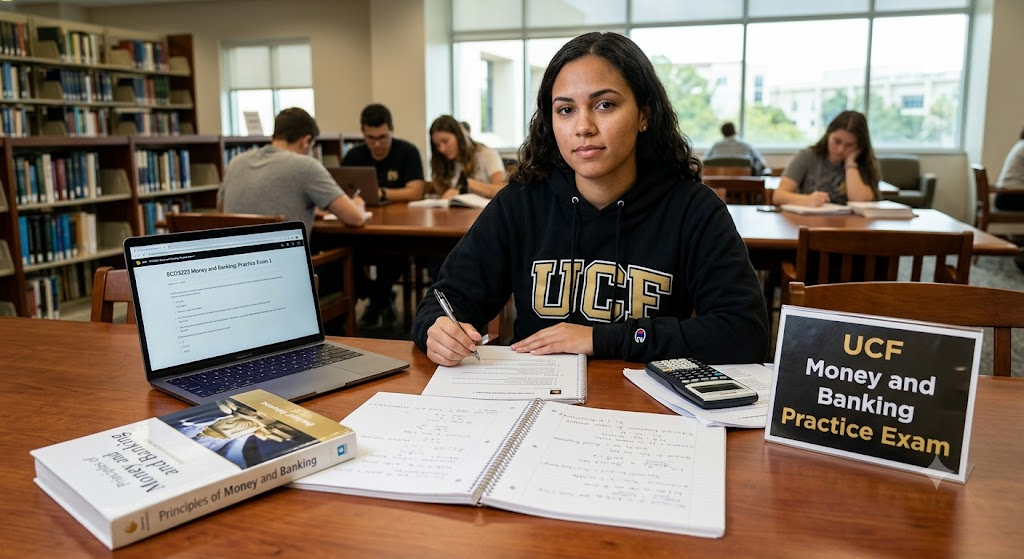
Additional Information
What the Course Entails and Exam Details
The UCF ECO3223 Money and Banking course provides a vital foundation for understanding how financial systems operate and interact with the broader economy.
While the exact syllabus details for Practice Exam 1 may vary by instructor, the initial section typically focuses on core, foundational principles that set the stage for more complex economic theories.
Core topics typically covered in this initial phase and included in Practice Exam 1 preparation often involve:
The functions and definition of money, including historical context and different forms of payment.
The structure of the financial system, including financial markets and institutions.
An introduction to interest rates, including how they are determined and their term structure.
Understanding the role and basics of central banking, specifically the Federal Reserve.
What to Expect in the Final Exam
Since this is a practice tool for an in-class examination, its format is modeled after typical university economics assessments.
The format is usually a mix of quantitative problems and conceptual multiple-choice questions designed to test both theoretical understanding and analytical application.
There is no formal 'passing score' required for this practice exam, as its purpose is diagnostic self-improvement rather than dynamic assessment.
However, students should aim to complete it within a comparable time limit to the real exam (e.g., 50-75 minutes) to build stamina and identify areas where they may struggle under time pressure.
Specific academic honesty rules of UCF apply, and while this is a practice tool, treating it with the same seriousness as a graded test is highly recommended.
How to Study and Exam Centers
Effective study strategies are paramount to success in ECO3223.
A strong preparation plan involves several distinct phases:
Active Review: Rather than passively re-reading your notes and textbook, use active recall. Cover your notes and try to explain key concepts aloud, or rewrite equations and proofs from memory.
Identify Your Gaps: Take this practice exam early. Do not wait until the day before your real exam. Mark the questions you got wrong or were unsure about, and immediately dedicate focused study time to those specific topics.
Connect Concepts: When studying, do not treat topics in isolation. Understand how, for example, a change in interest rates (determined in financial markets) influences the real economy and central bank policy decisions.
Use Campus Resources: Utilize UCF’s specific resources, including instructor office hours and any Supplemental Instruction (SI) sessions provided for ECO3223. Group study can also be highly beneficial.
Access and Taking the Exam: This practice exam is typically provided directly to enrolled students by their ECO3223 instructor, often through the UCF Webcourses (Canvas) portal or during lectures. It is not hosted on external commercial testing center platforms like Pearson VUE. Students must follow the specific instructions and access methods provided by their UCF professor.
Job Opportunities from the Course
A strong understanding of money and banking is a powerful asset in the finance and economics sectors.
Successfully mastering the concepts in ECO3223, including the foundations tested in Exam 1, opens the door to numerous impactful career paths:
Financial Analyst: Analyzing financial data to guide business and investment decisions.
Commercial Banking Associate: Assessing credit risk, managing client relationships, and analyzing loan applications.
Investment Banking Analyst: Assisting with mergers and acquisitions, capital raising, and corporate finance.
Economic Researcher: Working for government agencies, think tanks, or consulting firms to study monetary policy and economic trends.
Credit Analyst: Evaluating the creditworthiness of individuals and businesses for financial institutions.
Risk Management Specialist: Identifying and analyzing potential financial risks facing an organization.
Positions within Regulatory Bodies: For example, working at the Federal Reserve or the FDIC.
This comprehensive guide and practice approach will maximize your preparation and help you succeed in UCF's challenging Money and Banking course. Good luck with your studies!
Frequently Asked Questions
Reviews
5.0
Based on 0 reviews
Leave a Review
No reviews yet. Be the first to review!