
University of Central Florida (UCF) FIL1000 Cinema Survey Final Practice Exam
$69.00
- Buy to unlock unlimited access to all Quiz questions and Answers in this Quiz.
- After purchase you can print a PDF of the whole quiz at any point. The PDF will contain the questions and the correct answers.
About this Exam
Prepare for success with our comprehensive study guide for the UCF FIL1000 Cinema Survey Final Practice Exam. This resource is designed to support students enrolled in the University of Central Florida's introductory film course, "Cinema Survey." The exam, which serves as the final assessment for the term, evaluates a student's understanding of key concepts in film history, analytical techniques, and the appreciation of cinema as an art form. This guide is indispensable for anyone looking to solidify their knowledge and achieve a top score in their final evaluation.
Ready to test your knowledge?
Buy Now to Access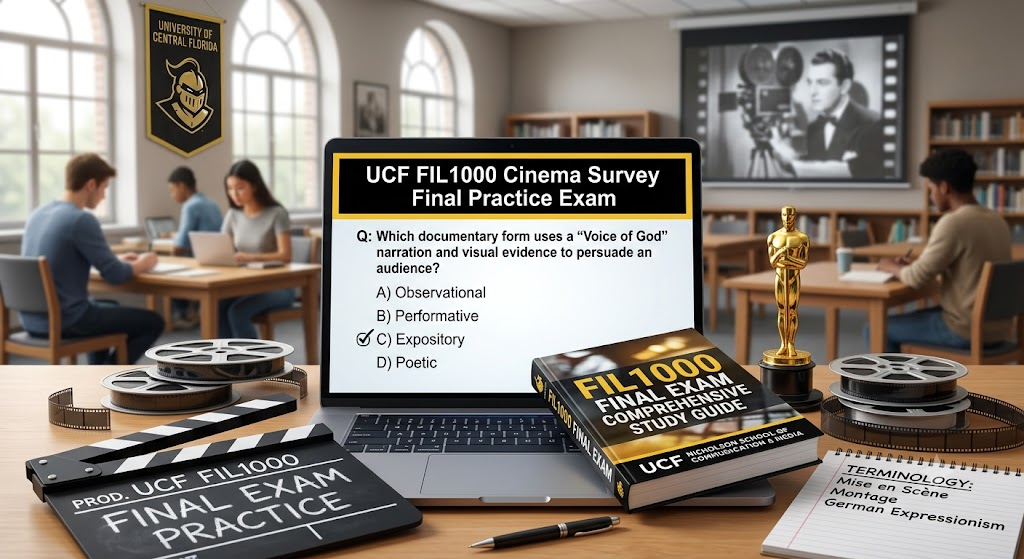
Additional Information
What the Course Entails and Exam Details
UCF's FIL1000 Cinema Survey is a dynamic introduction to the foundational principles of movie-making and its evolution. The final exam is comprehensive, testing the knowledge you've acquired throughout the semester. Key areas of focus typically include:
Film Form and Structure: Understanding how narrative, mise en scène, cinematography, editing, and sound design work together.
Film Genres: Analyzing the conventions and development of major genres like comedy, horror, documentary, and the musical.
Film History: Tracing pivotal moments, such as the silent era, German Expressionism, the Hollywood Studio System, and global New Waves.
Film Appreciation and Analysis: Developing the vocabulary and critical tools to interpret and discuss movies as complex cultural and artistic products.
What to Expect in the Final Exam
The final exam for FIL1000 is a fundamental part of the course grade. You can expect:
Format: The exam is primarily multiple-choice, though some instructors might include short answers or essay questions. It is designed to be completed within a specific time slot, generally around two to three hours, during the university's final exam week.
Delivery: Depending on the section, it could be proctored in a physical classroom or delivered online via UCF's learning management system, Webcourses@UCF.
Content: Questions will require you to define terminology, connect stylistic choices to their effects, analyze specific scenes or clips, and identify the significance of key films and historical figures.
Passing Score: To pass the final, you generally must achieve a standard university passing grade (typically a 60-70%), but the exact requirement for passing the course hinges on how the final grade is weighted by the instructor.
How to Study and Exam Centers
Maximize your study efforts with these actionable strategies and resources:
Actionable Study Strategies:
Create a Vocabulary Master List: Define all terms from your lectures and textbook, focusing on terms like mise en scène, cross-cutting, and non-diegetic sound.
Review Your Screening Notes: For every major film watched, summarize its plot, key stylistic elements, historical context, and how it illustrates course concepts.
Utilize Practice Questions: Re-do all quizzes, review old tests, and use student-created study guides to practice the types of questions you will see.
Form Study Groups: Collaborating with peers allows you to debate analysis and fill gaps in your knowledge.
Exam Centers:
UCF-Based Administration: Standard university exams like the FIL1000 final are administered by UCF. You do not need an external testing vendor.
Physical Classrooms: Check your course syllabus or Webcourses announcements for the exact date, time, and building location for a proctored, in-person exam.
UCF Online / Webcourses: If your section is entirely online or the exam is delivered virtually, it will be taken through the Webcourses portal. Some online exams may require using a proctoring service or the university's specified testing centers, like the University Testing Center (UTC), so always confirm in advance.
Job Opportunities from the Course
A strong performance in FIL1000 Cinema Survey is an encouraging first step on the path to a career in the film and media industry. Mastery of these fundamentals is a critical prerequisite for advanced specialized training in the Nicholson School of Communication and Media. The analytical skills and technical vocabulary you develop here unlock numerous career paths, including:
Film and Media Education: Including roles as an Art and Film Teacher, Film Festival Coordinator, or University Film Lecturer.
Media Production: With career titles such as Production Assistant, Production Coordinator, Videographer, or Digital Content Producer.
Post-Production and Technical Roles: Such as Film Editor, Assistant Editor, Sound Editor, or Media Manager.
Creative Roles: Opportunities as a Screenwriter, Narrative Designer, or Director, building from a foundation in visual storytelling.
Journalism and Criticism: Roles like Film Critic, Entertainment Journalist, Media Analyst, or Cultural Blogger.
Frequently Asked Questions
Reviews
5.0
Based on 0 reviews
Leave a Review
No reviews yet. Be the first to review!