
University of Central Florida (UCF) GEO1200 Physical Geography Midterm Practice Exam
$69.00
- Buy to unlock unlimited access to all Quiz questions and Answers in this Quiz.
- After purchase you can print a PDF of the whole quiz at any point. The PDF will contain the questions and the correct answers.
About this Exam
Welcome to your comprehensive guide for the UCF GEO1200 Physical Geography Midterm Practice Exam. GEO1200, or Physical Geography, is an introductory course at the University of Central Florida designed for students exploring the foundational principles of earth science and global environmental systems. This practice exam serves as a critical study tool, allowing students to assess their understanding of the initial course material and prepare effectively for the actual midterm assessment. It is ideal for UCF students enrolled in GEO1200 who want to solidify their knowledge and approach their midterm with confidence.
Ready to test your knowledge?
Buy Now to Access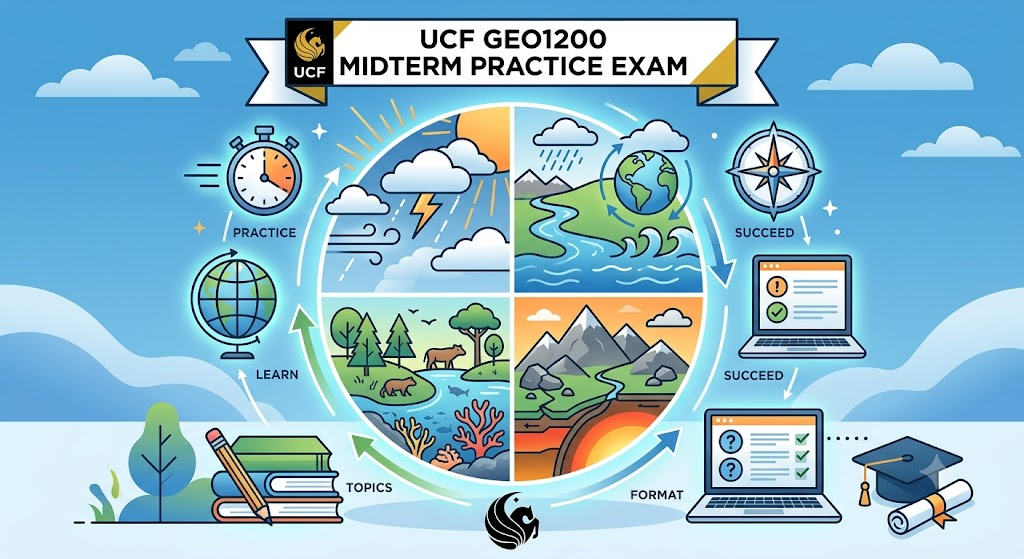
Additional Information
What the Course Entails and Exam Details
GEO1200 introduces students to the four major spheres of physical geography: the atmosphere, hydrosphere, lithosphere, and biosphere. Over the course of the first half of the semester, you will explore topics such as the science of geography, global maps and grids, the sun-earth relationship, seasons, global energy balance, and solar radiation. Furthermore, the course dives into the atmosphere's structure, global temperature patterns, air pressure, wind, moisture, and global water resources. You'll gain a deep understanding of atmospheric circulation and its influence on climate zones and weather patterns. The midterm exam covers these initial foundational concepts, requiring a strong grasp of spatial patterns and processes. It's essential to understand that physical geography is not just about memorization but about applying concepts to real-world scenarios across different regions.
What to Expect in the Final Exam
The actual UCF GEO1200 Midterm Exam is a standard university-level assessment designed to evaluate your knowledge of the materials covered to that point in the semester. While specific details might vary by instructor, students can generally expect the exam to be in a multiple-choice format, often consisting of 50 to 100 questions. It may also include matching, true/false, or short identification questions, covering definitions, concepts, theories, and map analysis. The passing score requirements align with the university's grading scale, usually set around a 70% for a 'C' or higher, depending on the grading scheme. Time limits are typically set around 50 to 75 minutes, corresponding to a standard class period or slightly longer. Students are required to adhere to the university's academic integrity policies, and proctoring methods (whether in-person in a classroom or via an online proctoring service) will be specified by the instructor. Use this practice exam to gauge how much time you spend per question and where you need additional study.
How to Study and Exam Centers
The key to success with the UCF GEO1200 Midterm Practice Exam is active engagement. Start by reviewing your course syllabus, lecture notes, textbook chapters, and any laboratory materials. Complete the practice exam under timed conditions, simulating the actual exam environment without using resources. Afterward, carefully review the correct answers and, more importantly, the rationale for why each option was correct or incorrect. Identify your weak areas and revisit those specific course topics in your notes or textbooks. Organize study sessions with classmates to discuss difficult concepts. Utilize flashcards for key terms, definitions, and geographical processes. For location, as this is a UCF course assessment, the real midterm will be administered in a UCF physical location (a classroom, a large lecture hall, or a campus testing center) as indicated by your professor. For online-only sections, tests are often proctored through systems like Honorlock or Respondus within the Webcourses system. Make sure you know your specific exam format and location long before the test day.
Job Opportunities from the Course
While a single course like Physical Geography is typically not a stand-alone certification for a job, it builds a foundational understanding essential for degrees in Geography, Environmental Studies, Geosciences, and related fields. Completing this course and a relevant degree unlocks a wide range of career paths including: Environmental Analyst, Geographic Information Systems (GIS) Technician, Urban and Regional Planner, Cartographer, Climate Change Analyst, Soil Conservationist, Hydrologist, Park Ranger, and Secondary Education Teacher (focusing on earth science). This knowledge is crucial for professions analyzing natural resources, environmental impact, and global systems. Students can leverage the knowledge gained for advanced coursework and eventual internships and jobs in these sectors.
Frequently Asked Questions
Reviews
5.0
Based on 0 reviews
Leave a Review
No reviews yet. Be the first to review!