
University of Central Florida (UCF) HUM2020 Encountering the Humanities Midterm Practice Exam
$69.00
- Buy to unlock unlimited access to all Quiz questions and Answers in this Quiz.
- After purchase you can print a PDF of the whole quiz at any point. The PDF will contain the questions and the correct answers.
About this Exam
The UCF HUM2020 Encountering the Humanities course is a foundational exploration into the breadth of human creative expression and thought. Designed for all undergraduate students as part of the General Education Program (GEP), it serves as an inviting doorway to understanding "what it means to be human." This course is not intended for specialists but for anyone who wishes to develop their capacity for critical thinking, empathy, and cultural understanding. The practice midterm exam is a essential tool, curated to help students measure their grasp of early course content and build confidence. It is designed to simulate the structure, difficulty, and time constraints of the formal midterm, making it a critical step for success. By using this practice guide, you can identify knowledge gaps, refine your study strategy, and approach the official exam with reduced anxiety and a clearer understanding of expectations.
Ready to test your knowledge?
Buy Now to Access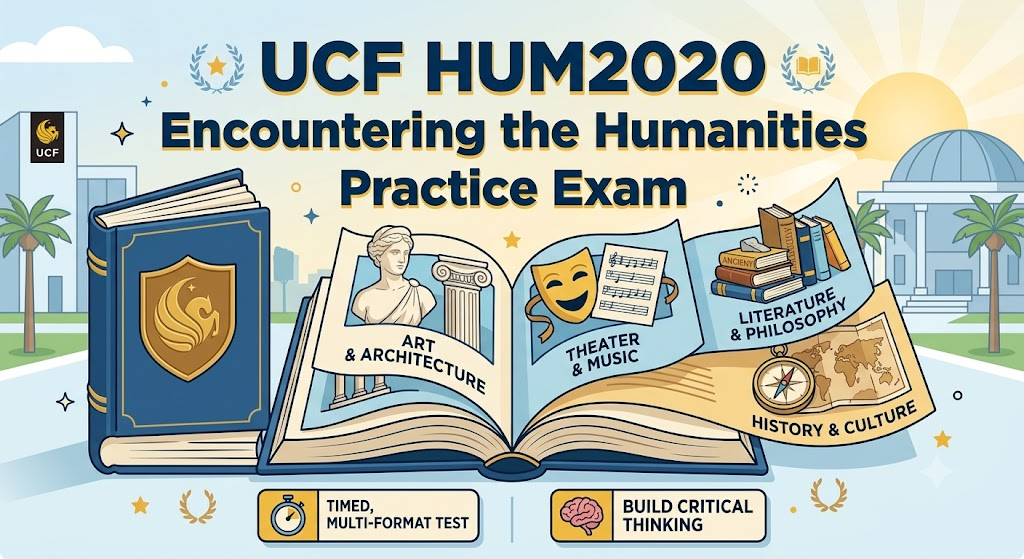
Additional Information
What the Course Entails and Exam Details
This course is interdisciplinary, examining how various fields within the humanities interpret the human experience. While specific syllabi may vary, the course typically focuses on the creative ideas, accomplishments, and cultural expressions from diverse traditions, with a strong foundation in the Western canon.
The core areas of study you can expect to be covered on your midterm include:
Understanding the Humanities: Definitional approaches and why they matter.
Visual Arts: Key concepts and analysis of painting, sculpture, architecture, and photography.
Performing Arts: Introduction to the history and impact of theater, dance, music, and opera.
Literature and Philosophy: Exploration of major texts, ideas, and foundational philosophical questions.
Religion and History: Understanding the role of belief systems and historical context in shaping human identity.
The practice midterm exam itself is a structured assessment that reflects the material covered in the first half of the semester. It focuses on foundational concepts, key terms, and the analysis of specific cultural works discussed in lectures and readings. It is an opportunity to apply the critical vocabulary you have learned.
What to Expect in the Final Exam
While this guide focuses on the practice midterm, understanding the trajectory of the course will help your preparation. A typical official HUM2020 midterm, administered in a physical or online setting, will be a timed assessment. The final exam, which comes at the end of the semester, is similar in format but is cumulative, covering all material from the entire term.
You can expect the official midterm to follow a multi-format structure:
Format: A combination of 30-50 multiple-choice, matching, and true/false questions designed to test objective knowledge of terms and works. This is often accompanied by one or more short-answer or essay questions requiring you to analyze, compare, or interpret specific concepts.
Passing Score: While individual instructors set specific grading scales, a minimum passing grade for the course is typically defined by UCF, with requirements often starting at a C (2.0) for GEP fulfillment.
Time Limit: You will generally be given 60 to 75 minutes to complete the official midterm.
Specific Rules: Policies regarding notes, textbooks, and academic integrity will be strictly enforced according to the university’s honor code.
This practice midterm is designed to help you prepare for these exact conditions.
How to Study and Exam Centers
Effective study for HUM2020 requires more than rote memorization; it requires active engagement with concepts and works.
How to Study:
Active Recall with Practice Questions: Don't just read your notes. Cover them and try to recall key definitions or the significance of a piece of art. Use this practice midterm multiple times, analyzing why the correct answers are correct and why the incorrect ones are wrong.
Analyze visual and textual works: Practice describing a painting’s style, a literary theme, or a philosophical concept using the precise critical terms provided in class (e.g., chiaroscuro, allegory, utilitarianism).
Group Study: Discuss complex ideas with your peers. Teaching a concept to someone else is one of the best ways to solidify your own understanding.
Review Weekly Quizzes: Go back to your weekly quizzes; they are often precursors to midterm and final exam questions.
Exam Centers and Formats:
Official Exam Location: At UCF, your official HUM2020 midterm will likely be administered through the Canvas learning management system as an online assessment. This might be a "mediated" class requirement or a standardized test for your section.
Physical Testing: For some sections, the instructor might utilize UCF’s specialized Student Academic Resource Center (SARC) testing services or other official university testing centers for proctored, on-campus examinations.
Practice Exam Availability: The practice midterm and all related study guides are accessed online through your dedicated course Canvas page.
Job Opportunities from the Course
A foundational education in the humanities provides essential "transferable skills" that are highly valued in every sector of the workforce. It doesn't prepare you for just one job; it prepares you for a career.
Career Paths and Opportunities Unlocked:
Content Creation and Media: Copywriter, Editor, Journalist, Technical Writer, Social Media Manager.
Business and Management: Public Relations Specialist, Marketing Coordinator, Corporate Communications, Human Resources Specialist.
Education and Public Service: High School Teacher (with certification), Museum Educator, Grant Writer, Non-profit Program Coordinator.
Law and Analysis: Intelligence Analyst, Legal Assistant, Researcher, Policy Advisor.
Cultural Institutions and Arts: Curator assistant, Arts Administrator, Cultural Resource Manager.
These skills—critical analysis, complex problem solving, persuasive writing, and cultural empathy—are consistently listed as the top skills desired by employers, making HUM2020 an invaluable investment in your professional future.
Frequently Asked Questions
Reviews
5.0
Based on 0 reviews
Leave a Review
No reviews yet. Be the first to review!