
University of Central Florida (UCF) MUL2010 Enjoyment of Music Practice Exam 3
$69.00
- Buy to unlock unlimited access to all Quiz questions and Answers in this Quiz.
- After purchase you can print a PDF of the whole quiz at any point. The PDF will contain the questions and the correct answers.
About this Exam
The University of Central Florida’s MUL 2010 Enjoyment of Music is a dynamic introductory course designed to cultivate a foundational appreciation for the history, structure, and cultural impact of Western music. This specific practice exam—Exam 3—is a comprehensive self-assessment tool meticulously created to prepare students for the third major assessment in the course. It targets a pivotal segment of the syllabus, likely covering major shifts from the late Classical era through the transformative developments of the Romantic and into the early 20th Century. This practice guide is designed for any student currently enrolled in UCF’s MUL2010 who aims to refine their understanding, boost their confidence, and ensure they are peak-ready for their official midterm.
Ready to test your knowledge?
Buy Now to Access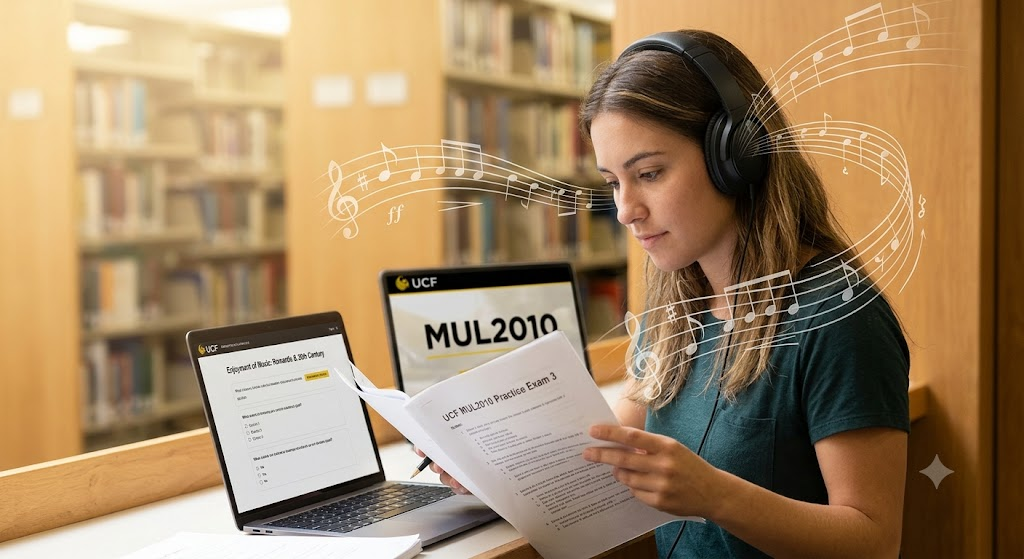
Additional Information
What the Course Entails and Exam Details
UCF’s Enjoyment of Music takes students on a structured journey through music history, equipping them to actively listen, identify core genres, and contextually understand the evolution of musical language. Following standard semester progression, Exam 3 will heavily concentrate on the critical eras immediately succeeding the Baroque and early Classical periods. This syllabus section typically encompasses:
The Late Classical Master: A deep dive into the revolutionary contributions of Ludwig van Beethoven, highlighting how his work bridged the Classical and Romantic eras and redefined symphonic structure.
The Romantic Revolution: Mastery of key concepts including program music vs. absolute music, the rise of the piano as a virtuoso instrument (think Chopin and Liszt), the development of the Art Song (Lied), and the thematic integration found in Romantic opera (Wagner and Verdi).
20th Century Innovations: An introduction to the radical departures of early modernism, covering Impressionism in music (Debussy), Expressionism (Schoenberg’s twelve-tone system), and the explosive rhythmic experimentation of Igor Stravinsky’s Rite of Spring.
Aural Skills: Crucially, this course is designed around listening. The practice exam will test your ability to recognize specific musical styles, textures, instrumentation, and core structures by ear, linking a sound snippet to its historical period or composer.
What to Expect in the Final Exam
While the exact structure may vary by instructor, the official third MUL2010 exam at UCF typically employs a blended format designed to test both conceptual knowledge and active listening proficiency.
Format: Students should expect a substantial number of multiple-choice and matching questions focused on definitions, composers, historical contexts, and key terminology (e.g., leitmotif, rubato, atonality, symphonic poem).
Listening Component: A significant portion of the exam, often around 30-40%, will involve mandatory listening identification. You will hear an excerpt of music and must correctly identify its title, composer, or historical era based solely on its unique aural characteristics.
Time Limit and Passing Score: The official exam is usually administered during a standard lecture period, giving students approximately 50 to 75 minutes. A passing grade in the course is generally a 'C' (70%) or higher for general education credit.
Specific Rules: All standard university academic integrity codes apply. The exam is closed-book, and students are typically restricted from using external devices.
How to Study and Exam Centers
This practice exam is a critical first step. To maximize your official score, follow these actionable strategies:
Practice Active Listening: Do not simply play music while multitasking. Dedicate specific time to listening to the course anthology tracks without distraction. Identify the key instruments, tempo changes, textures, and emotional content as they happen. This is the single most important study method for MUL2010.
Create Structured Playlists: Organize your required listening by era (Romantic, 20th Century) and by genre (Symphony, Art Song, Opera). Listen for common threads and stark contrasts within and between these groups.
Utilize Flashcards and Outlines: Use digital or physical flashcards for definitions and biographies. Create outlines summarizing the key cultural motivations and structural innovations of each major era and composer.
Review Instructor Materials: Thoroughly review the course syllabus, lecture slides, and any specific listening guides or notes provided by your professor on Canvas/Webcourses. Your instructor has designed the test and knows exactly what they want you to demonstrate.
Exam Location Information:
The official MUL2010 exams are typically administered through the UCF Webcourses (Canvas) portal. While some instructors require students to take the exam during a scheduled class time in their regular lecture hall on the UCF main campus, others may deliver the test remotely, requiring students to use a proctoring service like Honorlock. It is essential to carefully check your specific instructor’s syllabus and announcements on Webcourses to confirm whether you will be testing on campus or digitally.
Job Opportunities from the Course
As an essential component of a general education curriculum, MUL 2010 does not serve as vocational training for one specific technical career. Instead, it equips you with critical transferable skills that significantly enhance your professional profile. Mastering aural analysis, connecting art to complex historical contexts, and communicating abstract ideas all make you a highly effective candidate in many diverse fields. Career paths where these skills are directly applicable include:
K-12 Music Education or Arts Instruction (often as a starting point for general education)
Arts Administration and Non-Profit Management (working with orchestras, museums, and foundations)
Media Programming and Music Curating (e.g., for streaming services, radio, or podcasts)
Music Marketing and Public Relations
Entertainment Journalism and Music Criticism
Higher Education (e.g., academic advising or program coordinating in fine arts departments)
Completing this course signals that you are a culturally aware, critical thinker capable of synthesizing complex information across multiple disciplines—a skillset desirable in almost every modern industry.
Now that you have your study guide, use this generated image to stay focused and motivated during your preparation!
Frequently Asked Questions
Reviews
5.0
Based on 0 reviews
Leave a Review
No reviews yet. Be the first to review!