
University of Central Florida (UCF) PSY3213C Research Methods in Psychology Practice Exam 1
$69.00
- Buy to unlock unlimited access to all Quiz questions and Answers in this Quiz.
- After purchase you can print a PDF of the whole quiz at any point. The PDF will contain the questions and the correct answers.
About this Exam
The UCF PSY3213C Research Methods in Psychology Practice Exam 1 is a strategic diagnostic tool designed to simulate the challenges and format of the first major examination in this essential course. This specific practice test focuses on the initial third of the syllabus, preparing you to succeed on your actual "Exam 1." It is intended for undergraduate psychology majors and minors at UCF who need to master how psychologists think, design studies, and analyze data before moving on to more advanced coursework. Taking this practice exam is highly recommended for identifying personal knowledge gaps, building critical test-taking confidence, and reducing anxiety by making the exam environment predictable.
Ready to test your knowledge?
Buy Now to Access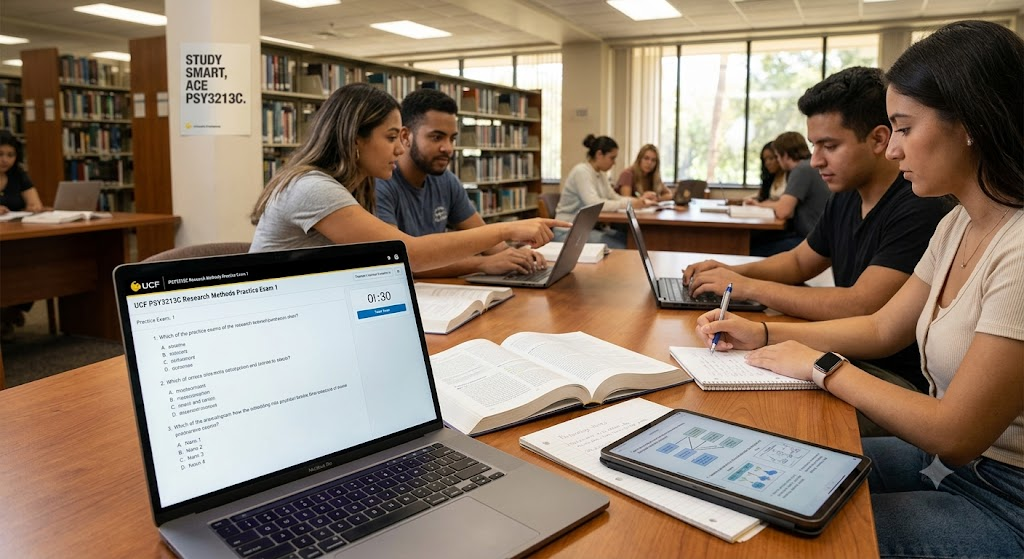
Additional Information
What the Course Entails and Exam Details
PSY3213C is a rigorous introduction to the core principles of scientific inquiry as applied to human behavior. It moves beyond "common sense" and teaches you the systematic methods required to generate reliable knowledge. The course (and consequently Practice Exam 1) heavily covers the theoretical underpinnings of research.
Key topics covered in the syllabus include:
Introduction to Psychology as a Science: Differentiating science from pseudoscience and understanding the goals of psychological research.
Generating Research Ideas: Moving from curiosity to testable hypotheses and operational definitions.
Ethics in Research: Deep knowledge of the Belmont Report, the APA Ethical Principles, and Institutional Review Boards (IRB). This is always a critical section on Exam 1.
Observational Research: Mastering different techniques (e.g., naturalistic observation, structured observation, case studies) and their inherent biases.
Survey Research and Sampling: Understanding different sampling methods (random vs. non-random) and how to design effective survey questions while avoiding bias.
Correlational Research: Understanding the meaning, limitations, and visualization of correlations.
Basic Statistics and Data Display: Familiarity with concepts like the normal curve, standard deviation, correlation coefficients, and creating effective tables and graphs.
Practicing these concepts under timed conditions is essential because Exam 1 typically tests your ability to apply definitions to new scenarios, not just recall facts.
What to Expect in the Final Exam
While you are preparing for Practice Exam 1, it is crucial to understand the format of the actual, high-stakes midterm (often called "Exam 1"). The core objective is for your practice session to mirror reality as closely as possible.
Typically, you can expect the actual UCF PSY3213C Exam 1 to be a comprehensive test with approximately 40 to 60 multiple-choice questions. Depending on your specific professor, there may also be short-answer components or conceptual matching. It is usually proctored (either in person or online using Respondus Lockdown Browser via Webcourses@UCF).
Students are generally given the standard class period to complete it, often 50 or 75 minutes. A passing score for individual exams is typically determined by the professor (e.g., 60-70%), but the cumulative nature of the course grading makes every exam critical. Remember that the final exam often includes some cumulative review, reinforcing the importance of mastering this initial material now.
How to Study and Exam Centers
Maximizing your performance on the actual exam requires more than just passive reading. You must use active recall and spaced repetition strategies. Utilize your textbook (often Research Methods in Psychology by Morling) and class lectures. Create flashcards for terms and definitions, as terminology is a major component of Exam 1. Focus especially on ethics, sampling methods, and defining variables (IV and DV).
The single most effective strategy is to treat your practice exam as the real test. Set a timer, clear your workspace, and complete the practice exam without interruption. Afterwards, thoroughly analyze not only the questions you got wrong but also the ones you were unsure about. Understand why the correct answer is right and why the other options are wrong.
Where to Take the Exams:
Unlike professional certifications, university course exams, including PSY3213C Exam 1, are not taken at external Pearson VUE centers.
Your specific course section, whether in person or online, dictates where and how you take both the practice and actual exams:
Webcourses@UCF: Practice exams are almost always provided in a quiz format within your course portal. Actual online exams are also administered here, often using proctoring software.
UCF Testing Center (SARC/SAS): For students requiring academic accommodations, the Student Academic Resource Center (SARC) or Student Accessibility Services (SAS) may proctor exams. In-person lecture hall testing is also common for face-to-face sections.
Job Opportunities from the Course
Mastering research methods is the most important skill for a psychology major's career prospects. The competencies you develop in this course—critical thinking, data analysis, and understanding ethical constraints—are universally valued in professional settings. This course directly unlocks the following career paths and specific job titles:
Clinical Research Coordinator / Assistant: Manages the operational side of clinical trials in hospitals and labs.
User Experience (UX) Researcher: Uses psychological methods to understand and improve human interaction with products and technology (very lucrative).
Market Research Analyst: Collects and analyzes data on consumer behavior to guide business strategy.
Data Analyst: Applies statistical knowledge to solve problems in corporate, government, or healthcare sectors.
Lab Manager: Oversees research operations in academic or private research institutions.
Social Science Research Assistant: Supports diverse projects for nonprofits, universities, or think tanks.
Policy Analyst: Uses data to evaluate the impact of public policies.
Academic Advisor / Higher Education Professional: Uses counseling and analytical skills to guide students, leveraging an understanding of educational research.
Advanced Degree Pathways: Success in this course is mandatory for admission to Ph.D. and Master’s programs in all fields of Psychology (Clinical, I-O, Social, Counseling, Developmental), as well as degrees in Public Health, Social Work, and Law.
By investing time in this UCF PSY3213C Research Methods Practice Exam 1, you are not just preparing for one test; you are laying the foundation for your scientific career. Good luck!
Frequently Asked Questions
Reviews
5.0
Based on 0 reviews
Leave a Review
No reviews yet. Be the first to review!