
University of Central Florida (UCF) PUR4000 Public Relations Practice Exam
$69.00
- Buy to unlock unlimited access to all Quiz questions and Answers in this Quiz.
- After purchase you can print a PDF of the whole quiz at any point. The PDF will contain the questions and the correct answers.
About this Exam
Welcome to your essential guide for navigating the PUR4000 Public Relations course at the University of Central Florida and preparing effectively for its final exam!
PUR4000, commonly known as Introduction to Public Relations, is a vital course and a required component for students seeking entry into UCF's highly-regarded Ad/PR restricted major track.
This course is designed to provide aspiring communication professionals with a robust foundation in the principles, history, theories, and fundamental strategies of public relations in the real world. This study guide and any associated practice resources are specifically curated for current UCF students or prospective majors who are currently enrolled or planning to take the PUR4000 course and are focused on excelling in their end-of-term final assessment.
Mastering this material is a significant stepping stone towards a successful career in the dynamic field of public relations.
Ready to test your knowledge?
Buy Now to Access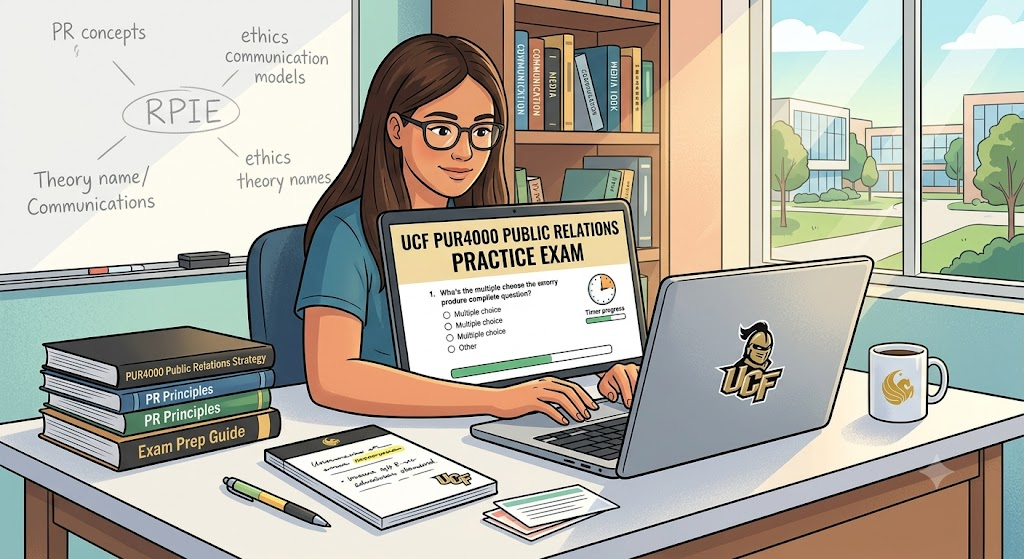
Additional Information
What the Course Entails and Exam Details
The UCF PUR4000 course is not merely a memory game; it is an exploration of the crucial role public relations plays in building and maintaining relationships between organizations and their diverse publics. The syllabus typically covers a wide array of core topics, ensuring students develop a holistic understanding of the discipline.
Key areas you can expect to delve into include:
PR Principles & History: Understanding the evolution of public relations and the foundational principles that guide ethical practice.
PR Theories: Exploring communication and persuasion theories applicable to public relations contexts.
Ethics and Law in PR: Learning about current ethical guidelines, copyright law, libel, and industry standards.
Research and Planning: Mastering essential research methods and the four-step public relations process (research, planning, implementation, evaluation - RPIE).
Writing for PR: Developing core professional writing skills for different formats such as news releases, media pitches, and memos.
Media Relations: Learning how to effectively engage with journalists and navigate the media landscape.
Crisis Communication & Issues Management: Understanding techniques for managing unexpected events and preparing organizational responses.
PR in Specific Sectors: An overview of public relations practice in corporate, nonprofit, government, and global environments.
This course is generally aimed at students who are exploring or are already committed to the Advertising/Public Relations major at UCF and serves as a fundamental prerequisite before students can fully enter the restricted major track. The "exam" this guide prepares you for is typically the comprehensive final exam administered by UCF at the end of the semester, testing knowledge across all these critical areas.
What to Expect in the Final Exam
As with most university final exams, students should be prepared for a proctored and challenging end-of-term assessment. While the exact structure can vary depending on the instructor and current university policies, a PUR4000 final exam often incorporates a mix of question formats to thoroughly test students' grasp of both theoretical knowledge and practical application.
Common components you might encounter include:
Multiple Choice Questions: These will likely assess your knowledge of key definitions, historical figures, fundamental theories, ethical codes, and standard PR practices. Be prepared for challenging scenarios that require you to identify the best answer.
True/False Statements: Testing specific details and principles.
Short Answer/Essay Questions: These are common in PUR4000, requiring you to apply concepts to real-world or theoretical scenarios. You might be asked to draft a short PR memo, analyze a simple crisis situation, define and elaborate on a key theory, or outline a basic PR plan based on a given prompt. These questions evaluate your critical thinking and professional communication skills.
The final exam is usually timed, adhering to the university's standardized final exam schedule, often allowing between 2 to 3 hours for completion. The passing score required to fulfill the Ad/PR major entry requirements is typically a C (or a specific numerical percentage as determined by the Nicholson School), and a higher grade is always beneficial for your GPA and major standing.
Academic integrity is paramount, and the exam will be subject to strict proctoring rules, whether in-person in a classroom or via the university's approved online proctoring software for web-based courses.
How to Study and Exam Centers
Preparing for the PUR4000 final exam requires a strategic and multifaceted approach. Leverage a range of effective study techniques:
Comprehensive Practice Exams: Utilize high-quality practice exams (like those provided by educational resources associated with this guide!) to simulate the actual testing experience. Actively engaging with diverse question types will not only familiarize you with potential formats but also build your confidence and refine your time management.
Thoroughly Review Your Syllabus and Textbooks: The syllabus is your roadmap. Ensure you have reviewed all assigned readings from your primary textbook and any supplementary materials. Pay close attention to definitions, case studies, and key models.
Consolidate Your Class Notes: Review and organize your lecture notes from throughout the semester. Focus on identifying and highlighting key concepts, examples, and discussions emphasized by your instructor.
Create Flashcards: Use digital or physical flashcards to memorize crucial definitions, theories, and standard ethical codes. This technique is particularly helpful for self-testing and rapid recall.
Form Study Groups: Collaborating with peers can be invaluable. Discussing complex concepts, debating scenarios, and teaching each other specific topics can significantly deepen your understanding and expose you to different perspectives.
Practice PR Writing: Don't neglect the practical application! Dedicate time to practice drafting common PR documents like news releases, media pitches, or crisis statements within a timed framework.
Where and How to Take the Final Exam: The actual final exam will be administered by the University of Central Florida. For students in face-to-face or mixed-mode classes, the exam will likely be proctored in a physical classroom on the UCF main campus during the designated final exam week.
For students in web-based courses, the exam may be administered online via the university's learning management system (Canvas) and will typically require an approved proctoring solution such as Respondus LockDown Browser and/or Monitor.
Students must carefully check their course syllabus, Canvas announcements, and official UCF communications for specific details regarding time, location (physical or virtual), and the precise requirements for their section's final exam.
The university also has a centralized University Testing Center on the main campus, but this is typically used for specific entrance/placement tests, alternative testing, or correspondence exams rather than standardized course finals for all current students. Always confirm the details specific to your PUR4000 section.
Job Opportunities from the Course
Successfully completing the PUR4000 course and pursuing the Advertising/Public Relations major opens doors to a vibrant array of exciting career paths. While this single course is a key step, it lays the groundwork for diverse professional roles.
Potential career titles for graduates with a background in Public Relations from UCF include:
Public Relations Assistant
Social Media Coordinator/Manager
Junior Public Relations Account Executive
Communication Coordinator
Media Relations Coordinator
Content Marketing Specialist
Crisis Communication Junior Associate
Internal Communication Specialist
Event Coordinator (with a PR focus)
Nonprofit Communication Coordinator
Government Public Information Officer (PIO)
PR and Marketing Intern (a crucial stepping stone)
These positions span various industries, including corporate, tech, entertainment, healthcare, and nonprofit, offering dynamic environments where your communication skills can make a real impact.
Frequently Asked Questions
Reviews
5.0
Based on 0 reviews
Leave a Review
No reviews yet. Be the first to review!