
University of Central Florida (UCF) REE3433 Real Estate Law Practice Exam 2
$69.00
- Buy to unlock unlimited access to all Quiz questions and Answers in this Quiz.
- After purchase you can print a PDF of the whole quiz at any point. The PDF will contain the questions and the correct answers.
About this Exam
The UCF REE3433 Real Estate Law Practice Exam 2 is a crucial study tool designed for students enrolled in the University of Central Florida's Real Estate Law course.
This specific practice exam focuses on the legal principles governing real estate transactions within the state of Florida.
It is designed to help students, typically undergraduate business or real estate majors and minors, synthesize the complex legal concepts covered in the middle portion of their semester.
By taking this practice exam, students can assess their understanding of key topics and identify areas where they need further study before the final graded assessment, enhancing their readiness for both the academic exam and a future career in the real estate industry.
Ready to test your knowledge?
Buy Now to Access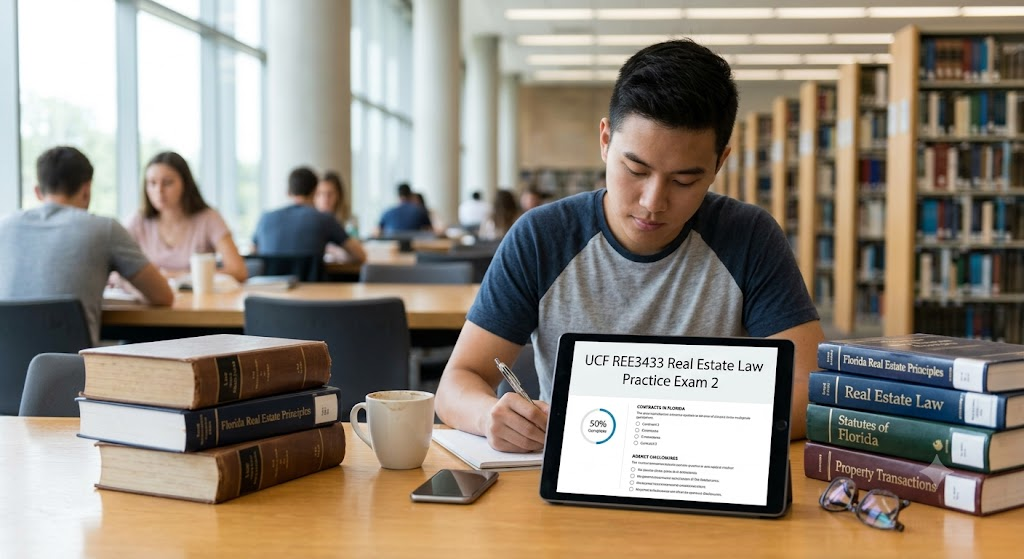
Additional Information
What the Course Entails and Exam Details
The full UCF REE3433 Real Estate Law course provides a comprehensive foundation in the legal aspects of owning, transferring, and managing real estate.
It covers both fundamental property law principles and the specific statutory and regulatory framework unique to Florida.
Exam 2 typically focuses on a significant segment of the course, often including:
Real Estate Contracts: Mastering the legal requirements for valid and enforceable real estate contracts in Florida, including listing agreements, buyer broker agreements, and purchase and sale contracts.
Florida Real Estate Commission (FREC) Rules: Understanding the specific regulations and administrative code governing the conduct of real estate licensees in Florida.
Agency Relationships: Detailing the types of agency relationships (transaction broker, single agent, no brokerage relationship), their associated duties, and disclosure requirements.
Titles and Deeds: Distinguishing between different types of deeds (statutory, special warranty, quitclaim) and the concepts of legal versus equitable title.
Dispute Resolution: Examining the legal methods for resolving real estate disputes in Florida, including mediation, arbitration, and litigation.
Violations and Penalties: Knowing the potential administrative, civil, and criminal penalties for violating Florida real estate license law.
What to Expect in the Final Exam
The actual graded Exam 2 for REE3433 at UCF will closely parallel the structure and complexity of this practice exam.
While the exact format is determined by the individual instructor, students can generally expect:
Format: A closed-book, timed examination, often consisting of multiple-choice questions. Some instructors may also include short answer, essay questions, or practical legal scenario analyses.
Time Limit: Usually between 60 and 90 minutes, requiring efficient time management and a strong grasp of the material.
Passing Score: A passing grade is typically defined by the course syllabus (e.g., 60% or 70%). However, students should aim much higher, as this score significantly impacts their final grade.
Calculators: Unless specifically stated for a "real estate math" component, simple, non-programmable calculators are usually not required or permitted for the law-focused exam.
How to Study and Exam Centers
Effectively preparing for UCF REE3433 Real Estate Law Exam 2 requires a multi-faceted approach combining active recall and practical application.
Actionable Study Strategies:
Treat the Practice Exam Like the Real Thing: Take this practice exam under simulated testing conditions. Time yourself, eliminate distractions, and do not use your notes. This will give you an accurate baseline of your knowledge and reveal which topics are your weakest.
Create Statutory Flashcards: The Florida Real Estate Statutes (Chapter 475) are a critical component. Create digital or physical flashcards for key definitions, deadlines, and prohibited actions.
Analyze Florida Real Estate Scenarios: Don't just memorize definitions; practice applying the law to scenarios. For example, determine the proper agency disclosure required for a specific transaction type.
Review Instructor-Provided Materials: Pay close attention to the specific case studies, legal forms, and lecture examples highlighted by your UCF professor.
Taking the Exam:
This is a course-specific exam for enrolled UCF students. The final graded exam is typically administered through UCF's Learning Management System, Webcourses@UCF, or during a scheduled class period.
It is not administered through external testing centers like Pearson VUE, which are for the official state licensing exam.
Job Opportunities from the Course
Completing UCF REE3433 Real Estate Law, and excelling in its exams, builds a powerful foundation for a wide range of legal and transactional roles within the real estate industry.
While not a standalone certification for attorney practice (which requires a J.D.), this academic knowledge is a critical asset for careers including:
Real Estate Broker or Sales Associate (a fundamental requirement for licensure)
Real Estate Paralegal
Escrow Officer or Title Closing Agent
Community Association Manager (CAM)
Real Estate Transaction Coordinator
Right-of-Way Agent
Zoning and Land Use Technician
Property Manager
Frequently Asked Questions
Reviews
5.0
Based on 0 reviews
Leave a Review
No reviews yet. Be the first to review!