
University of Central Florida (UCF) SOP3004 Social Psychology Practice Test 3
$69.00
- Buy to unlock unlimited access to all Quiz questions and Answers in this Quiz.
- After purchase you can print a PDF of the whole quiz at any point. The PDF will contain the questions and the correct answers.
About this Exam
The UCF SOP3004 Social Psychology Practice Test 3 is an essential study tool designed for undergraduate students enrolled in the SOP3004 Social Psychology course at the University of Central Florida. This practice exam is specifically created to help students master the third major block of course content, which typically covers advanced topics such as group dynamics, prejudice, aggression, and prosocial behavior. This resource is ideal for psychology majors, social science students, or anyone taking the course as an elective who wants to achieve a high grade. It provides a realistic simulation of the final assessment environment, helping students identify knowledge gaps and build confidence before the actual exam day.
Ready to test your knowledge?
Buy Now to Access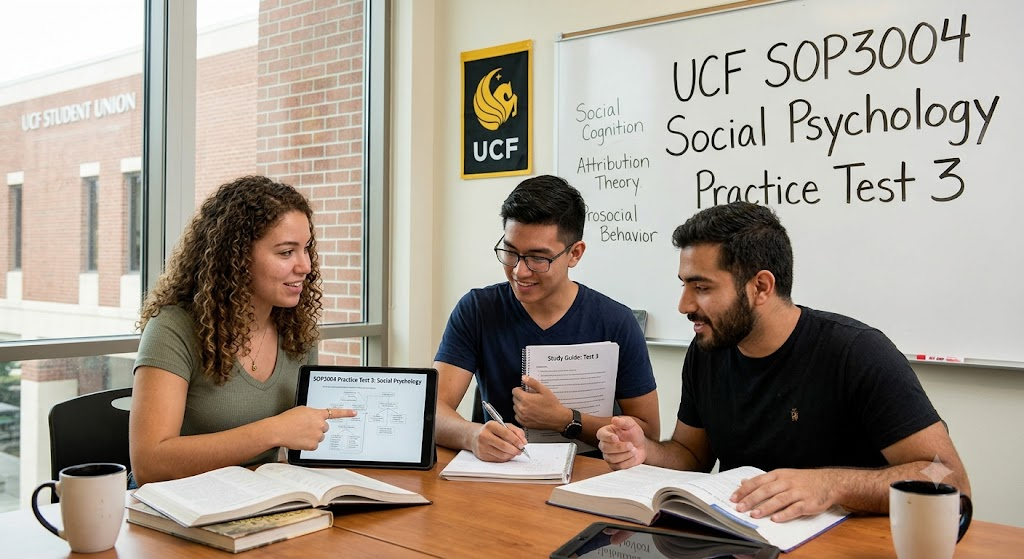
Additional Information
What the Course Entails and Exam Details
The SOP3004 Social Psychology course explores how individuals' thoughts, feelings, and behaviors are influenced by the actual, imagined, or implied presence of others. The content covered by Practice Test 3 specifically emphasizes the interaction between the individual and the group.
Key topics included in this practice exam typically cover the following modules from the syllabus:
Group Dynamics: The study of group formation, structure, processes, and how groups influence individual behavior (e.g., social facilitation, social loafing, groupthink, and deindividuation).
Stereotyping, Prejudice, and Discrimination: Analyzing the cognitive (stereotypes), affective (prejudice), and behavioral (discrimination) components of intergroup relations, including origins and methods for reduction.
Aggression: Exploring the biological, social, and situational factors that contribute to aggressive behavior, and theories on how to reduce it.
Prosocial Behavior and Altruism: Examining why people help others, including the bystander effect, diffusion of responsibility, and motivational models of helping.
Social Influence and Conformity: Advanced analysis of informational and normative social influence, and classic studies on obedience (e.g., Milgram).
What to Expect in the Final Exam
The final exam for UCF SOP3004 is a comprehensive assessment covering all course materials. Practice Test 3 mimics the format students will encounter.
Here is what you can expect in the final assessment:
Exam Format: The actual exam is almost exclusively multiple-choice, focusing on terminology, theory application, and scenario-based analysis of social behavior.
Number of Questions: While Practice Test 3 varies, the actual final exam typically contains 50–75 questions depending on the instructor’s requirements.
Time Limit: Students are generally given a standard testing window, often 60 to 75 minutes, in line with regular class periods.
Passing Score: The standard academic grading scale at UCF applies. A score of 70% (C) is typically considered passing, but psychology majors often aim for significantly higher to maintain competitive GPAs for graduate study.
Specific Rules: The final exam is often administered through UCF's Webcourses@UCF portal (Canvas) and may require the use of LockDown Browser or a similar proctoring tool. Check your specific syllabus for academic integrity policies regarding open books or notes.
How to Study and Exam Centers
Effective preparation requires a structured approach. Use these actionable strategies to make the most of your study time:
Simulate the Testing Environment: When taking Practice Test 3, do so without your notes or textbook. Set a timer and minimize distractions to gauge your actual retention under pressure.
Review Incorrect Answers Thoroughly: The value of a practice test is in the review. If you miss a question, don't just find the correct answer; understand why your answer was incorrect and the underlying concept.
Master Key Vocabulary: Social psychology relies heavily on specific terms. Create flashcards (or use digital tools like Quizlet) for terms like "cognitive dissonance," "fundamental attribution error," and "pluralistic ignorance."
Create Concept Maps: For complex modules like Stereotyping and Prejudice, create concept maps linking the origins of prejudice (e.g., realistic group conflict theory) with methods of reduction (e.g., the jigsaw classroom technique).
Exam Locations: The SOP3004 course and its practice exams are fully integrated into Webcourses@UCF (Canvas). Students take practice tests online at their convenience. For the official final exam, students should refer to their syllabus. The final may also be online (requiring LockDown Browser and a webcam) or administered in-person at the main UCF Testing Center (Howard Phillips Hall) or authorized computer labs, especially for students with approved testing accommodations. Pearson VUE or third-party physical centers are not typically used for standard UCF course exams.
Job Opportunities from the Course
A strong understanding of Social Psychology gained through SOP3004 is applicable across numerous career paths. This course content develops crucial soft skills and analytical abilities valued by employers.
Below is a clear list showing the career paths and job titles unlocked by expertise in this field:
Human Resources Specialist: Utilizing knowledge of group dynamics and conflict resolution to manage personnel, hiring, and employee relations.
Market Research Analyst: Applying principles of social influence, attitude formation, and persuasion to understand consumer behavior.
Marketing and Advertising Coordinator: Creating persuasive campaigns based on attribution theory, social cognition, and cognitive dissonance models.
Social Worker/Case Manager: Understanding the social determinants of behavior to support individuals and families navigating complex systems.
Survey Researcher/Data Analyst: Designing and conducting surveys on social attitudes and behavior for government or non-profit organizations.
Non-Profit Program Coordinator: Developing community outreach programs by leveraging theories of prosocial behavior and altruism.
UX (User Experience) Researcher: Analyzing how people interact with technology using principles of social perception and cognition.
Jury Consultant: Using insights from conformity and group decision-making to assist legal teams in the jury selection process.
Frequently Asked Questions
Reviews
5.0
Based on 0 reviews
Leave a Review
No reviews yet. Be the first to review!