
University of Central Florida (UCF) SPA3011 Speech Science Practice Exam 2
$69.00
- Buy to unlock unlimited access to all Quiz questions and Answers in this Quiz.
- After purchase you can print a PDF of the whole quiz at any point. The PDF will contain the questions and the correct answers.
About this Exam
The University of Central Florida (UCF) SPA3011 Speech Science course is a fundamental scientific pillar for undergraduate students majoring in Communication Sciences and Disorders (CSD). This essential course provides the core scientific knowledge required to understand how humans produce and perceive speech, spanning the fields of acoustics, physiology, and perception. It introduces the vital concepts that bridge the gap between basic physical principles and clinical application in speech-language pathology and audiology. This comprehensive Study Guide and Practice Exam 2 are meticulously designed as powerful preparatory tools to help you confidently master the mid-course material and simulate the exam-day experience. By synthesizing key theories and challenging you with realistic, application-based questions, this guide empowers you to excel.
Ready to test your knowledge?
Buy Now to Access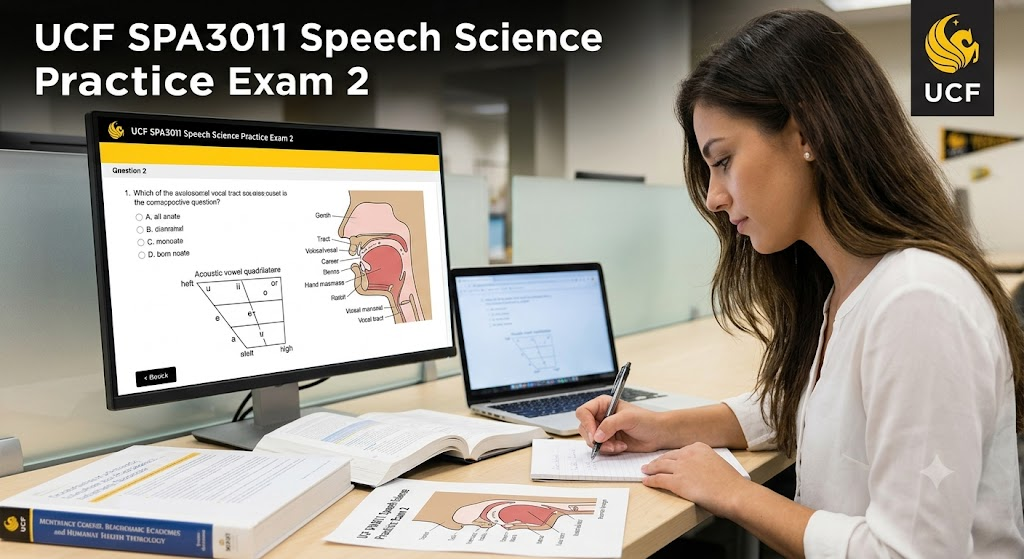
Additional Information
What the Course Entails and Exam Details
SPA3011, often titled "Speech Acoustics" or "Speech Science," provides an in-depth investigation into the physical and physiological processes underlying human communication. The course syllabus covers foundational topics that connect physics to anatomy. While the exact content can shift slightly, "Practice Exam 2" typically focuses heavily on the production mechanisms of speech. You can expect to encounter questions requiring a detailed understanding of the respiratory system, the laryngeal mechanism, and the acoustics of vowels. Key concepts for this stage often include the anatomy of the larynx, the myoelastic-aerodynamic theory of phonation, respiratory control for speech, and a deep understanding of the Source-Filter Theory as applied to vowel production. A major component of Exam 2 will likely involve calculating fundamental frequency, understanding pitch vs. frequency, and analyzing acoustic vowel quadrilateral charts. Mastery here is crucial before advancing to complex consonant production and speech perception.
What to Expect in the Final Exam
While "Practice Exam 2" is a simulation, it is structured to mirror the format of a typical mid-term test at UCF. Expect a challenging yet fair combination of question types. The exam will likely be hosted within the UCF Webcourses (Canvas) platform. The format commonly includes:
Multiple Choice: Testing recall and application of theories.
True/False: Assessing understanding of specific definitions.
Short Answer/Calculation: Requiring you to apply formulas (e.g., for frequency, period, or wavelength) or label anatomical diagrams.
Acoustic Analysis: Interpreting basic waveforms and vowel spectra.
A typical mid-term like this has a time limit, often 60 to 75 minutes, simulating the pressure of a real testing environment. While this practice exam does not have a formal passing score required for course credit, aim for a score above 80% to indicate that you have developed a strong mastery of the current material. Treat this as a diagnostics tool to identify weak areas.
How to Study and Exam Centers
Effective preparation requires an active and multifaceted approach. Do not rely solely on passive reading. Here are actionable strategies to enhance your studying for SPA3011 Exam 2:
Master the Diagrams: Create your own labeled diagrams of the larynx, the respiratory system, and the source-filter model. Do this from memory multiple times.
Practice Calculations: Work through numerous practice problems involving frequency, period, and wavelength until you can do them confidently.
Acoustic Interpretation: Spend time with example spectrograms and vowel charts, explaining to yourself what the formants (F1, F2) indicate about tongue position.
Use the Practice Exam as a Tool: Take this Practice Exam 2 under timed, closed-book conditions to identify your remaining knowledge gaps.
Active Recall: Cover your notes and explain concepts (like the myoelastic-aerodynamic theory) out loud as if you were teaching someone.
As a "Practice Exam" or internal course assessment, you will likely take this test through your UCF Webcourses (Canvas) portal. It does not require a specific physical testing center like Pearson VUE or a proctored, high-security environment unless explicitly stated in your syllabus for a proctored midterm.
Job Opportunities from the Course
Completing SPA3011 is not an end but a critical gateway on your pathway to a rewarding career in human communication science and disorders. While this single course does not confer certification, your performance is a strong indicator of your readiness for graduate studies. Finishing the full CSD undergraduate degree at UCF, of which this course is a cornerstone, unlocks a clear list of career paths, including:
Speech-Language Pathology Assistant (SLPA): In many states, this allows for professional work under the supervision of a licensed SLP.
Audiology Assistant: Assisting audiologists in clinical settings.
Behavior Therapist: Using communication principles to assist individuals on the autism spectrum.
Early Intervention Specialist (Non-licensed): Working in developmental services.
Special Education Paraprofessional: Supporting students with communication needs.
Clinical or Research Lab Assistant: Contributing to research in speech, language, or hearing.
Graduate Study: Admission to a Master's program in Speech-Language Pathology or a Doctorate in Audiology (AuD), unlocking the highest career and earning potential.
Frequently Asked Questions
Reviews
5.0
Based on 0 reviews
Leave a Review
No reviews yet. Be the first to review!