
University of Central Florida (UCF) SPA3101 Anatomy and Physiology of Speech, Language, and Hearing Practice Exam 2
$69.00
- Buy to unlock unlimited access to all Quiz questions and Answers in this Quiz.
- After purchase you can print a PDF of the whole quiz at any point. The PDF will contain the questions and the correct answers.
About this Exam
This comprehensive study guide is specifically designed to help students prepare for the University of Central Florida (UCF) SPA3101 Anatomy and Physiology of Speech, Language, and Hearing Practice Exam 2. SPA3101 is a cornerstone course within the Communication Sciences and Disorders (CSD) program, serving as a critical foundation for future speech-language pathologists and audiologists. This practice exam is a key tool to assess understanding of complex anatomical structures and physiological processes involved in human communication halfway through the semester. It is designed for undergraduate students aiming to master these essential biological concepts before advancing to clinical coursework.
Ready to test your knowledge?
Buy Now to Access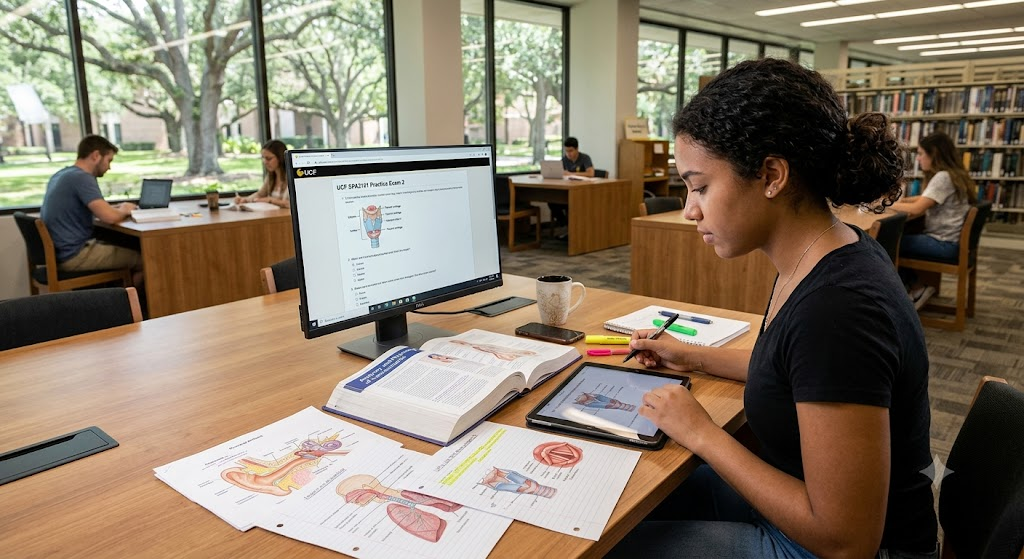
Additional Information
What the Course Entails and Exam Details
SPA3101 Anatomy and Physiology of Speech, Language, and Hearing provides an in-depth exploration of the biological systems supporting communication. This second practice exam typically transitions from fundamental terminology into the detailed mechanics of speech production and early hearing science.
The course entails mastering intricate systems and often focuses on:
Respiratory System for Speech: Understanding the anatomy of the lungs, rib cage, diaphragm, and muscles of inhalation and exhalation, alongside the physiology of breathing for life versus breathing for speech.
Phonatory System: Detailed study of the larynx, including the intricate cartilages (thyroid, cricoid, arytenoid), intrinsic and extrinsic muscles, and the complex physiology of vocal fold vibration (myoelastic-aerodynamic theory).
Articulatory and Resonatory Systems: Examination of the pharynx, oral cavity, and nasal cavity. Students must identify the structures (hard palate, velum, tongue, teeth, mandible) and understand how they shape the sound source.
Auditory System (Introductory): An introduction to the anatomy of the outer and middle ear, including the tympanic membrane and ossicular chain, and how they contribute to the conductive mechanism of hearing.
Nervous System Overview: A preliminary look at how the central and peripheral nervous systems control these speech-production mechanisms.
The practice exam details reflect this focus, acting as a crucial checkpoint to ensure students have a firm grasp of these complex systems.
What to Expect in the Final Exam
While structure varies, the UCF SPA3101 practice exam is generally designed to simulate the format and rigor of the official major assessments and the comprehensive final.
Students can typically expect:
Format: A balanced mix of question types. This includes traditional Multiple Choice questions focusing on terminology and concepts, as well as significant visual components. Labeling intricate diagrams of the larynx, respiratory system, or cross-sections of the vocal tracts is very common. You might also encounter short answer questions requiring you to explain physiological processes (e.g., "Describe the function of the posterior cricoarytenoid muscle").
Passing Score Requirements: As this is a foundational prerequisite course, a strong performance is critical. Students usually need to achieve a grade of 70% (C) or higher to progress smoothly in the CSD major. The practice exam provides an early indicator of your current standing.
Time Limits: Typically simulated to match classroom conditions, allowing approximately 60 to 90 minutes for completion.
Rules: Rules mirror official university procedures. This often includes being a closed-book, closed-note exam proctored via UCF’s Learning Management System (LMS) or in a physical classroom setting.
How to Study and Exam Centers
Preparation for SPA3101 must be active and visual rather than passive reading.
Actionable Study Strategies:
Master the Anatomy Visuals: Do not just read. Actively label and re-label blank diagrams of the larynx, respiratory system, and articulatory structures until you can do it flawlessly from memory.
Understand 'Why' (Physiology): For every structure, be able to explain its function. If you identify a muscle, ask, "What happens when this muscle contracts?" This links anatomy to physiology.
Use Active Recall: Create flashcards (physical or virtual via Quizlet) focusing on definitions, muscle functions, and specific cartilage properties.
Practice with Diagrams: Use the diagrams provided in lecture and the textbook. Use a whiteboard to draw and explain systems to yourself or a study partner.
Exam Centers:
UCF SPA3101 practice exams are typically administered through Webcourses@UCF (the university's Canvas-based LMS). This allows students to take the exam online, sometimes requiring a proctoring service or lock-down browser, depending on instructor preference.
Occasionally, practice exams may be scheduled as in-person sessions within specific UCF College of Health Professions and Sciences (CHPS) classrooms or computer labs on the main Orlando campus. Students must consult their specific syllabus and instructor announcements for exact scheduling and location details.
Job Opportunities from the Course
Successfully mastering the concepts covered in SPA3101 is the mandatory first step toward a career in communication disorders. While this specific course does not unlock immediate job titles, it is a foundational requirement for degrees that lead to the following career paths:
Speech-Language Pathologist (SLP)
Audiologist (AuD)
Speech-Language Pathology Assistant (SLPA)
Audiology Assistant
Rehabilitation Aide
Special Education Support Staff
Early Intervention Specialist
Voice Coach or Specialist
Researcher in Speech and Hearing Sciences
Healthcare Administrator (within rehabilitation settings)
Frequently Asked Questions
Reviews
5.0
Based on 0 reviews
Leave a Review
No reviews yet. Be the first to review!