
University of Central Florida (UCF) SPA3472 Behavioral Methods in Communication Disorders Final Practice Exam
$69.00
- Buy to unlock unlimited access to all Quiz questions and Answers in this Quiz.
- After purchase you can print a PDF of the whole quiz at any point. The PDF will contain the questions and the correct answers.
About this Exam
The UCF SPA3472 Behavioral Methods in Communication Disorders Final Practice Exam is a crucial diagnostic tool for undergraduate students aiming for a career in speech-language pathology, audiology, or related therapeutic fields. This course is a cornerstone of the Bachelor of Communication Sciences and Disorders (BS in CSD) program at UCF. It is designed to bridge the gap between basic behavioral principles and their practical application in assessing and treating communication disorders across the lifespan. Successful students demonstrate not only an understanding of the concepts but also the analytical skills to apply them to real-world clinical scenarios. This practice exam allows students to assess their readiness for the high-stakes end-of-semester evaluation and refine their study plan.
Ready to test your knowledge?
Buy Now to Access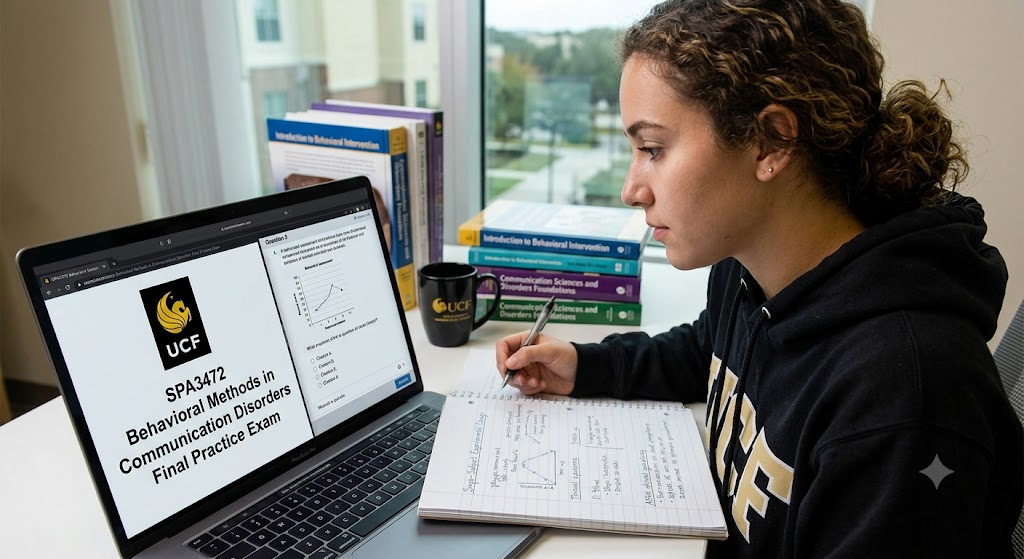
Additional Information
What the Course Entails and Exam Details
SPA3472, Behavioral Methods in Communication Disorders, is a 3-credit course that examines standard behavior modification techniques through the lens of a communication science and disorders professional. It is an upper-division course that requires a synthesis of knowledge. The comprehensive syllabus covers several core areas that form the foundation for all behavioral intervention:
Principles of Behavior: An in-depth look at reinforcement (positive and negative), punishment (positive and negative), extinction, stimulus control, and shaping.
Behavioral Assessment: Learning to define, measure, and analyze communication behaviors, including direct observation, data collection methods (e.g., frequency, duration, interval, latency), and functional behavior assessment (FBA).
Behavioral Intervention: The development, implementation, and modification of behavior management plans, with a focus on ethical practices and client-centered care.
Single-Subject Experimental Design: An introduction to the methodology used to measure clinical progress, such as reversal (ABAB) and multiple baseline designs.
Data Analysis and Interpretation: How to chart behavioral data, identify trends, and use data to make evidence-based clinical decisions.
Ethical Considerations in Behavioral Therapy: The course heavily emphasizes ethical guidelines, particularly the ASHA (American Speech-Language-Hearing Association) Code of Ethics, in applying behavioral change.
For the final practice exam, students should expect a comprehensive assessment that covers all of these main topics. It is a tool for self-correction before the official final.
What to Expect in the Final Exam
While the exact structure of the real final exam is proprietary to the UCF course instructor, a standard practice final for a behavioral methods class will mirror its likely format to provide an authentic testing experience. Students should expect to encounter:
Scenario-Based Multiple Choice: These questions won't just ask for definitions but will require the application of a concept to a provided clinical vignette. For example: "A non-verbal child on an ABA therapy plan receives a preferred toy after signing 'more.' What behavioral principle is demonstrated?"
Data Interpretation: You might be given a graph or a chart and asked to identify the trend, determine the stability of the baseline, or choose the best single-subject design to measure a specific outcome.
Ethical Scenarios: Expect a question or two where you must identify an ethical violation and select the proper course of action based on the ASHA Code of Ethics.
Terminology Matching: You need a strong grasp of specialized terms like 'conditioned reinforcer,' 'operant chamber,' 'prompting,' and 'fading.'
Practice with Case Studies: Often, practice exams include detailed cases where you are asked to draft a simple behavioral objective or choose appropriate behavioral strategies (e.g., differential reinforcement of alternative behavior).
A practice final does not have an official passing score, but it acts as a valuable diagnostic tool, highlighting areas that require immediate, focused study.
How to Study and Exam Centers
Preparation for a behavioral methods exam is most effective when it is active and analytical. Here are key study strategies and guidance on where to find the practice exam:
Active Study Strategies:
Create Conceptual Flashcards: Don't just list a term; include its definition, a real-world example, and how it might apply in a speech-language pathology clinic. For "shaping," you might write: "Definition: Systematically reinforcing successive approximations toward a target behavior. Example in SLP: Reinforcing a client with aphasia for producing a single sound, then a syllable, then a word."
Practice with Real Clinical Data: Use the examples provided in your course material. Ask your professor if there are supplemental datasets available. Practice graphing and interpreting different behavioral data points.
Review ASHA's Ethics Guidance: The ASHA Code of Ethics is not just a side topic; it's a foundation of the course. Understand the difference between responsibilities to clients, colleagues, and the public.
Analyze Case Studies with Peers: Form a study group and take turns creating case vignettes. One person describes a client's communication and behavioral profile, and the others propose ethical and appropriate behavioral objectives and strategies.
Complete the UCF Practice Exam Multiple Times: Approach the practice exam as a tool, not just a one-time test. Identify why a certain option is correct and why the other options (distractors) are incorrect. Use this to refine your reasoning.
Practice Exam Centers and Location:
The final practice exam for UCF SPA3472 is most commonly made available to students within the official course learning management system (LMS), which is Webcourses@UCF (powered by Canvas). It is typically a self-paced, online resource. While some professors may schedule a virtual session for discussion, it is largely something you can complete on your own. It is designed to be accessible wherever you have a stable internet connection.
Students should follow the direct instructions from their current UCF professor and check their SPA3472 course shell in Webcourses for specific links and dates. It is crucial to distinguish this practice tool from the formal official exam, which will have explicit proctoring, time limits, and location requirements dictated by the instructor (whether online with a tool like Honorlock or in a scheduled physical classroom at the UCF campus).
Job Opportunities from the Course
A strong performance in SPA3472 is a foundational step that opens the door to numerous fulfilling career paths. This course is a vital building block in the education of future communication disorders professionals.
Direct and Entry-Level Career Paths (with BS in CSD):
Speech-Language Pathology Assistant (SLPa): This is one of the most direct applications of this course. SLPas implement therapy plans under the supervision of a licensed Speech-Language Pathologist (SLP) and must be expert data collectors and behavioral managers.
Registered Behavior Technician (RBT) / Behavior Therapist: SPA3472 is an excellent primer for anyone seeking to work in Applied Behavior Analysis (ABA) with individuals with autism or other developmental disabilities. The knowledge of reinforcement and data collection transfers directly.
Clinic/Hospital Support Staff: The analytical and observational skills developed here are invaluable in supporting communication disorders clinics and managing patient interaction.
Teacher's Assistant / Special Education Aide: The ability to understand and influence behavioral change is highly desirable in educational settings, supporting both communication goals and classroom management.
Pathway to Master’s Degree in Communication Sciences and Disorders:
Successful completion of this course is a core prerequisite for the highly competitive graduate programs required to become a licensed Speech-Language Pathologist (SLP). SPA3472 provides the specific behavioral toolkit you will need for your clinical rotations and future practice in settings such as:
Early Intervention (birth-to-3)
Public and Private Schools (K-12)
Hospitals and Medical Centers
Rehabilitation Centers and Skilled Nursing Facilities
Community Clinics and Private Practices
By preparing diligently for your practice final in SPA3472, you are not just studying for a test; you are building the practical, ethical, and analytical foundation for a rewarding career helping others improve their communication and their lives.
Frequently Asked Questions
Reviews
5.0
Based on 0 reviews
Leave a Review
No reviews yet. Be the first to review!