
University of Central Florida (UCF) WOH2012 World Civilization I Exam 1 Practice
$69.00
- Buy to unlock unlimited access to all Quiz questions and Answers in this Quiz.
- After purchase you can print a PDF of the whole quiz at any point. The PDF will contain the questions and the correct answers.
About this Exam
Preparing for your UCF WOH2012 World Civilization I Exam 1?
This comprehensive study guide and the associated practice exam are designed specifically to boost your confidence and understanding of the key historical concepts, events, and civilizations covered in this crucial first assessment.
Tailored for students currently enrolled in the University of Central Florida's WOH2012 course, this resource helps bridge the gap between classroom learning and successful exam performance.
Ready to test your knowledge?
Buy Now to Access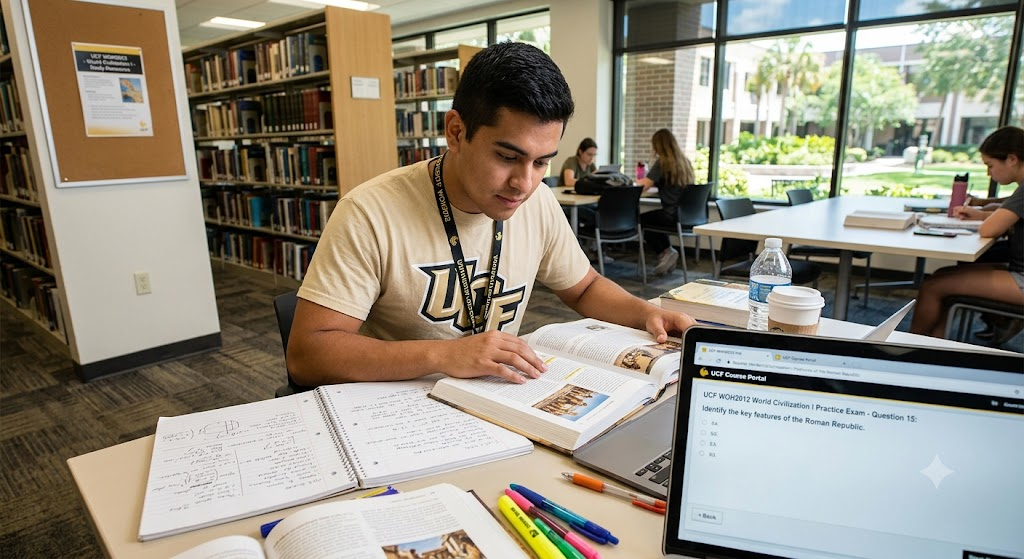
Additional Information
What the Course Entails and Exam Details
What the WOH2012 Course Entails:
The University of Central Florida’s WOH2012 (World Civilization I) course typically covers an extensive timeline, from the earliest human societies through approximately 1500-1600 CE. This sweeping historical journey explores:
The development and characteristics of the world’s major early river valley civilizations (Mesopotamia, Egypt, Indus Valley, China).
The rise and impact of significant classical empires and belief systems (Greece, Rome, Persia, India, early Imperial China).
The formation, evolution, and interactions of world religions (Hinduism, Buddhism, Judaism, Christianity, Islam).
The dynamics of key regional societies and empires in the post-classical era (Byzantine Empire, early Islamic Caliphates, sub-Saharan African kingdoms, the Americas before European contact, early modern European and Asian societies).
Patterns of trade, migration, warfare, and cultural exchange across diverse world regions.
Critical historical skills, including primary and secondary source analysis, evaluating historical evidence, and understanding historical interpretation.
UCF WOH2012 Exam 1 Specifics:
The initial exam in the WOH2012 course, often called "Exam 1" or a similar title, typically focuses on the earlier segments of the syllabus. This frequently includes:
Early Humans & Neolithic Revolution: The transition to agricultural and sedentary societies.
Early River Valley Civilizations: Key features, social structures, technological developments, and cultural achievements of these societies.
The Classical Age: The foundational philosophies, political systems, and major events in classical Greece, Rome, India, and China.
The Rise of Major Belief Systems: The early stages and core tenets of several influential religions.
What to Expect in the Final Exam
While this is a practice resource for the first assessment, the format, types of questions, and exam environment for the actual final exam (and often, midterms or earlier tests) in WOH2012 at UCF are crucial to understand. You can typically expect:
Format: A mix of question types is common. This frequently includes multiple-choice questions, matching, and short-answer or essay responses. Multiple-choice is often a major component to assess broad knowledge, while essays require deeper analysis and critical thinking.
Duration: The exam is likely timed, often spanning 1-2 hours depending on the weight of the test and the specifics set by the instructor.
Location: For the official exams, students either take them within the designated course lecture hall or at a proctored testing center as specified by UCF and the course syllabus. Online sections of the course may have online proctoring requirements (e.g., Honorlock or similar services) requiring a webcam and specific test environments.
Material: The exam will directly draw upon lectures, assigned readings (textbooks, primary source readers), and other course materials. The syllabus will outline the specific chapters or modules being tested.
Rules: Expect standard academic integrity and exam rules. No unapproved materials (calculators are usually not needed, and notes are generally not allowed unless specified), strict time limits, and identity verification are standard. For online exams, ensure your testing environment meets all requirements beforehand.
Passing: Success on individual exams contributes to your overall course grade as detailed in the syllabus. There isn't typically a single "passing score" for one exam, but a stronger performance is essential for a good final course grade and overall academic progress.
How to Study and Exam Centers
Actionable Study Strategies for WOH2012 Exam 1:
Attend and Actively Take Notes in Lectures: This is fundamental. Instructors often highlight key themes and details that will be tested. Note-taking helps you process information and creates a strong foundation for review.
Thoroughly Read Assigned Material: Don't skim. Read the textbook chapters and any assigned primary source readings. Actively engage with the text by highlighting or taking notes.
Use Course Syllabus as a Study Guide: Review the stated course learning objectives and weekly topics. This ensures you are covering all required material.
Create Flashcards: Flashcards are excellent for memorizing key terms, dates, historical figures, and defining characteristics of civilizations or belief systems.
Utilize Study Groups: Collaborate with classmates to discuss course material, quiz each other, and clarify complex concepts. Different perspectives can enhance understanding.
Practice with this Resource and Other Available Materials: Review class notes, textbook quizzes, and any practice exams or study guides provided by your instructor or TA. Use this practice exam and guide to identify areas where you need more focus.
Formulate Practice Essay Questions: Based on key themes in the course, try to anticipate essay questions and outline your potential responses. This develops critical thinking and essay-writing skills.
Stay Organized: Keep your notes, reading materials, and study resources well-organized. Good organization saves time and reduces stress.
Time Management: Break down your study sessions into manageable chunks over several days or weeks. Avoid cramming, which is often less effective.
Consult Your Instructor/TAs: If you are struggling with specific concepts, attend office hours or email your instructor or TAs for clarification.
How and Where to Take Official UCF Exams:
On-Campus Sections: For traditional face-to-face courses, exams are typically held in the regular classroom during the scheduled class time or a special exam period. Specific locations will be communicated by your instructor.
Online Sections/Specific Needs: For online courses or students with approved academic accommodations, exams might be proctored online or require scheduling at one of UCF’s official testing centers.
UCF Testing Center (SAS): Student Academic Services often administers exams requiring accommodations or proctoring. Be sure to register and schedule in advance.
Online Proctoring (if applicable): Online courses may use services like Honorlock, which allow students to take proctored exams securely from their own computer. Ensure you understand and have tested the technological requirements beforehand.
Official Communication: Always rely on the information provided in your official course syllabus and any direct communications (Canvas announcements, emails) from your instructor for the most accurate and up-to-date exam details.
Job Opportunities from the Course
A single course like WOH2012, while foundational, doesn't directly grant a specific job title. However, completing this course and the broader history or humanities degree program it is part of unlocks a wide range of career paths, as it cultivates highly transferable and valued skills such as critical thinking, research, writing, analytical reasoning, and communication. Here is a list of some of the potential job opportunities and fields:
Museum Curator/Staff
Archivist
Librarian (specifically in historical/academic settings)
Historical Researcher/Consultant
High School History Teacher (requires degree in education as well)
University Professor/Academic (requires advanced degrees)
Public Historian
Policy Analyst (government, NGOs, think tanks)
Law (highly values historical context and analysis skills)
Journalist/Writer
Grant Writer/Development Officer
Marketing/Communications (transferable skills)
Tourism/Travel Guide
Remember to always prioritize the official UCF and instructor-provided resources and information over any practice guide or external materials. Use this study guide as a supplementary tool to enhance your preparation. Good luck with your WOH2012 Exam 1!
Frequently Asked Questions
Reviews
5.0
Based on 0 reviews
Leave a Review
No reviews yet. Be the first to review!