
USAF Airfield Driving Practice Exam
$69.00
- Buy to unlock unlimited access to all Quiz questions and Answers in this Quiz.
- After purchase you can print a PDF of the whole quiz at any point. The PDF will contain the questions and the correct answers.
About this Exam
The USAF Airfield Driving Qualification is a mandatory certification for all United States Air Force personnel and designated civilian employees whose duties require them to operate any form of vehicle on an active airfield flight line. This qualification ensures that every driver possesses the specialized knowledge and skills required to navigate this extremely hazardous environment safely and efficiently. By demanding a high level of proficiency, the USAF aims to prevent ground mishaps, enhance operational readiness, and, most importantly, eliminate the potential for disastrous runway incursions that could jeopardize personnel and aircraft.
Ready to test your knowledge?
Buy Now to Access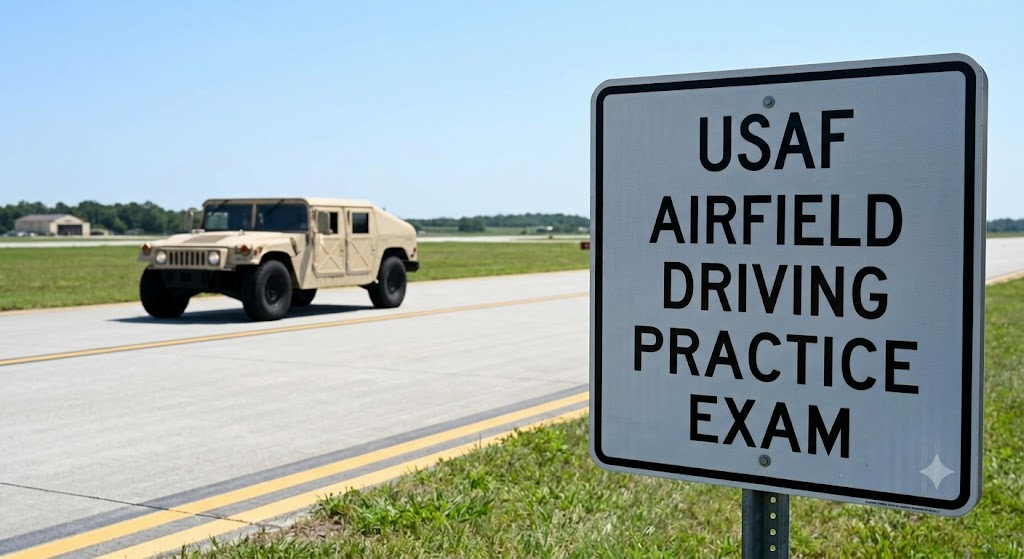
Additional Information
What the Course Entails and Exam Details
This training program is comprehensive, covering fundamental
concepts of airport operations and the strict protocols that govern them. The
curriculum is designed to teach you not only the mechanics of airfield driving
but also the critical safety mindset necessary for success. Key topics covered
in the training include:
- Understanding
Airfield Markings and Signs: You must master the language of the
flight line. This includes identifying and correctly interpreting runway
hold short lines, taxiway centerline and edge markings, boundary markers,
and various signage (e.g., Mandatory Instruction, Location, Direction, and
Destination signs). Understanding these visual cues is the foundation of
safe navigation.
- Deciphering
Airfield Lighting: The airfield has complex lighting systems that
guide aircraft and vehicles, especially during periods of darkness or low
visibility. You will learn the meaning of runway edge lights, taxiway edge
lights (blue), threshold lights, and the critical runway status lights
(RWSL) system.
- Navigating
the Control Tower Environment: Effective communication is paramount.
The course covers proper radio procedures and terminology, including the
phonetic alphabet and standard phrases. You will learn how to contact the
Air Traffic Control Tower (ATCT) for permission to cross or operate on
active runways and taxiways and, equally important, how to strictly adhere
to their instructions.
- Identifying
and Avoiding Run-way Incursions: A significant portion of the training
focuses on the definition, causes, and severe consequences of runway
incursions. You will learn detailed procedures to prevent these incidents,
including maintaining constant situational awareness and using required
checklists.
- Operating
Vehicle Safety Protocols: The training covers specific rules for
operating vehicles on the flight line, including speed limits,
right-of-way rules for aircraft, and proper parking procedures. This also
includes procedures for handling vehicle breakdowns or emergencies on the
airfield.
What to Expect in the Final Exam
The qualification process typically consists of both a
written examination and a practical evaluation. You must demonstrate
proficiency in both areas to receive your airfield driving privileges.
The Written Examination is often a multiple-choice or
short-answer test. It is designed to evaluate your retention and understanding
of the key concepts, regulations, and procedures learned throughout the
training. You can expect questions on:
- Interpreting
specific airfield signs and markings.
- Proper
radio procedures when contacting ATCT.
- Identifying
"runway hold short" points and when you must stop.
- Understanding
right-of-way rules for aircraft and emergency vehicles.
- Knowing
the required safety equipment for airfield vehicles.
The Practical Evaluation is a hands-on assessment
where an evaluator will observe your ability to apply your knowledge in a
real-world scenario. During this evaluation, you will likely be required to:
- Conduct
a vehicle inspection before entering the airfield.
- Correctly
navigate a pre-determined route on the taxiways and runways.
- Properly
communicate with the Air Traffic Control Tower, including requesting and
acknowledging clearances.
- Demonstrate
compliance with all airfield speed limits and traffic rules.
- Properly
identify key airfield landmarks, signs, and markings during the drive.
How to Study and Exam Centers
Preparation is key to succeeding on the USAF Airfield
Driving Practice Exam. Here are specific study strategies:
- Master
the Study Guide (AFPAM 24-301): The official USAF Airfield Driving
Study Guide is your primary resource. Dedicate significant time to
studying this document. Pay close attention to definitions, regulations,
and all safety protocols. Create flashcards for critical terms and
procedures.
- Utilize
the Practice Exam: Take advantage of the practice exam available in
this study guide. It is designed to simulate the format and content of the
actual written test, helping you identify areas where you need additional
study.
- Review
Installation-Specific Information: Each USAF installation may have
unique airfield features, local procedures, and hot spots. Make sure you
are familiar with the specific instructions and maps provided by your
base's Airfield Driving Program Manager (ADPM).
- Mentorship
and Hands-On Observation: Seek out an experienced airfield driver who
can mentor you. Observe their driving, communication with the tower, and
general awareness. If possible, ride along during authorized airfield
operations to get a first-hand look at the environment before your
practical evaluation.
- Practice
Communications: Use the phonetic alphabet and standard phrasing until
it becomes second nature. Practice simulating radio calls to the tower
with a partner to build confidence and fluency.
Job Opportunities from the Course
Successfully obtaining your USAF Airfield Driving
Qualification is a mandatory requirement for many roles within the Air Force
and with DoD contractors. It directly opens the door to numerous job
opportunities, including:
- Aircraft
Maintenance Technician: Technicians must frequently drive on the
flight line to reach aircraft, transport equipment, or tow planes to and
from hangars and parking spots.
- Air
Traffic Controller (ATC): While ATCs primary role is in the tower,
obtaining this qualification allows them to inspect the airfield firsthand
and better understand ground operations.
- Airfield
Management Specialist (AM): These specialists monitor the airfield
surface for hazards, check for foreign object debris (FOD), and assist
with coordinating ground movements. Driving is central to their daily
duties.
- Security
Forces: These personnel patrol the entire installation, including the
flight line, to ensure the security of aircraft, equipment, and personnel.
- Aeromedical
Evacuation Technician: Technicians must navigate the airfield to meet
arriving or departing medical transport aircraft.
- Flight
Line Refueler: Operators of R-11 and other refueling vehicles rely on
their airfield driving qualification to safely navigate to aircraft and
deliver fuel.
Frequently Asked Questions
Reviews
5.0
Based on 0 reviews
Leave a Review
No reviews yet. Be the first to review!