
USCG Enlisted Professional Military Education (EPME) Practice Exam
$69.00
- Buy to unlock unlimited access to all Quiz questions and Answers in this Quiz.
- After purchase you can print a PDF of the whole quiz at any point. The PDF will contain the questions and the correct answers.
About this Exam
The USCG Enlisted Professional Military Education (EPME) exam is a crucial milestone for ambitious Coast Guard personnel aiming to advance their careers.
It is expertly designed for enlisted members of the United States Coast Guard who are preparing to step into higher leadership roles and climb the ranks from E-4 up to E-9.
This certification process ensures that every advancing sailor possesses the foundational knowledge required to lead effectively and uphold the core values of the Coast Guard.
By taking a USCG EPME practice exam, candidates can confidently assess their readiness, identify knowledge gaps, and familiarize themselves with the rigorous standards of military professionalism required for their next promotion.
Ready to test your knowledge?
Buy Now to Access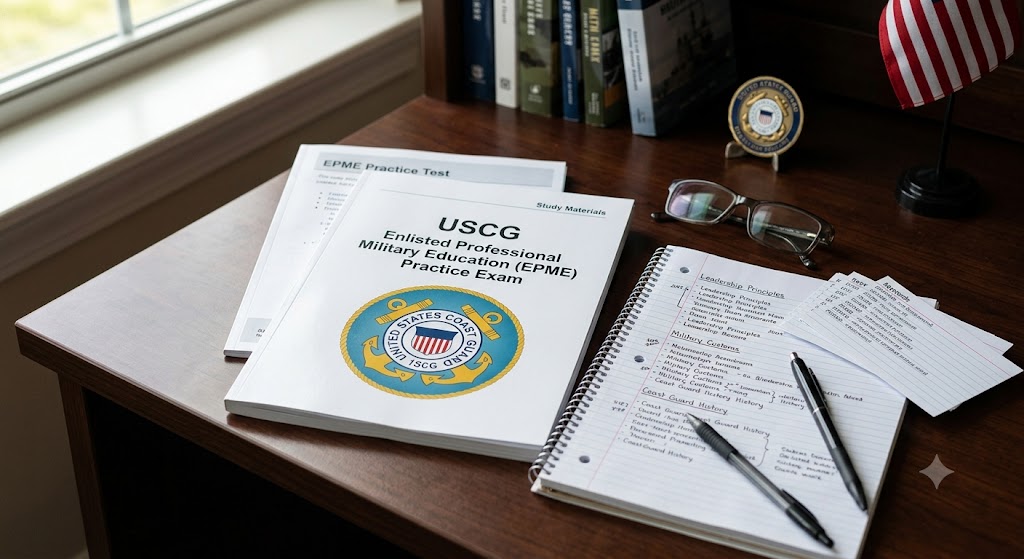
Additional Information
What the Course
Entails and Exam Details
The EPME curriculum encompasses a comprehensive syllabus
focused on developing well-rounded, capable military leaders.
Core topics include advanced Coast Guard history, military
customs and courtesies, ethical leadership principles, and critical safety and
security protocols.
Candidates will also dive deeply into maritime law
enforcement basics, emergency response management, and effective communication
strategies.
The skills covered are specifically tailored to each pay
grade, ensuring that the scope of knowledge accurately reflects the increased
responsibilities the enlisted member will soon assume.
What to Expect in
the Final Exam
The final EPME advancement test is traditionally formatted
as a comprehensive multiple-choice examination.
Questions are heavily scenario-based and draw directly from
the official Coast Guard competency requirements for your specific prospective
rank.
While exact time limits can vary based on the specific rank
being tested, candidates generally have an ample, strictly timed window of a
few hours to complete the test.
To achieve a passing score, members must meet the minimum
cutoff established for their advancement cycle, making precision and thorough
preparation absolutely essential.
Standard testing rules apply, meaning no outside materials,
unauthorized electronics, or study aids are permitted in the testing
environment once the clock starts.
How to Study and
Exam Centers
The most actionable study strategy is to immerse yourself in
the official USCG Enlisted Professional Military Education manual and utilize
reliable EPME practice exams to simulate the testing environment.
Creating digital flashcards for military acronyms, forming
study groups with fellow advancing members, and dedicating daily time to review
Coast Guard directives will dramatically boost your retention.
When it comes time to take the actual exam, it is not
administered at public facilities like Pearson VUE; instead, it is handled
internally by the military.
You will take the test through official Coast Guard
electronic testing portals under the direct supervision of your unit’s
Educational Services Officer (ESO).
Always coordinate with your ESO well in advance to confirm
your testing date, secure a spot at an authorized base testing center, and
ensure all your prerequisite paperwork is cleared.
Job Opportunities from the Course
Successfully mastering the EPME material and passing your
advancement exam unlocks profound career progression within the United States
Coast Guard.
First and foremost, it directly qualifies you for promotion
to Non-Commissioned Officer (NCO) ranks, such as Petty Officer, Chief Petty
Officer, Senior Chief, and Master Chief.
Achieving these ranks opens the door to specialized
leadership job titles like Boatswain's Mate, Maritime Enforcement Specialist,
and Damage Controlman at a supervisory level.
Furthermore, passing this exam paves the way for assignments
as an Officer in Charge (OIC) or Executive Petty Officer (XPO) on various Coast
Guard cutters and shore units.
Ultimately, this certification is the primary vehicle for
transitioning from a junior enlisted follower into a respected, high-level
operational commander and technical expert in the maritime defense sector.
Frequently Asked Questions
Reviews
5.0
Based on 0 reviews
Leave a Review
No reviews yet. Be the first to review!