
USCG Helmsman Practice Exam
$69.00
- Buy to unlock unlimited access to all Quiz questions and Answers in this Quiz.
- After purchase you can print a PDF of the whole quiz at any point. The PDF will contain the questions and the correct answers.
About this Exam
The United States Coast Guard (USCG) Helmsman certification is a vital qualification for mariners aiming to advance their careers on the water.
This credential proves your ability to safely and accurately steer a vessel under the strict direction of the officer of the watch.
It is specifically designed for deckhands, aspiring Able Seamen, and entry-level maritime professionals who want to take on critical navigation responsibilities.
Mastering the helm is a fundamental skill that demonstrates your reliability, focus, and precision in high-stakes maritime operations.
Ready to test your knowledge?
Buy Now to Access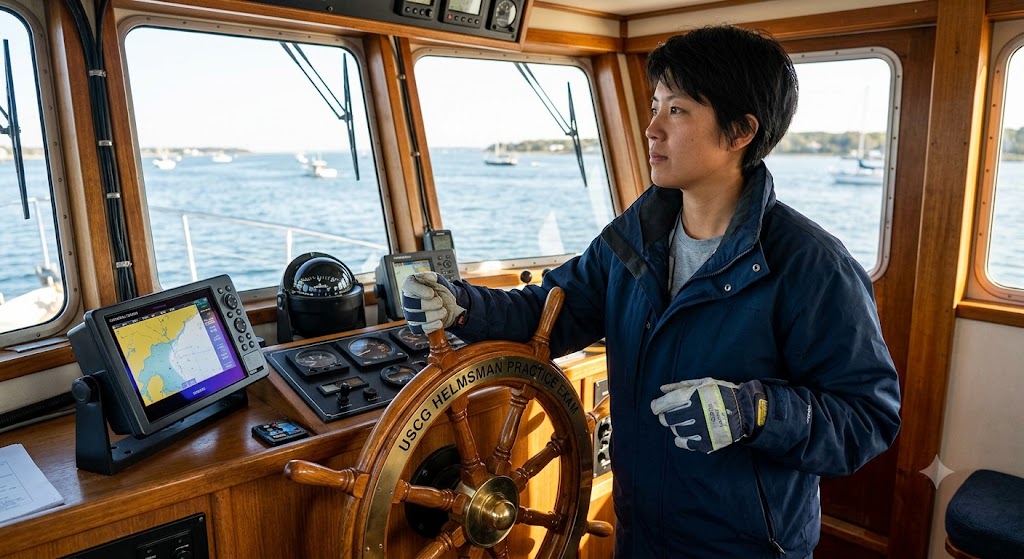
Additional Information
What the Course Entails and Exam Details
The USCG Helmsman course and its associated exam cover a
robust syllabus of navigational and practical ship-handling skills.
You will learn standard marine steering commands and how to
properly repeat and respond to helm orders from the conning officer.
The curriculum dives deep into reading and understanding
both magnetic and gyro compasses in various sea conditions and visibility
levels.
Additionally, the course entails emergency steering
procedures, understanding the turning circle of a vessel, and managing the
effects of wind and current on ship handling.
Students also practice the critical transition between
auto-pilot and manual steering, ensuring they are fully prepared for any
mechanical or navigational situation on the bridge.
3. What to Expect in the Final Exam
The USCG Helmsman final assessment typically consists of
both a written examination and a practical demonstration of your skills.
The written portion features multiple-choice questions
focused heavily on helm terminology, compass reading, and standard operating
procedures.
For the practical exam, candidates must successfully
demonstrate their steering proficiency on a Coast Guard-approved bridge
simulator or a live training vessel.
You are usually required to achieve a passing score of at
least 70% on the written portion, though some approved maritime training
centers may enforce a higher benchmark for their specific programs.
Time limits generally range from one to two hours for the
written test, while the practical assessment depends on how quickly and
accurately you complete a required set of steering maneuvers.
How to Study and
Exam Centers
To pass the USCG Helmsman exam with flying colors, start by
familiarizing yourself with standard helm commands using flashcards and
repetition.
Utilize official USCG practice question banks and online
study portals to get comfortable with the phrasing and format of the written
multiple-choice test.
If you have access to a simulator or a training vessel
through your employer or school, prioritize hands-on practice to build your
muscle memory and spatial awareness.
When you are ready to test, you can take the written exam at
a USCG Regional Exam Center (REC) located in various major port cities across
the country.
Alternatively, many Coast Guard-approved maritime training
schools and academies offer the complete course and administer the final exam
directly on their campuses for added convenience.
Job Opportunities
from the Course
Earning your USCG Helmsman qualification opens the door to
numerous exciting and well-paying roles within the commercial maritime
industry.
You can step directly into the role of a dedicated Helmsman
or Quartermaster on large commercial cargo vessels, tankers, and cruise ships.
It is also a crucial, mandatory stepping stone for becoming
an Able Seaman (AB), which is one of the most highly sought-after deck
positions in the merchant marine.
Other lucrative career paths include working as a Senior
Deckhand on tugboats, offshore supply vessels, and private luxury mega-yachts.
Ultimately, this certification lays the vital groundwork for
aspiring deck officers who plan to accumulate sea time and eventually earn
their Mate or Master licenses.
Frequently Asked Questions
Reviews
5.0
Based on 0 reviews
Leave a Review
No reviews yet. Be the first to review!