
USCG Injectors Practice Exam
$69.00
- Buy to unlock unlimited access to all Quiz questions and Answers in this Quiz.
- After purchase you can print a PDF of the whole quiz at any point. The PDF will contain the questions and the correct answers.
About this Exam
The USCG Injectors Practice Exam is a highly specialized assessment designed for maritime professionals aiming to secure or upgrade their merchant marine credentials.
This assessment focuses specifically on the mechanical operations, maintenance, and troubleshooting of marine diesel engine fuel injectors.
It is primarily tailored for candidates seeking ratings such as Qualified Member of the Engine Department (QMED), as well as those pursuing Assistant Engineer or Chief Engineer licenses.
By mastering this module, maritime engineers prove their technical competency in ensuring the safe, efficient, and reliable operation of massive vessel motor plants.
Ready to test your knowledge?
Buy Now to Access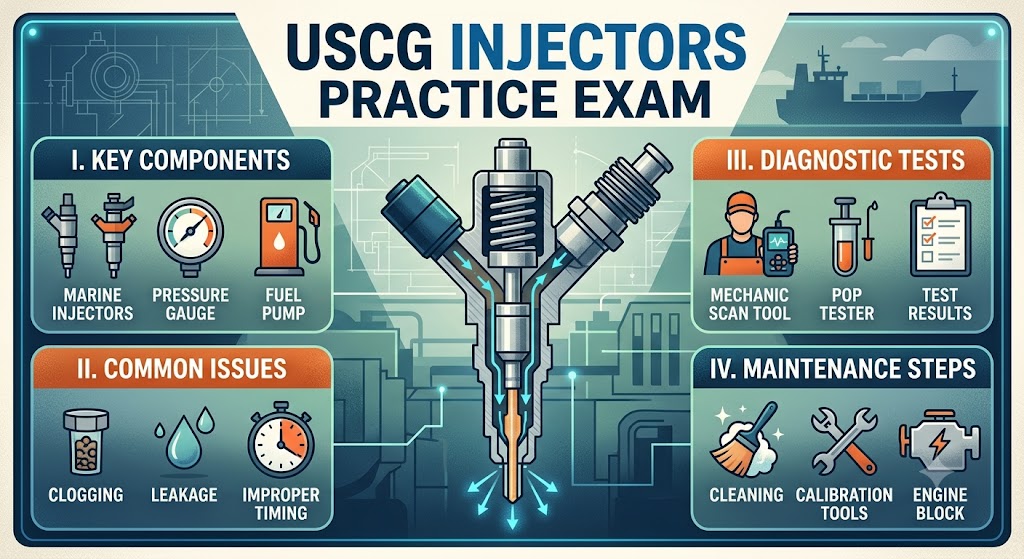
Additional Information
What the Course
Entails and Exam Details
Preparing for this exam requires a deep dive into the
fundamental principles of marine diesel engines and fuel injection systems.
Candidates will extensively study the internal components of
fuel injectors, including nozzles, pumps, atomizers, and high-pressure fuel
lines.
The syllabus heavily emphasizes the mechanical theory behind
fuel atomization, timing, and combustion efficiency within the engine cylinder.
Additionally, the course covers critical maintenance
procedures, such as safely bleeding fuel lines, cleaning injector nozzles, and
calibrating injection pressure.
Safety protocols and environmental regulations regarding
fuel handling and spill prevention are also core competencies tested in this
material.
What to Expect in the Final Exam
The final assessment is typically administered as part of
the broader USCG Motor Plants or General Engineering multiple-choice
examinations.
You can expect a series of rigorous, multiple-choice
questions that test both theoretical knowledge and practical, scenario-based
troubleshooting.
Depending on the specific license level you are testing for,
the passing score usually ranges from 70% for standard ratings to 74% or higher
for engineering officer endorsements.
The exam is administered in a strictly proctored,
closed-book environment.
Candidates are given a specific time limit, generally
ranging from two to three hours for the complete Motor Plants module, requiring
excellent time management and confident decision-making.
How to Study and
Exam Centers
Success on this exam requires a blend of hands-on mechanical
understanding and consistent written practice.
You should utilize specialized USCG question banks and
practice tests to familiarize yourself with the exact phrasing and format used
by the Coast Guard.
Reviewing technical schematics, engine room manuals, and
visual diagrams of injector cutaways will help you memorize component functions
and fluid pathways.
Flashcards are highly recommended for memorizing specific
pressure values, clearances, and troubleshooting steps.
When you are ready, the official exam must be taken at a
designated USCG Regional Exam Center (REC).
Alternatively, candidates enrolled in Coast Guard-approved
maritime training academies may take the exam directly through their
institution's authorized testing portal.
Job Opportunities from the Course
Successfully passing this exam module and obtaining your
USCG engineering credential unlocks a variety of lucrative and highly respected
maritime careers.
Qualified Member of the Engine Department (QMED)
Marine Diesel Mechanic
Oiler / Motorman
Third Assistant Engineer
Second Assistant Engineer
First Assistant Engineer
Chief Engineer
Port Engineer
Frequently Asked Questions
Reviews
5.0
Based on 0 reviews
Leave a Review
No reviews yet. Be the first to review!