
USCG Pollution Responder Practice Exam
$69.00
- Buy to unlock unlimited access to all Quiz questions and Answers in this Quiz.
- After purchase you can print a PDF of the whole quiz at any point. The PDF will contain the questions and the correct answers.
About this Exam
The United States Coast Guard (USCG) Pollution Responder qualification is a critical certification designed for personnel tasked with preserving the marine environment.
This program ensures that individuals possess the knowledge and practical skills required to effectively respond to and mitigate oil spills and hazardous substance releases.
It is primarily aimed at Coast Guard Active Duty and Reserve personnel, particularly Marine Science Technicians (MSTs), as well as members of the Coast Guard Auxiliary and authorized industry partners who operate in a response capacity.
Achieving this designation confirms a foundational competence in understanding relevant regulations, employing proper response techniques, and coordinating with multi-agency partners under the National Incident Management System (NIMS).
It represents a dedication to environmental stewardship and public safety in the maritime domain.
Ready to test your knowledge?
Buy Now to Access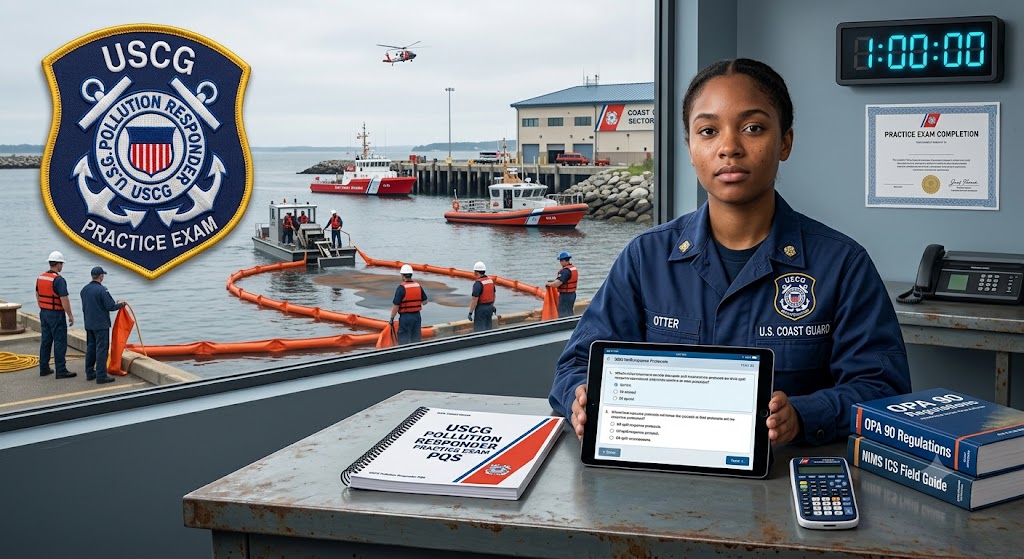
Additional Information
What the Course Entails and Exam Details
The path to qualification involves a combination of
specialized training, on-the-job experience, and formal assessment.
Prospective responders must complete prerequisite courses,
which often include Incident Command System (ICS) 100, 200, 300, 700, and 800,
as well as 24-hour HAZWOPER (Hazardous Waste Operations and Emergency Response)
training.
The core of the qualification is structured around a
comprehensive Performance Qualification Standard (PQS) workbook.
This workbook covers essential topics such as the legal
basis for pollution response (including OPA 90), the five phases of pollution
incident response, forecasting spill trajectories, initial reporting, health
and safety protocols, containment and cleanup methods, and necessary
documentation and enforcement actions.
As part of the process, candidates participate in actual or
simulated pollution incidents and complete practical tasks under the
supervision of qualified Verifying Officers.
The final written component of this process, the subject of
this practice exam, validates the regulatory and operational knowledge
essential for safe and effective response management.
What to Expect in
the Final Exam
The full USCG Pollution Responder qualification is
multifaceted, but the final assessment typically involves both a written
examination and an oral board.
The written final exam is a closed-book test, often
comprising multiple-choice questions designed to measure retention of the core
regulatory and technical knowledge.
It will cover the broad spectrum of topics outlined in the
PQS, from identifying different types of pollutants to the specific
requirements for generating a Pollution Incident Report (POLREP).
Specifics regarding the number of questions, time limits,
and exact passing scoary slightly by unit but generally require a high degree
of proficiency (often 80% or higher).
After passing the written exam, candidates must successfully
complete a unit-level oral board where they are evaluated on their ability to
apply their knowledge to realistic scenarios and make critical, time-sensitive
decisions.
How to Study and
Exam Centers
Preparation for the written final exam must be systematic
and thorough.
Your primary study guide is the PQS workbook itself, which
you should work through methodically with your unit mentors and Verifying
Officers.
Review all associated reference materials, including USCG
Commandant Instructions (COMDTINSTs), environmental laws, and your Local
Contingency Plan (LCP).
Take advantage of any available practice questions, internal
USCG training resources, or external "mastery programs" to test your
knowledge retention.
Since the qualification is an internal USCG process, the
"exam centers" for the written and oral portions are your designated
unit training department or Sector.
There are no external commercial testing centers for the
official exam; rather, it is administered and recorded within the USCG's
Training Management Tool (TMT).
Personnel must coordinate with their command to schedule
their final assessments upon completion of all prerequisites.
Job Opportunities
from the Course
Earning the USCG Pollution Responder certification unlocks a
range of critical, environmental-focused career paths, primarily within the
Coast Guard but with strong civilian crossover potential.
- Coast
Guard Marine Science Technician (MST): The premier rating for
environmental protection and response in the USCG.
- Coast
Guard Auxiliary Assistant Pollution Investigator: A key role for
volunteers supporting active-duty pollution missions.
- Marine
Environmental Specialist: A civilian or contractor role managing a
variety of marine environmental concerns.
- Hazardous
Materials Specialist: Expertise transferable to industrial, municipal,
and private sector response teams.
- Facility
Supervisor: Oversight of commercial waterfront facilities requiring
compliance with environmental regulations.
- Vessel
Inspector: Applying regulatory knowledge to ensure ship compliance
with pollution prevention standards.
- OSHA
Response Trainer: Providing required safety training to other
environmental and emergency response professionals.
Frequently Asked Questions
Reviews
5.0
Based on 0 reviews
Leave a Review
No reviews yet. Be the first to review!