
USCG Rules of the Road Practice Test
$69.00
- Buy to unlock unlimited access to all Quiz questions and Answers in this Quiz.
- After purchase you can print a PDF of the whole quiz at any point. The PDF will contain the questions and the correct answers.
About this Exam
The United States Coast Guard (USCG) Rules of the Road examination is a fundamental requirement for anyone aspiring to become a licensed deck officer, from OUPV (6-pack) Captains to Master of large vessels.
This certification, part of the broader USCG mariner credentialing process, is designed to ensure that all individuals operating commercial and certain large recreational vessels are fully versed in the critical international and inland navigation regulations. Passing this exam demonstrates that you possess the essential knowledge to safely navigate waterways, prevent collisions, and effectively communicate intentions on the water, whether you're navigating high seas or coastal harbors.
Ready to test your knowledge?
Buy Now to Access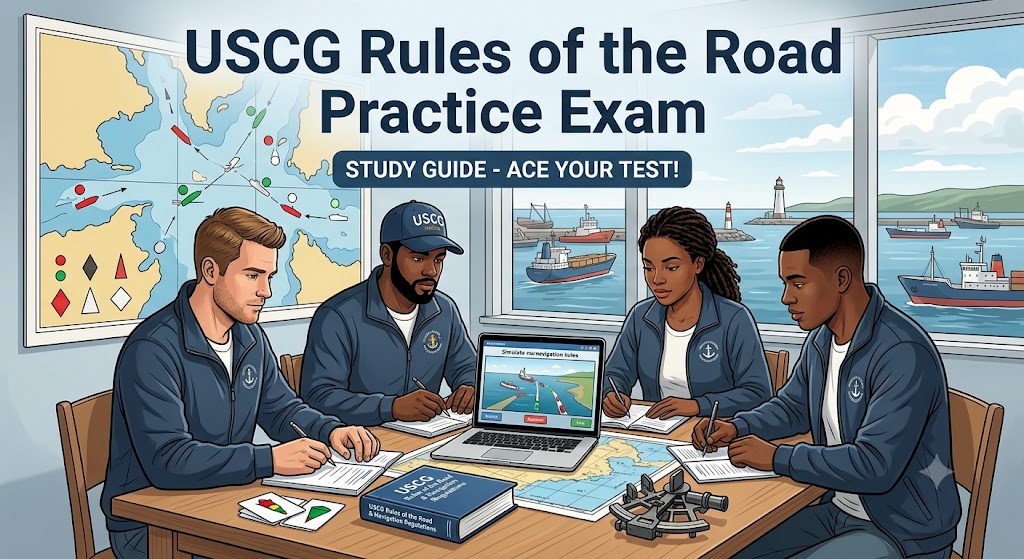
Additional Information
What the Course Entails and Exam Details
This examination is not a course in itself, but rather a
final evaluation of your understanding of the Navigation Rules &
Regulations Handbook (Commandant Instruction M16672.2, or current equivalent),
commonly referred to as the "Rules of the Road."
Your study should cover the full spectrum of both the
International Regulations for Preventing Collisions at Sea, 1972 (COLREGs), and
the specific US Inland Navigation Rules. Key areas you must be proficient in
include:
- Steering
and Sailing Rules (Rules 1-19): Look-out, Safe Speed, Risk of
Collision, Action to Avoid Collision, Narrow Channels, Traffic Separation
Schemes, Responsibility between vessels (Give-way, Stand-on, Sailing
vessels, etc.), and Conduct of vessels in various conditions of
visibility.
- Lights
and Shapes (Rules 20-31): Properly identifying every lighting and day
shape configuration a vessel might display, signaling its type, activity,
size, status (e.g., restricted visibility, towing, fishing, constrained by
draft, pilot, anchored), and direction of travel.
- Sound
and Light Signals (Rules 32-37): Correct usage and interpretation of
maneuvering and warning signals, and distress signals.
- Exemptions
and Annexes: Specific operational adjustments and technical details.
What to Expect in
the Final Exam
The actual USCG Rules of the Road examination is a robust
multiple-choice test taken under proctored conditions at a USCG Regional
Examination Center (REC).
Here’s a general overview of the final exam structure:
- Format:
Multiple-choice questions. You will be presented with a scenario, rule
interpretation, visual diagram, or sound signal, and you must select the
correct application or definition from the given options.
- Topics:
Questions will span all sections of the Navigation Rules (International
and Inland), lights, shapes, and signals. Expect scenario-based questions
where you must determine the appropriate action as either a stand-on or
give-way vessel.
- Passing
Score: The USCG Rules of the Road section often has one of the highest
passing grade requirements, typically 90% or higher (meaning you
can only afford a few incorrect answers, sometimes as few as 3 errors on a
~100 question test). For certain specific deck officer ratings, the
threshold for key navigational questions can be even stricter, potentially
requiring a 100% on a core section or overall very high score, emphasizing
the paramount importance of navigational safety. For most mariners, aim
for near-perfection and certainly no less than a solid, confident 90%
score.
- Time
Limit: There is usually a specific time limit allocated for this
module within your larger exam schedule, typically a few hours. Time
management is crucial, as some questions may require careful reading and
scenario interpretation.
- Rules:
Standard testing protocols apply; no cell phones, unauthorized materials,
or assistance. You will likely be provided with a basic rule book or
necessary charts for specific questions, but the vast majority of the
rules must be memorized and understood.
How to Study and
Exam Centers
Preparation is paramount. The Rules of the Road are
essentially maritime law and must be understood deeply and applied instantly.
- Use
Practice Exams (Highly Recommended): Engage in extensive practice
tests that simulate the real USCG exam format. Look for reputable practice
apps, online portals, and study guide books that offer large, up-to-date
question banks directly reflecting USCG style.
- Master
the Official Source: The "Navigation Rules & Regulations
Handbook" is your Bible. Read it thoroughly, understand the
terminology, and focus on the practical application of each rule. Study
both the International and the Inland sections, noting the specific, often
subtle differences.
- Scenario
Practice: Don't just memorize definitions. Practice applying the rules
to real-life situations. Analyze crossing situations, head-on encounters,
overtaking, navigating in restricted visibility, and interpreting varying
light and shape combinations. Draw them out if it helps!
- Take
USCG-Approved Courses: For many higher-level licenses, completing a
comprehensive, USCG-approved "Rules of the Road" or "Bridge
Watchkeeping" course is required before you can even register for the
exam. These courses provide excellent structured instruction and often
include their own comprehensive practice materials.
- Create
Flashcards: Flashcards are invaluable for memorizing specific lights,
day shapes, and sound signal combinations.
- Form
Study Groups: Collaborating with other aspiring mariners can clarify
tricky rules and provide different perspectives on scenario
interpretation.
Exam Centers: The final proctored exam must be taken
at one of the USCG Regional Examination Centers (RECs) distributed across the
United States. You must schedule your exam in advance through the USCG National
Maritime Center (NMC) website or contact center after your mariner license
application (including necessary training certificates) has been approved.
Job Opportunities from the Course
Passing the USCG Rules of the Road Exam is not just a
requirement; it is a critical skill that opens doors to numerous career paths
in the maritime industry. While this exam is just one component, it is a key
unlock for professional mariner roles that command respect and competitive
salaries. Your license will specify the scope of vessels and waters you can
operate on, but this qualification is foundational for positions such as:
- Captain
/ Master (Vessels ranging from small charter boats to large cargo ships,
ferries, tugs, etc., depending on tonnage/waters qualification)
- Chief
Mate / Second Mate / Third Mate (Various tonnages and routes, a
prerequisite for eventual Master status)
- Deck
Officer on commercial fishing vessels, towing vessels, passenger ships,
and research vessels.
- Port
Captain / Marine Superintendent (Supervising vessel operations from shore)
- Marine
Pilot (In some cases, this level of knowledge is a mandatory stepping
stone)
- Various
positions within the USCG and commercial sectors focused on maritime
safety, navigation auditing, and compliance.
Frequently Asked Questions
Reviews
5.0
Based on 0 reviews
Leave a Review
No reviews yet. Be the first to review!