
USCG Search and Rescue Controller Practice Exam
$69.00
- Buy to unlock unlimited access to all Quiz questions and Answers in this Quiz.
- After purchase you can print a PDF of the whole quiz at any point. The PDF will contain the questions and the correct answers.
About this Exam
The United States Coast Guard (USCG) Search and Rescue (SAR) Controller course and subsequent certification are designed for personnel who will function as watchstanders, planners, and operational coordinators within Coast Guard command centers. These individuals are responsible for managing the complex logistics, communications, and decision-making required during critical maritime rescue missions. This certification ensures that controllers possess the specialized knowledge and skills necessary to direct rescue assets, analyze search patterns, and coordinate effectively with other agencies. The target audience includes active-duty USCG personnel, civilians in related roles, and occasionally personnel from partnering maritime organizations who are moving into command center operations. This program provides the foundational expertise to save lives at sea through structured, effective command and control.
Ready to test your knowledge?
Buy Now to Access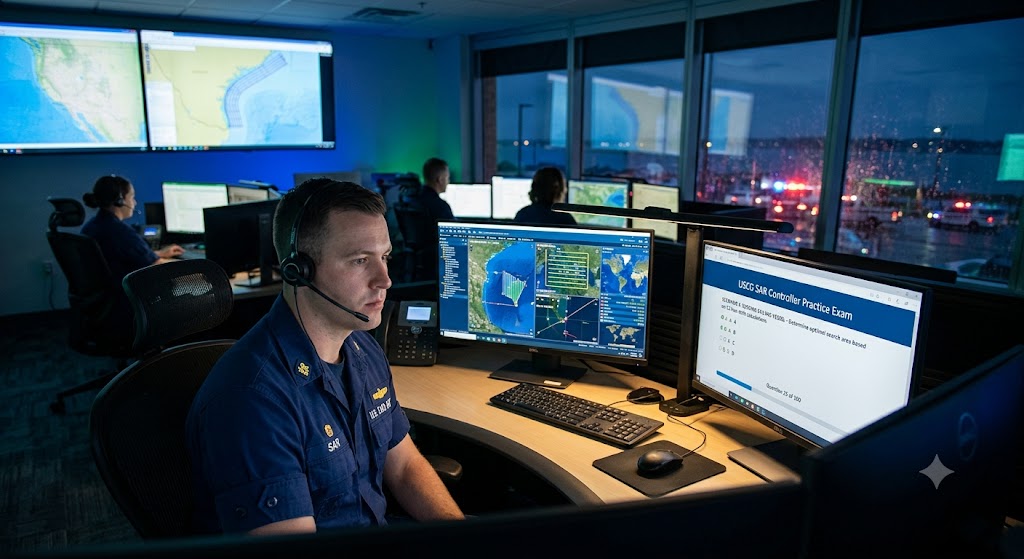
Additional Information
What the Course Entails and Exam Details
The comprehensive curriculum for becoming a qualified SAR
Controller covers a wide spectrum of critical maritime search and rescue
skills. The course entails understanding the National Search and Rescue Manual
(NSARM) and international conventions, mastering search planning principles
(including determining datum, sweep width, and probability of detection), and
applying various search patterns effectively (like creeping line, parallel, or
vector searches). It delves into operational communications, resource
management, meteorology, and tide/current analysis for drift calculations. Key
skills also involve risk assessment using formal models, legal considerations
in SAR operations, and utilizing specialized computer software like the Search
and Rescue Optimal Planning System (SAROPS). The exam details for official
qualification involve a multi-stage assessment. Candidates typically complete a
series of graded written tests covering theory and procedures, followed by
practical simulations in which they must successfully manage a complex SAR
scenario in a command center environment. These simulations test real-time
decision-making, team leadership, and proficiency with SAR systems. Some
structures may also include an oral board examination to evaluate a candidate’s
reasoning and regulatory knowledge under pressure.
What to Expect in the Final Exam
When preparing for the final assessments that lead to
official SAR Controller qualification, students should anticipate a highly
rigorous process. The final evaluation typically isn't a single traditional
exam but a structured program of rigorous testing and practical evaluation. The
knowledge-based portion often takes the form of extensive multiple-choice and
short-answer written tests, focusing heavily on regulatory knowledge,
calculations, and procedural standards. Candidates must usually achieve high passing
scores, often 80% or 90% or higher, reflecting the low margin for error in SAR
operations. There are often strict time limits for both the written sections
and the scenario-based simulations. In the dynamic simulations, which are the
cornerstone of the assessment, you will be evaluated on your ability to make
rapid, sound decisions, direct assets effectively, analyze incoming
information, and maintain situational awareness under stress. Examiners use a
rubric to grade specific performance criteria. Understanding the chain of
command, legal boundaries, and the technical applications of all search
planning methodology is critical for success in these assessments. Failure in a
critical section, particularly the practical management of a search, can result
in remediation or non-qualification.
How to Study and
Exam Centers
Preparation for the SAR Controller qualification, whether
for the actual test or for using this USCG SAR Controller Practice Exam,
requires diverse and dedicated study methods. The primary resources are the
official USCG manuals, especially the National Search and Rescue Plan, the
National Search and Rescue Manual (NSARM), and relevant operational
instructions. Reviewing and working through practice scenarios is invaluable.
Candidates should focus on search pattern geometry, drift calculations using
provided tables and formulas, and understanding the legal frameworks of global
SAR. Using simulations and practice test materials that mimic the structure of
official USCG evaluations can build familiarity and speed. Active involvement
in training and mentorship within a real Coast Guard command center is the best
practical preparation. For the official qualification and testing, examinations
and practical evaluations are almost exclusively conducted at specialized Coast
Guard training facilities, such as USCG Training Center Yorktown, Virginia, or
at specific large Coast Guard district/sector command centers that are
designated for qualifying operations personnel. These are not general testing
center exams; they are internal to the service and require official assignment
or authorization within the USCG training pipeline.
Job Opportunities
from the Course
Successfully completing the SAR Controller training and
qualification process unlocks specific, specialized career paths, primarily
within the United States Coast Guard and potentially related governmental or
maritime emergency management roles.
- USCG
Search and Rescue Controller (Command Center)
- Search
and Rescue Specialist (Civilian USCG positions)
- Operations
Specialist (OS) – specialized assignment
- Search
and Rescue Mission Coordinator (SMC)
- Maritime
Emergency Management Specialist (Government agencies/Ports)
- Contingency
Planner
- Watchstander
(various USCG Command & Control centers)
- SAR
Operations Instructor
Frequently Asked Questions
Reviews
5.0
Based on 0 reviews
Leave a Review
No reviews yet. Be the first to review!